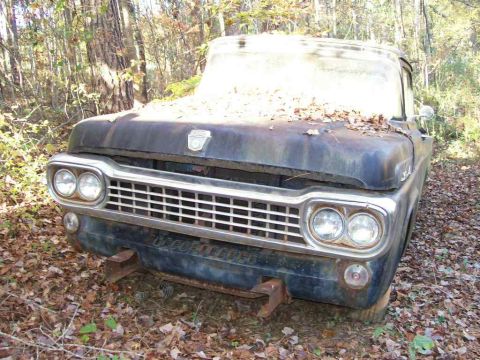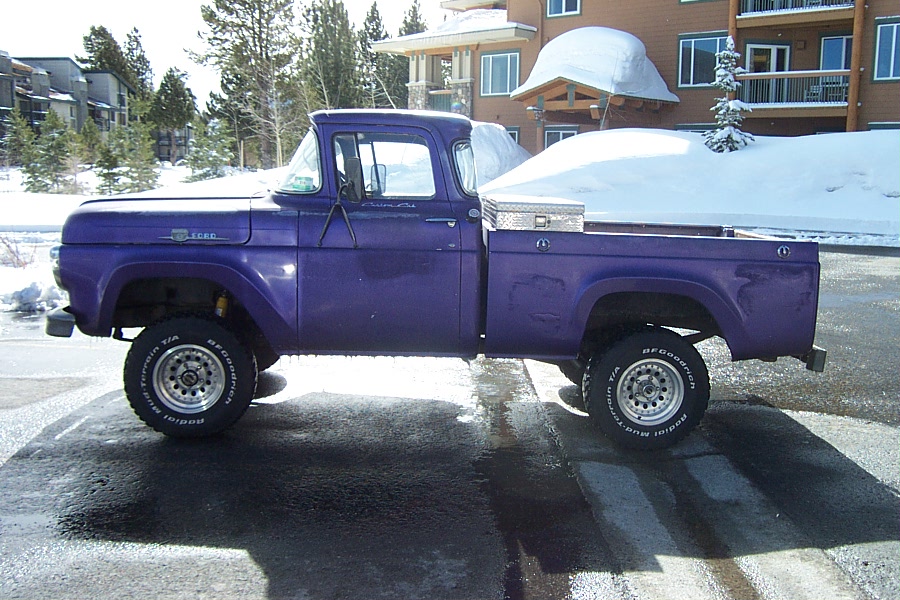
The 1957-1960 Ford F-100 was the third generation of Ford's F-Series, a flatter and slab-sided redesign that collectors nickname the "Fridge" for its boxy, refrigerator-like shape. This Ford F-100 integrated the front fenders into the body and offered two bed styles: the smooth-sided Styleside and the fendered Flareside. Power came from the 223-cubic-inch Mileage Maker inline-six as the base engine and from the overhead-valve Y-block V8 in 272-cubic-inch and 292-cubic-inch displacements, all rated in SAE gross horsepower as was standard before 1972. The most significant mechanical change of the generation came for the 1959 model year, when Ford added factory-installed four-wheel drive to the F-100, making it among the first half-ton pickups offered with four-wheel drive straight from the factory rather than through aftermarket conversion. The 1957-1960 Ford F-100 used a body-on-frame layout with a solid front axle; the Twin-I-Beam independent front suspension did not arrive until the 1965 model year, on the following generation.
Other Ford F-100 generations
Ford F-100 1957-1960 at a glance
- Generation: Third-generation Ford F-Series, nicknamed the "Fridge" for its slab-sided shape.
- Body and beds: integrated front fenders; the smooth-sided Styleside and the fendered Flareside beds.
- Standard engine: 223-cubic-inch Mileage Maker inline-six.
- V8 options: 272-cubic-inch and 292-cubic-inch overhead-valve Y-block V8s.
- Horsepower basis: SAE gross figures (pre-1972).
- Four-wheel drive: factory-installed four-wheel drive added for the 1959 model year.
- Front suspension: solid front axle; the Twin-I-Beam independent front suspension did not arrive until 1965.
- Generation end: 1960 was the final year of this body before the 1961 fourth-generation redesign.
Year-by-year changes
| Model year | Standard six | V8 options | Key changes |
|---|---|---|---|
| 1957 Ford F-100 | 223 cu in Mileage Maker six | 272 Y-block V8 | Third-generation redesign with flatter, slab-sided styling and integrated front fenders; the Styleside and Flareside bed names are used. New "Fridge" body debuts. |
| 1958 Ford F-100 | 223 cu in Mileage Maker six | 272, 292 Y-block V8 | Quad (dual) headlamps adopted and a grille update; the 292-cubic-inch Y-block V8 was offered alongside the 272. |
| 1959 Ford F-100 | 223 cu in Mileage Maker six | 272, 292 Y-block V8 | Factory-installed four-wheel drive added to the F-100 for 1959, the first time Ford offered four-wheel drive on the half-ton from the factory. |
| 1960 Ford F-100 | 223 cu in Mileage Maker six | 272, 292 Y-block V8 | Grille and trim updates; final year of the third-generation body before the 1961 fourth-generation redesign. |
The "Fridge" redesign for 1957
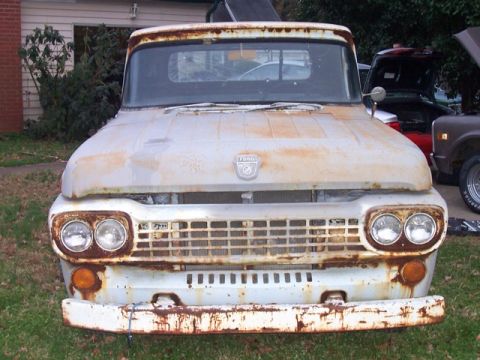
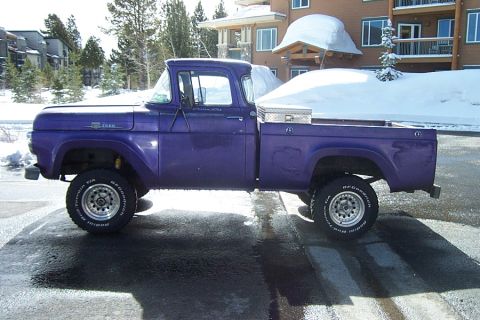
The 1957 Ford F-100 brought a flatter, slab-sided body that collectors nickname the "Fridge" for its boxy, refrigerator-like profile. Ford integrated the front fenders into the body for a cleaner shape and offered two distinct bed designs on the F-100: the smooth-sided Styleside, whose bed sides were flush with the cab, and the Flareside, which kept separate rear fenders and a narrower box. This third-generation styling ran from the 1957 model year through 1960, after which the integrated-body fourth-generation Ford F-100 arrived for 1961.
Engines of the 1957-1960 Ford F-100
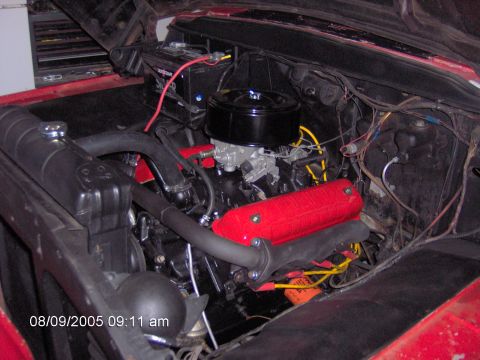
The base engine of the 1957-1960 Ford F-100 was the 223-cubic-inch Mileage Maker inline-six. The V8 option was Ford's overhead-valve Y-block, offered in 272-cubic-inch form and, from the late 1950s, in a larger 292-cubic-inch displacement. All horsepower figures for these engines were quoted in SAE gross terms, the standard before the 1972 switch to net ratings, so the published numbers are higher than net figures would be for the same engines. Transmissions included three-speed and four-speed manuals along with an automatic option.
Factory four-wheel drive arrives for 1959
The headline mechanical change of the 1957-1960 Ford F-100 generation came for the 1959 model year, when Ford added factory-installed four-wheel drive to the F-100. Before 1959, four-wheel-drive Ford half-tons were built by aftermarket converters; the 1959 Ford F-100 made four-wheel drive a regular-production factory option. The 1957-1960 Ford F-100 still used a solid front axle; the Twin-I-Beam independent front suspension was a later development that arrived for the 1965 model year on the following generation.
Body styles and trims
The 1957-1960 Ford F-100 was sold as a two-door pickup with a choice of the smooth Styleside or fendered Flareside bed. The 1958 model adopted quad (dual) headlamps and a revised grille, and the 1960 model received further grille and trim changes. The Ford F-100 sat as the half-ton in a lineup that continued upward to the three-quarter-ton F-250 and the one-ton F-350.
Frequently asked questions
What is the "Fridge" Ford F-100?
"Fridge" is a collector nickname for the 1957-1960 third-generation Ford F-Series, given for its boxy, slab-sided shape that resembles a refrigerator. The Ford F-100 versions of this body run from the 1957 redesign through the 1960 model year.
What engines did the 1957-1960 Ford F-100 use?
The 1957-1960 Ford F-100 used the 223-cubic-inch Mileage Maker inline-six as the base engine, with the overhead-valve Y-block V8 in 272-cubic-inch and 292-cubic-inch displacements as the V8 options. Horsepower was quoted in SAE gross figures.
When did Ford add factory four-wheel drive to the F-100?
Ford added factory-installed four-wheel drive to the F-100 for the 1959 model year. Before 1959, four-wheel-drive Ford half-tons were aftermarket conversions rather than factory-built trucks.
What is the difference between Styleside and Flareside?
On the 1957-1960 Ford F-100, the Styleside bed had smooth sides flush with the cab, while the Flareside bed kept separate rear fenders and a narrower box with running boards. Both were offered on the F-100 in this generation.
Did the 1957-1960 Ford F-100 have Twin-I-Beam suspension?
No. The 1957-1960 Ford F-100 used a solid front axle. The Twin-I-Beam independent front suspension did not reach the F-100 until the 1965 model year, on the fourth generation.
Sources
Asked all the time
What is the "Fridge" Ford F-100?
"Fridge" is a collector nickname for the 1957-1960 third-generation Ford F-Series, given for its boxy, slab-sided shape that resembles a refrigerator. The Ford F-100 versions of this body run from the 1957 redesign through the 1960 model year.
What engines did the 1957-1960 Ford F-100 use?
The 1957-1960 Ford F-100 used the 223-cubic-inch Mileage Maker inline-six as the base engine, with the overhead-valve Y-block V8 in 272-cubic-inch and 292-cubic-inch displacements as the V8 options. Horsepower was quoted in SAE gross figures.
When did Ford add factory four-wheel drive to the F-100?
Ford added factory-installed four-wheel drive to the F-100 for the 1959 model year. Before 1959, four-wheel-drive Ford half-tons were aftermarket conversions rather than factory-built trucks.
What is the difference between Styleside and Flareside?
On the 1957-1960 Ford F-100, the Styleside bed had smooth sides flush with the cab, while the Flareside bed kept separate rear fenders and a narrower box with running boards. Both were offered on the F-100 in this generation.
Did the 1957-1960 Ford F-100 have Twin-I-Beam suspension?
No. The 1957-1960 Ford F-100 used a solid front axle. The Twin-I-Beam independent front suspension did not reach the F-100 until the 1965 model year, on the fourth generation.
The wall · registered 1957-1960 F-100s
Sorted by depth of documentation. Click any vehicle to open its permanent record.