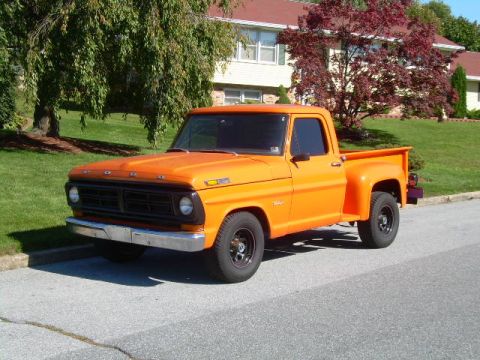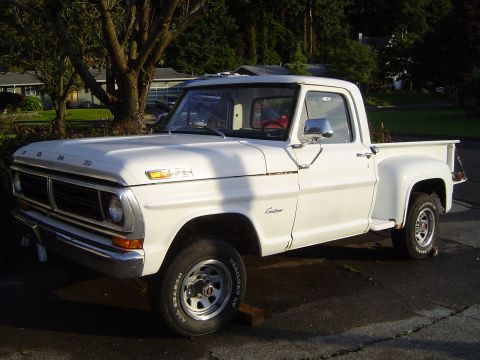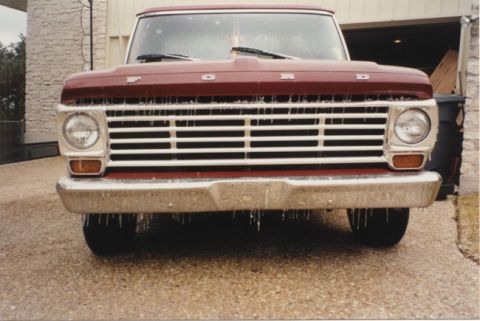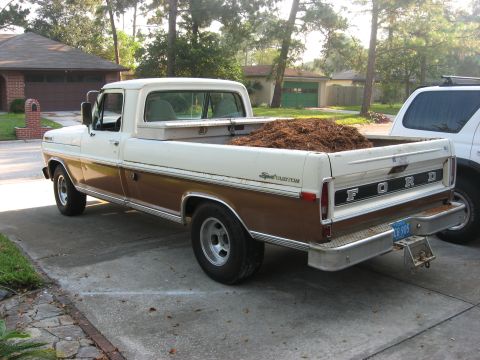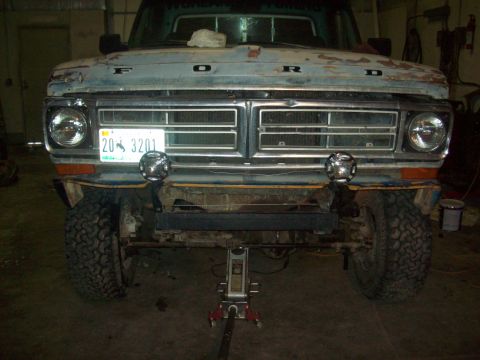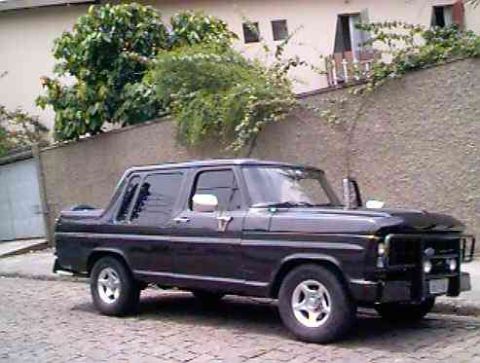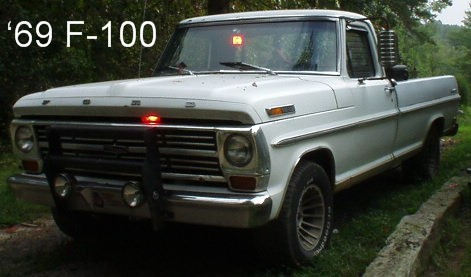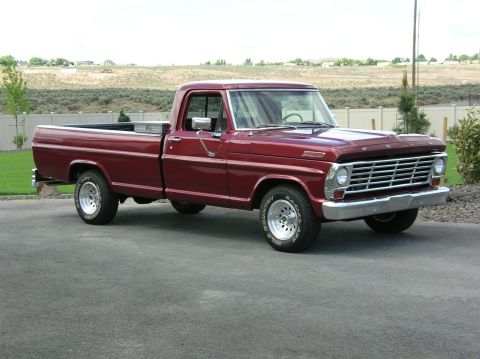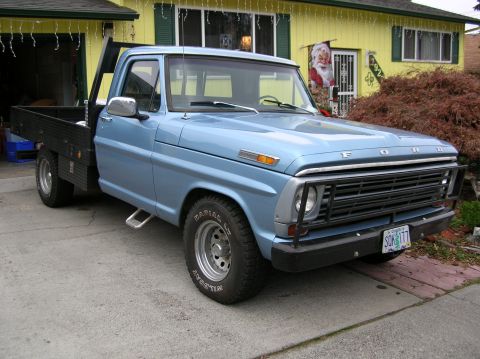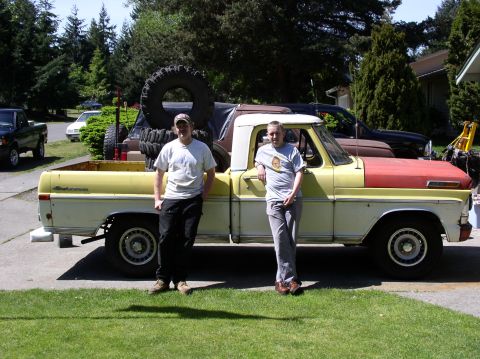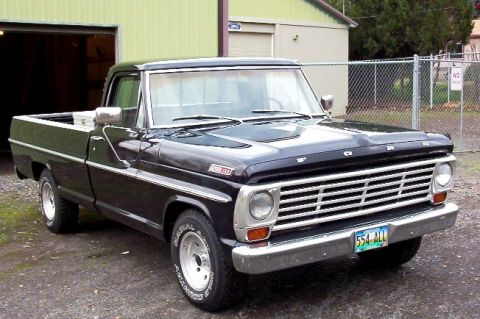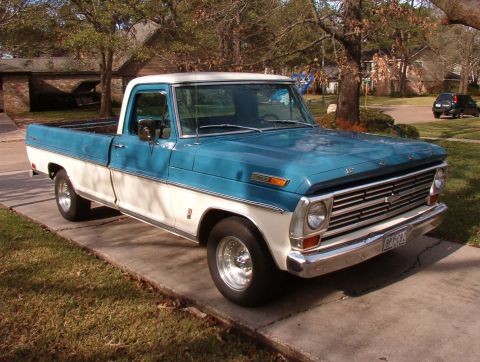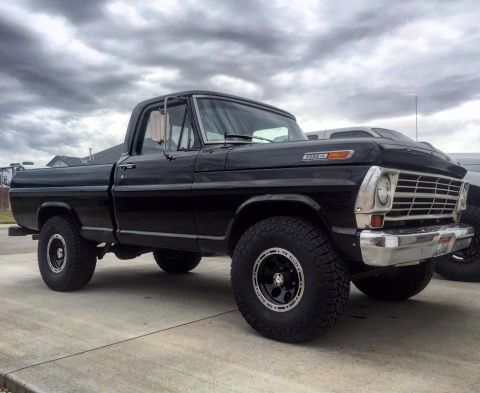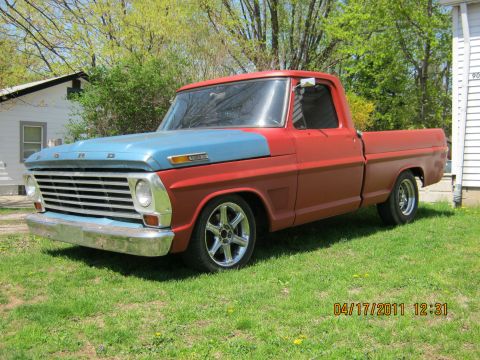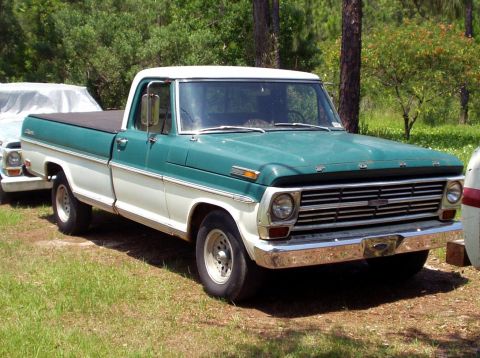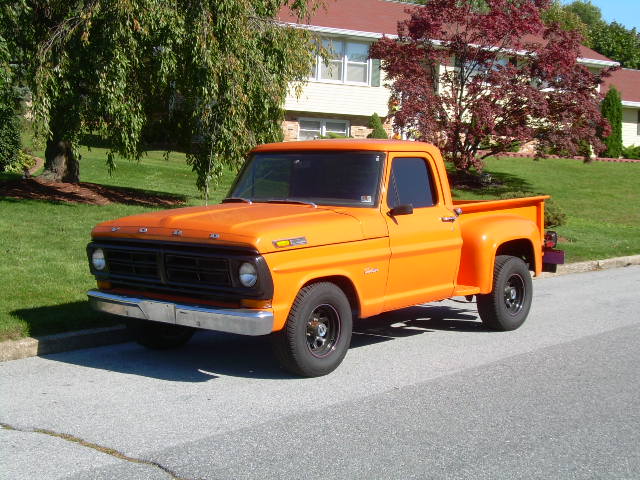
The 1967-1972 Ford F-100 was the fifth generation of Ford's F-Series, nicknamed the "Bumpside" for the raised horizontal character line that runs along its body sides. This Ford F-100 carried over the Twin-I-Beam independent front suspension on two-wheel-drive trucks and continued to offer the 240-cubic-inch and 300-cubic-inch inline-sixes introduced for 1965. The V8 lineup shifted during the run: the FE-family 352-cubic-inch V8 powered early trucks, the smaller 302-cubic-inch Windsor V8 joined late in the decade, and the FE 360 and 390 V8s served as the larger options through the end of the generation. A key reporting change falls inside this generation: through the 1971 model year Ford quoted SAE gross horsepower, but for the 1972 model year the industry switched to the lower SAE net figures, so a 1972 Ford F-100 carries net ratings while earlier years carry gross. The 1967-1972 Ford F-100 used a body-on-frame layout and was sold as a regular-cab pickup with the Styleside and Flareside beds; the factory extended SuperCab did not arrive until 1974, on the following generation.
Other Ford F-100 generations
Ford F-100 1967-1972 at a glance
- Generation: Fifth-generation Ford F-Series, nicknamed the "Bumpside" for the raised body-side character line.
- Sixes: 240-cubic-inch and 300-cubic-inch inline-sixes.
- V8 options: 302-cubic-inch Windsor V8; FE-family 352, 360, and 390 V8s, with the 360 and 390 offered through 1972.
- Front suspension: Twin-I-Beam independent front on two-wheel-drive trucks; solid front axle on four-wheel drive.
- Horsepower basis: SAE gross through 1971; SAE net from the 1972 model year.
- Body styles: regular cab only from the factory; Styleside and Flareside beds.
- Generation end: 1972 was the final year before the 1973 "Dentside" sixth generation.
Year-by-year changes
| Model year | Standard six | V8 options | Key changes |
|---|---|---|---|
| 1967 Ford F-100 | 240 cu in six (300 cu in optional) | 352 FE V8 | Fifth-generation "Bumpside" redesign; the 352-cubic-inch FE V8 was the V8 option. Horsepower quoted in SAE gross. |
| 1968 Ford F-100 | 240 cu in six (300 cu in optional) | 360, 390 FE V8 | The 352 FE was replaced by the optional 360 and 390 FE V8s. Federal safety updates such as side marker lights were adopted. |
| 1969 Ford F-100 | 240 cu in six (300 cu in optional) | 302 Windsor; 360, 390 FE V8 | The 302-cubic-inch Windsor V8 became available, joining the FE 360 and 390 V8s. |
| 1970 Ford F-100 | 240 cu in six (300 cu in optional) | 302 Windsor; 360, 390 FE V8 | Grille and trim updates; the 302 Windsor and FE 360 and 390 V8s carried over. |
| 1971 Ford F-100 | 240 cu in six (300 cu in optional) | 302 Windsor; 360, 390 FE V8 | Final year of SAE gross horsepower ratings. |
| 1972 Ford F-100 | 240 cu in six (300 cu in optional) | 302 Windsor; 360, 390 FE V8 | Horsepower switched to SAE net ratings; the 360 and 390 FE V8s carried over. Final year of the "Bumpside" generation. |
The "Bumpside" redesign for 1967
The 1967 Ford F-100 introduced the fifth-generation F-Series, which collectors nickname the "Bumpside" for the raised horizontal character line pressed along the body sides. The Ford F-100 retained the Twin-I-Beam independent front suspension on two-wheel-drive trucks that had arrived for 1965, while four-wheel-drive trucks used a solid front axle. The "Bumpside" body ran from the 1967 model year through 1972, after which the "Dentside" sixth-generation Ford F-100 arrived for 1973.
Engines of the 1967-1972 Ford F-100
The base engines across the 1967-1972 Ford F-100 were the 240-cubic-inch and 300-cubic-inch inline-sixes carried over from 1965. The V8 lineup changed during the generation. The 1967 Ford F-100 offered the FE-family 352-cubic-inch V8, which Ford replaced for 1968 with the FE 360 and 390 V8s. The 302-cubic-inch Windsor small-block V8 became available for 1969. The 360 and 390 FE V8s remained available through the 1972 model year and continued into the next generation. Horsepower was reported as SAE gross through 1971 and as the lower SAE net from the 1972 model year, so figures for a 1972 Ford F-100 are not directly comparable to the gross figures of earlier years.
Gross versus net horsepower in this generation
The 1967-1972 Ford F-100 sits across the industry's switch from gross to net horsepower. Through the 1971 model year, Ford quoted SAE gross horsepower, measured on an engine without accessories or a full exhaust. For the 1972 model year, the industry moved to SAE net horsepower, measured with the engine's normal accessories and exhaust installed, which produces lower numbers for the same engine. A buyer comparing a 1971 Ford F-100 to a 1972 Ford F-100 should treat the 1971 figures as gross and the 1972 figures as net rather than reading the drop purely as lost power.
Body styles and four-wheel drive
The 1967-1972 Ford F-100 was sold as a regular-cab pickup with the smooth Styleside and the fendered Flareside beds; the factory extended SuperCab did not arrive until 1974, on the following "Dentside" generation. Factory four-wheel drive continued to be available, using a solid front axle rather than the two-wheel-drive Twin-I-Beam layout. The 1972 model year closed the "Bumpside" fifth generation before the 1973 "Dentside" redesign.
Frequently asked questions
What is the "Bumpside" Ford F-100?
"Bumpside" is the collector nickname for the 1967-1972 fifth-generation Ford F-Series, named for the raised horizontal character line along its body sides. The Ford F-100 versions of this body run from the 1967 redesign through the 1972 model year.
What engines did the 1967-1972 Ford F-100 use?
The 1967-1972 Ford F-100 used the 240-cubic-inch and 300-cubic-inch inline-sixes, the 302-cubic-inch Windsor V8 from 1969, and the FE-family 352 (1967), 360, and 390 V8s. The 360 and 390 continued through 1972 and into the next generation.
Did the 1967-1972 Ford F-100 have Twin-I-Beam suspension?
Yes, on two-wheel-drive trucks. The 1967-1972 Ford F-100 carried over the Twin-I-Beam independent front suspension introduced for 1965. Four-wheel-drive F-100 trucks used a solid front axle instead.
Why did the 1972 Ford F-100 horsepower numbers drop?
The 1972 model year switched from SAE gross to SAE net horsepower ratings, which are measured with accessories and exhaust installed and read lower than gross figures. The 1972 Ford F-100 carries net ratings while 1971 and earlier carry gross ratings.
When did the 302 V8 reach the Ford F-100?
The 302-cubic-inch Windsor V8 became available in the Ford F-100 for the 1969 model year, joining the FE 360 and 390 V8s in the "Bumpside" lineup.
Sources
Asked all the time
What is the "Bumpside" Ford F-100?
"Bumpside" is the collector nickname for the 1967-1972 fifth-generation Ford F-Series, named for the raised horizontal character line along its body sides. The Ford F-100 versions of this body run from the 1967 redesign through the 1972 model year.
What engines did the 1967-1972 Ford F-100 use?
The 1967-1972 Ford F-100 used the 240-cubic-inch and 300-cubic-inch inline-sixes, the 302-cubic-inch Windsor V8 from 1969, and the FE-family 352 (1967), 360, and 390 V8s. The 360 and 390 continued through 1972 and into the next generation.
Did the 1967-1972 Ford F-100 have Twin-I-Beam suspension?
Yes, on two-wheel-drive trucks. The 1967-1972 Ford F-100 carried over the Twin-I-Beam independent front suspension introduced for 1965. Four-wheel-drive F-100 trucks used a solid front axle instead.
Why did the 1972 Ford F-100 horsepower numbers drop?
The 1972 model year switched from SAE gross to SAE net horsepower ratings, which are measured with accessories and exhaust installed and read lower than gross figures. The 1972 Ford F-100 carries net ratings while 1971 and earlier carry gross ratings.
When did the 302 V8 reach the Ford F-100?
The 302-cubic-inch Windsor V8 became available in the Ford F-100 for the 1969 model year, joining the FE 360 and 390 V8s in the "Bumpside" lineup.
Technical Reference
Member-uploaded diagrams & documents for this generation. AI-classified; community-verified where badged.
Manual Pages (5)
- Shop manual title page from the Ford Division Service Department, first printing September 1964, with group index tabs from Fuel System to Index.
- Group index page of a Ford Econoline shop manual listing Vehicle Identification, Brakes, Suspension, Rear Axle, Transmission, Engine and other sections.
- Foreword to the three-volume shop manual for all 1967 Ford Trucks except Econoline and Ranchero, describing how the information is grouped.
- Contents page for Group 13 Charging System covering Autolite alternators and regulators, 65- and 105-ampere Leece Neville alternators and specifications.
- Contents page for Group 8 Engines covering the 170, 240 and 300 Six, 352 V-8, Super Duty V-8, Ford 363 diesel, Cummins and Detroit Diesel 8V-71 engines.
Blueprints (2)
- Ford F-100 Custom Brake Caliper Bracket - SolidWorks CAD Design ScreenshotThis is a photograph of a dual-monitor computer workstation running SolidWorks Premium 2013, capturing the design process for a custom part labeled "F100 Caliper Bracket." The left monitor shows the 3D part file (F100…
- Ford F-100 Disc Brake Caliper Bracket - SolidWorks CAD Model & DrawingThis is a photograph of a dual-monitor computer setup running SolidWorks, documenting the design of a custom part labeled "F100 Caliper Bracket." The left monitor shows the 3D solid model of the bracket, a flat plate…
Data/Spec Plates (1)
The wall · registered 1967-1972 F-100s
Sorted by depth of documentation. Click any vehicle to open its permanent record.