Home/
Registry/
Ford/
Bronco/
1978-1979/
“buyers guide”/
Photo
supermotors.net/registry/media/820584
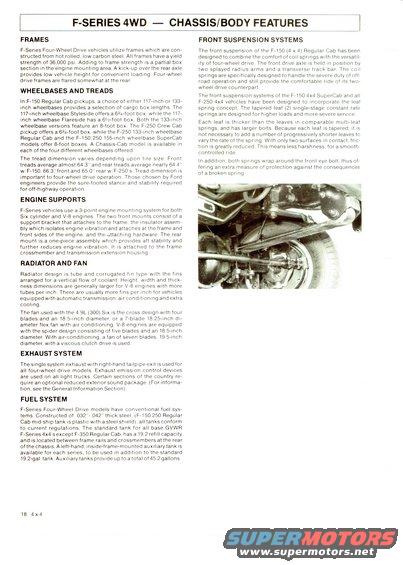
Diagram detailing the chassis and body features of F-Series 4WD vehicles.
F-SERIES 4WD CHASSIS/BODY FEATURES FRAMES F-Series Four-Wheel Drive vehicles utilize frames which are con- structed from hot rolled, low carbon steel. All frames have a yield strength of 36,000 psi. Adding to frame strength is a partial box section in the engine mounting area. A kickup over the rear axle provides low vehicle height for convenient loading. Four-Wheel drive frames are flared somewhat at the rear. WHEELBASES AND TREADS In F150 Regular Cab pickups. a choice of either 117-inch or 133- inch wheelbases provides a selection of cargo box lengths. The 117-inch wheelbase Styleside offers a 63/4-foot box. while the 117 inch wheelbase Flareside has a 6/2foot box. Both the 133inch wheelbase versions feature an 8-foot box. The F250 Crew Cab pickup offers a 63/4-foot box, While the F250133vinch wheelbase Regular Cab and the F150/250155-inch wheelbase SuperCab models offer 8-foot boxes. A ChassisCab model is available in each of the four different Wheelbases offered The tread dimension varies depending upon tire size. Front treads average almost 64.3 and rear treads average nearly 64.4 wiF-150. 66.3 front and 65.0 rear wlF-250s. Tread dimension is important to four-Wheel drive operation. Those chosen by Ford engineers provide the surefooted stance and stability required for off-highway operation. ENGINE SUPPORTS FSeries vehicles use a 3p0int engine mounting system for both Six cylinder and V-8 engines. The two front mounts consist of a support bracket that attaches to the frame. the insulator assem- bly which isolates engine vibration and attaches at the frame and front sides of the engine, and the attaching hardware. The rear mount is a one-piece assembly which prowdes aft stability and further reduces engine vibration. It is attached to the frame crossmember and transmission extension housing. RADIATOR AND FAN Radiator deSign is tube and corrugated fin type With the fins arranged for a vertical flow of coolant. Height, Width and thick ness dimensions are generally larger for V-8 engines With more tubes per inch. There are usually more fins per inch for vehicles equipped with automatic transmission. air conditioning and extra cooling. The fan used With the 4.9L (300) Six is the cross deSign with four blades and an 18.5inch diameter. or a 7vblade1825inch di- ameter flex fan With air conditioning. V8 engines are equipped with the spider design consisting of five blades and an 18.5inch diameter. With airconditioning. a fan of seven blades,19.5-inch diameter, with a viscous clutch drive is used. EXHAUST SYSTEM The single system exhaust With right-hand tailpipe eXIt is used for all four-wheel drive models. Exhaust emis5ion control devices are used on all light trucks. Certain sections of the country re- quire an optional reduced exterior sound package. (For informa~ tion. see the General Information Section). FUEL SYSTEM F-Series FourWheel Drive models have conventional fuel sys- tems. Constructed of .032.042 thick steel. (II150.9250 Regular Cab midship tank is plastic with a steel shield), all tanks conform to current regulations. The standard tank for all base GVWR F-Series 4x4's except F350 Regular Cab. has a 19.2 refill capacity and is located between frame rails and crossmembers at the rear ofthechassis.Aleft-hand. inside-frame-mounted auXiliawtank is available for each series. to be used in addition to the standard 19.2-gal. tank. Auxiliary tanks provide up to a total of 45.2 gallons. 18 4x4 FRONT SUSPENSION SYSTEMS The front suspension of the F-150 (4 x 4) Regular Cab has been designed to combine the comfort of coil springs With the versatil- ity of fourwheel drive. The front drive axle is held in posmon by two splayed radius arms and a transverse track bar. The c0il springs are specifically designed to handle the severe duty of off road operation and still provide the comfortable ride of its two Wheel drive counterpart. The front suspension systems of the F450 4x4 SuperCab and all F250 4x4 vehicles have been designed to incorporate the leaf spring concept. The tapered leaf (2) singlestage constant rate springs are designed for higher loads and more severe service Each leaf is thicker than the leaves in comparable multi-leaf springs, and has larger bolts. Because each leaf is tapered, it is not necessary to add a number of progressively shorter leaves to vary the rate of the spring. With only two surfaces in contact, fric- tion is greatly reduced. This means less harshness. for a smooth controlled ride. In addition, both springs wrap around the front eye bolt. thus of- fering an extra measure of protection against the consequences of a broken spring.
Comments
More from this build
No comments yet.