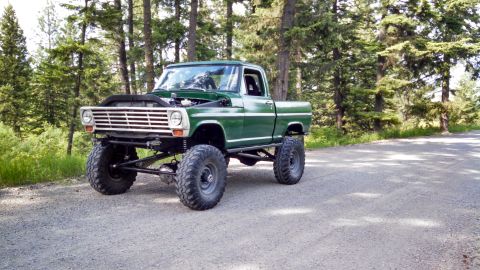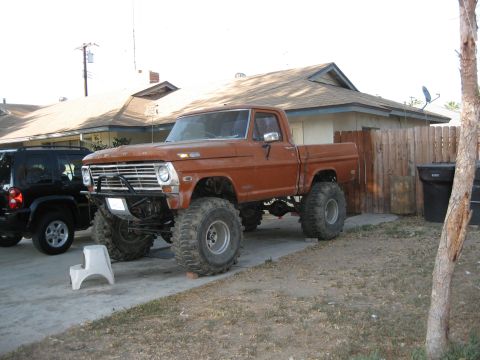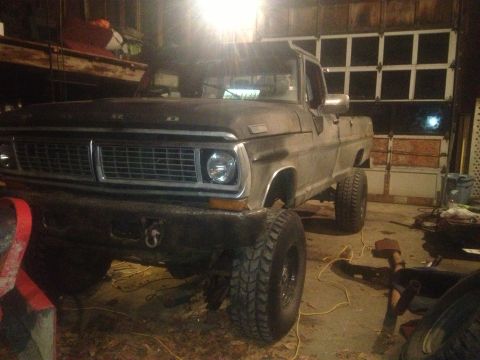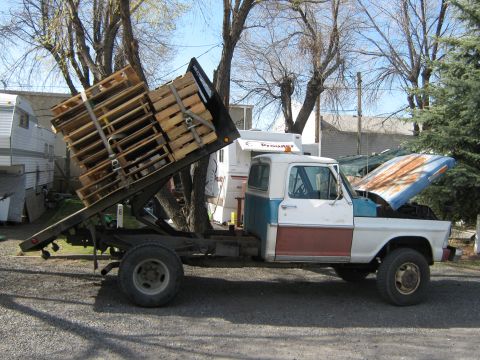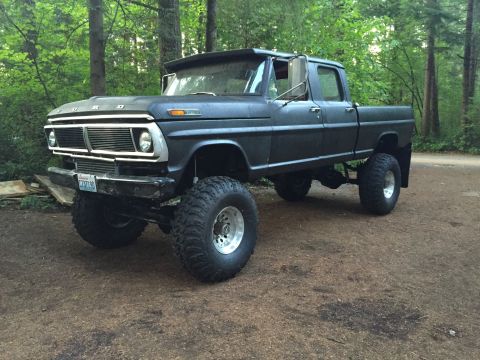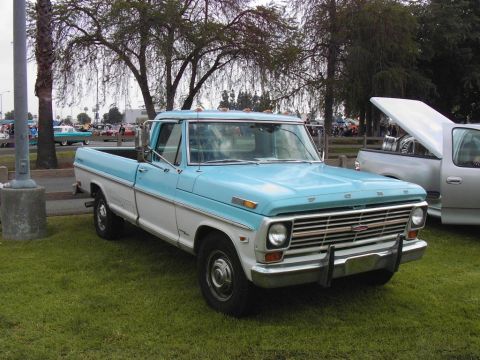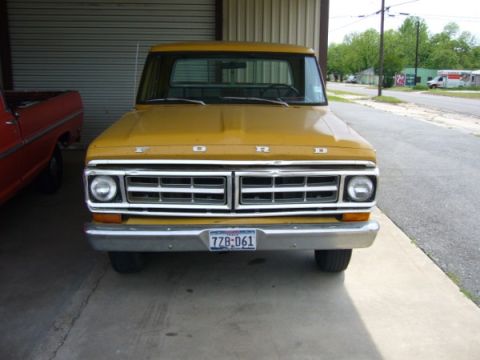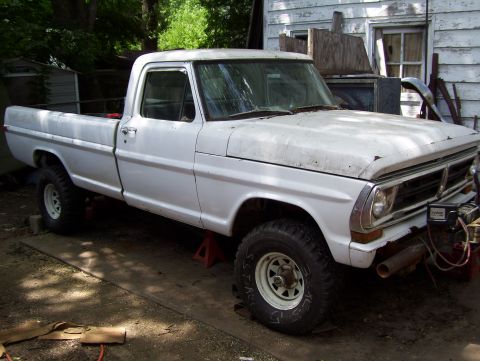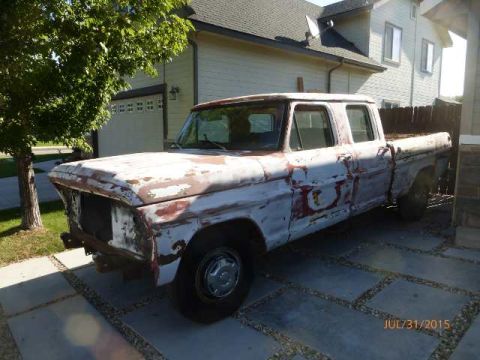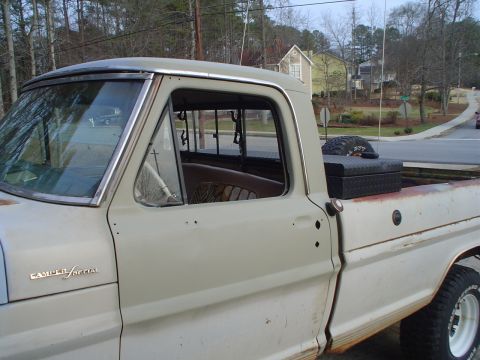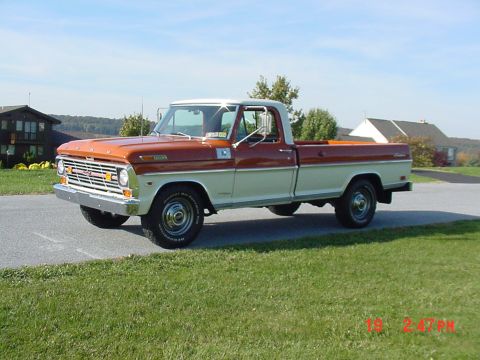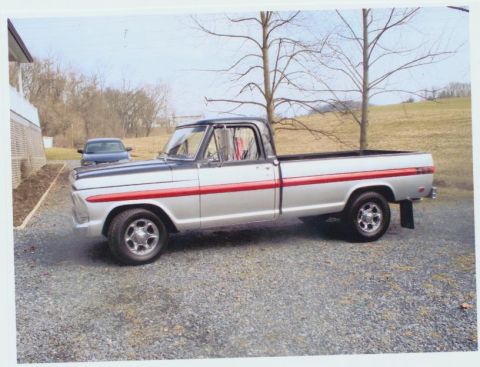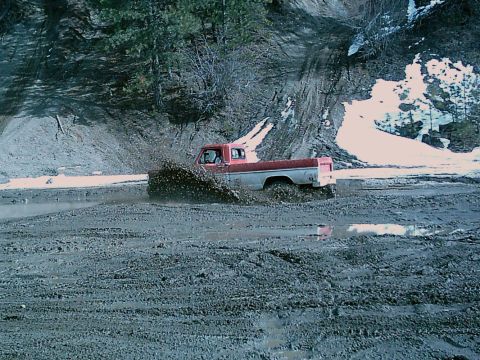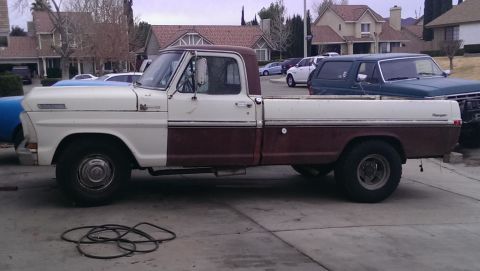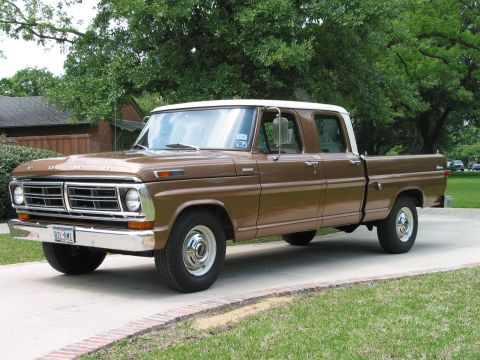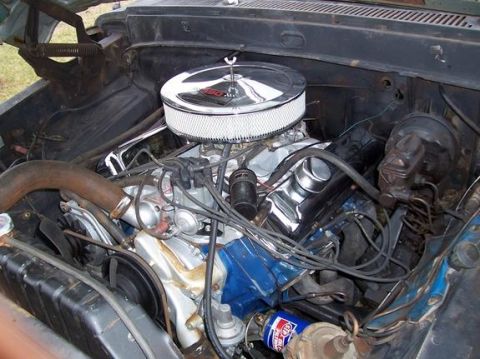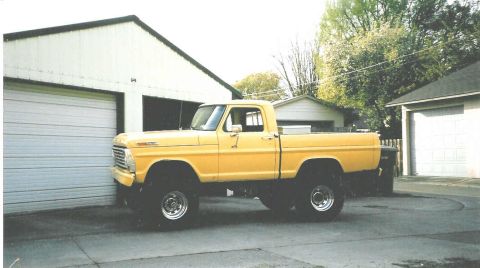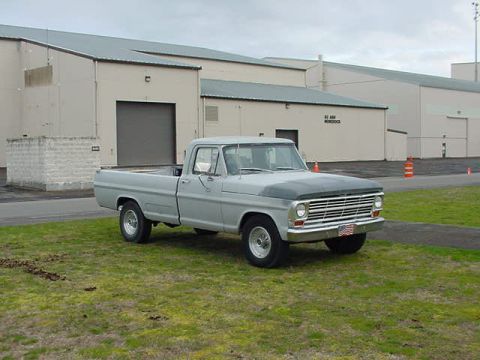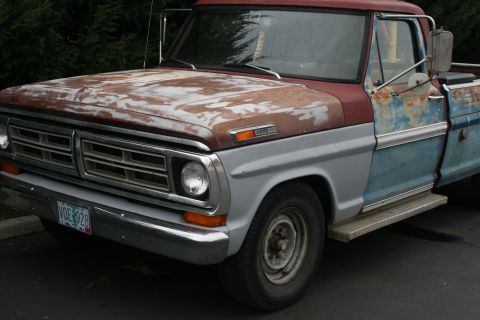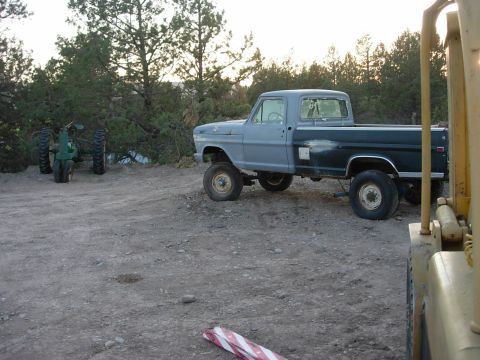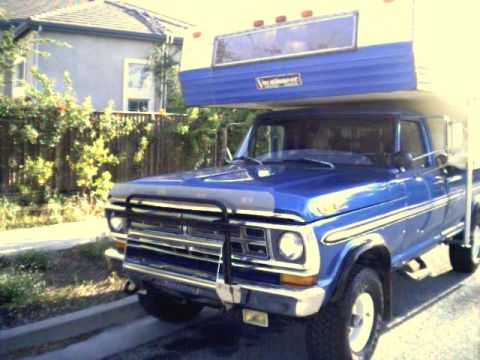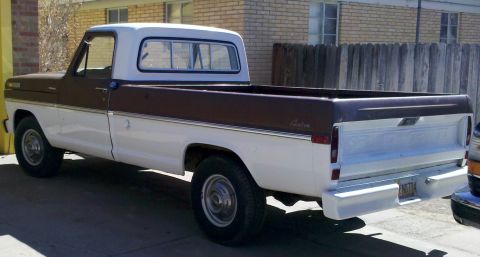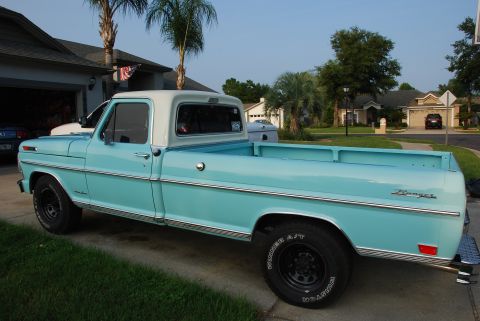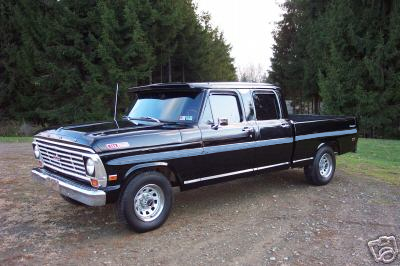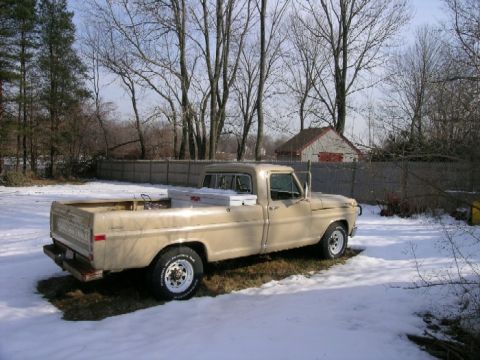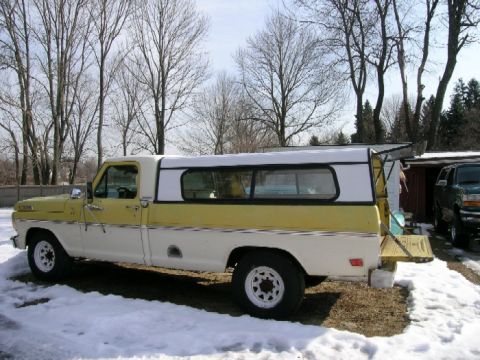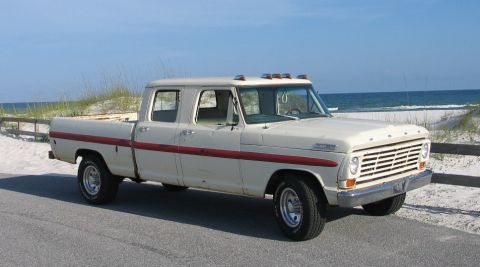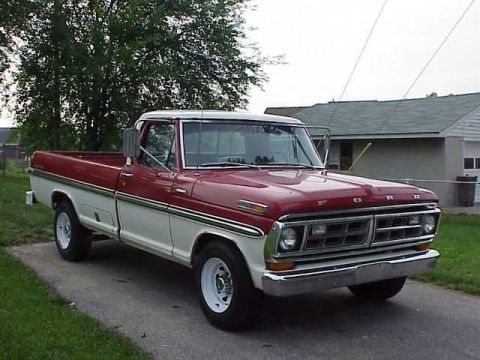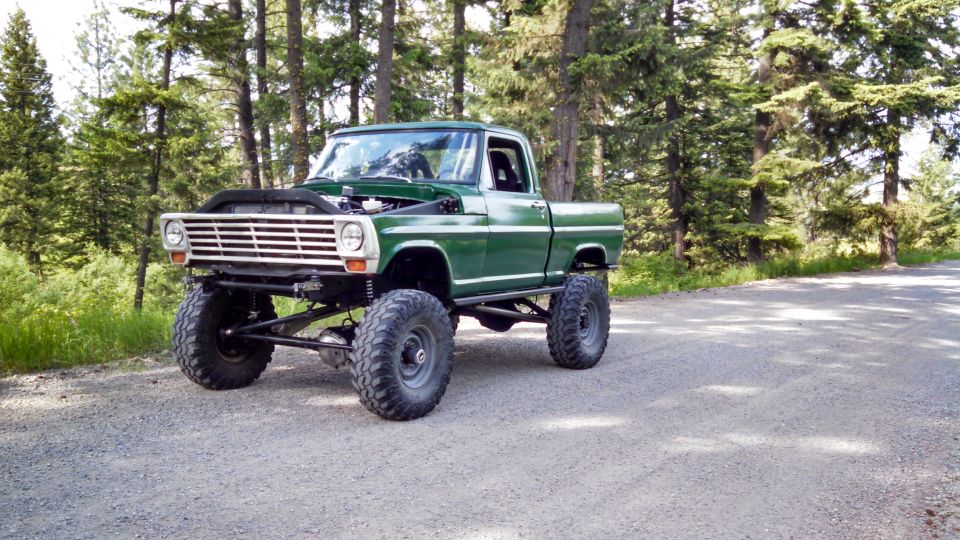
The 1967 model year brought the fifth-generation Ford F-Series, nicknamed the "Bumpside" for the horizontal beltline crease that runs along the bodyside. The 1967-1972 Ford F-250 is the three-quarter-ton version of this truck, sharing its cab and front sheet metal with the half-ton F-100 but carrying heavier axles, brakes, frame, and springs. The F-150 nameplate did not yet exist, so the F-250 sat directly above the F-100 in the lineup. Engines were all gas, with no diesel offered in this generation. The base engines were the 240 and 300-cubic-inch inline-sixes, with the 302 small-block V8 added for 1969 and the FE-series 360 and 390 big-block V8s available through the run. Horsepower was quoted in SAE gross terms through 1971 and switched to the lower SAE net standard for 1972, so a 1972 rating reads lower than a 1971 rating for the same engine. The 1967-1972 Ford F-250 4x4 used a solid front axle, the standard four-wheel-drive layout before the independent Twin-Traction Beam front suspension arrived for 1980. Body styles included the regular cab, and a four-door Crew Cab and the camper-oriented Camper Special package were available on the three-quarter-ton trucks.
Other Ford F-250 generations
The 1967-1972 Ford F-250 at a glance
- Generation: fifth-generation F-Series, nicknamed the "Bumpside" for the bodyside beltline crease
- Years: 1967 through 1972, replaced by the sixth-generation "Dentside" F-250 for 1973
- Class: three-quarter-ton, sharing its cab with the F-100; the F-150 did not yet exist
- Engines: 240 and 300 inline-sixes; 302 V8 (added 1969); 360 and 390 FE big-block V8s; no diesel
- Horsepower standard: SAE gross through 1971, SAE net for 1972 (1972 figures read lower)
- Transmissions: three-speed and four-speed (NP435) manuals; C6 three-speed automatic
- 4x4 front axle: solid front axle (Dana 44 class), the standard layout before the 1980 Twin-Traction Beam change
- Body styles: regular cab and four-door Crew Cab; Camper Special package offered
Ford F-250 1967-1972 year by year
| Year | Ford F-250 changes | Engines offered (gas) |
|---|---|---|
| 1967 | Fifth-generation "Bumpside" F-Series launches; the F-250 is the three-quarter-ton model sharing the F-100 cab | 240 I6; 300 I6; 352 FE V8 |
| 1968 | Federally mandated side marker lights added to the Ford F-250; the 352 is dropped and the 360 and 390 FE V8s are added | 240 I6; 300 I6; 360 FE V8; 390 FE V8 |
| 1969 | The 302 small-block V8 is added to the Ford F-250 engine range | 240 I6; 300 I6; 302 V8; 360 FE V8; 390 FE V8 |
| 1970 | Largest restyle of the generation: new grille with wraparound front parking and signal lamps; Ranger XLT added as the top trim | 240 I6; 300 I6; 302 V8; 360 FE V8; 390 FE V8 |
| 1971 | Minor grille revision on the Ford F-250; powertrain carries over | 240 I6; 300 I6; 302 V8; 360 FE V8; 390 FE V8 |
| 1972 | Final year of the Bumpside Ford F-250; horsepower ratings switch from SAE gross to the lower SAE net standard | 240 I6; 300 I6; 302 V8; 360 FE V8; 390 FE V8 |
What the "Bumpside" label means
The 1967 Ford F-250 introduced the fifth-generation F-Series, which enthusiasts call the "Bumpside" for the prominent horizontal crease, or bump, that runs along the bodyside from the front fender to the taillight. The cab was wider than the previous generation and rode on a heavier frame. As with the rest of the F-Series, the 1967-1972 F-250 shared its cab and core sheet metal with the F-100, so the three-quarter-ton truck is distinguished by its heavier axles, brakes, and springs rather than by unique bodywork. Because the F-150 nameplate did not arrive until 1975, the F-250 in this generation sat directly above the half-ton F-100.
Engines and the gross-to-net horsepower change
The 1967-1972 Ford F-250 was gas-only; no diesel was offered. The base engines were the 240 and 300-cubic-inch inline-sixes, durable pushrod engines used across the F-Series. The 302 small-block V8 was added for 1969, and the FE-series big-block V8s, the 360 and the 390, were available for the heavier work the three-quarter-ton truck was built for (the 352 FE was offered for 1967 only before the 360 and 390 took over for 1968). An important point for comparing figures across this generation is that Ford quoted horsepower in SAE gross terms through 1971 and switched to the SAE net standard for 1972. Net ratings are measured with the engine's accessories installed and read meaningfully lower, so a 1972 F-250 engine shows a lower horsepower number than the same engine in 1971 even when little changed mechanically.
Drivetrain and the solid front axle
The 1967-1972 Ford F-250 used three-speed and four-speed manual transmissions, including the NP435 four-speed with its low granny gear, along with the C6 three-speed automatic. The four-wheel-drive 1967-1972 Ford F-250 used a solid front axle, the standard four-wheel-drive arrangement of the era; Ford did not adopt the independent Twin-Traction Beam front suspension on the F-250 until the 1980 redesign. The tall four-wheel-drive F-250, with its raised stance and divorced transfer case, is the truck enthusiasts nickname the "Highboy."
Body styles and the Camper Special
The 1967-1972 Ford F-250 was offered in regular-cab form and as a four-door Crew Cab, the body style Ford had introduced earlier in the decade and carried into the Bumpside era. As a three-quarter-ton truck, the F-250 was a natural base for a slide-in camper, and Ford offered a Camper Special package that added heavy-duty cooling and charging equipment and camper wiring to support the added load. Trim levels through the generation ranged from the base and Custom Cab work trims to the better-equipped Ranger and, from 1970, the top Ranger XLT.
Frequently asked questions
What generation is the 1967-1972 Ford F-250?
The 1967-1972 Ford F-250 is the fifth-generation F-Series, nicknamed the "Bumpside" for the horizontal crease along the bodyside. It is the three-quarter-ton truck of the generation, sharing its cab with the F-100, and it was replaced by the sixth-generation "Dentside" F-250 for 1973.
What engines did the 1967-1972 Ford F-250 use?
The 1967-1972 Ford F-250 used the 240 and 300-cubic-inch inline-sixes and FE-series big-block V8s (the 360 and 390), with the 302 small-block V8 added for 1969. The 352 FE was offered for 1967 only. All were gas engines; no diesel was offered in this generation.
Did the 1967-1972 Ford F-250 4x4 have a solid front axle?
Yes. The 1967-1972 Ford F-250 4x4 used a solid front axle, the standard four-wheel-drive layout of the era. Ford did not switch the F-250 to independent Twin-Traction Beam front suspension until the 1980 redesign.
Why do 1972 Ford F-250 horsepower figures look lower?
Ford quoted horsepower in SAE gross terms through 1971 and switched to the SAE net standard for 1972. Net ratings are measured with accessories installed and read lower than gross ratings, so a 1972 Ford F-250 engine shows a lower number than the same engine did in 1971 even with little mechanical change.
Did the 1967-1972 Ford F-250 offer a Crew Cab?
Yes. The 1967-1972 Ford F-250 was available as a four-door Crew Cab, a body style Ford had introduced earlier and carried into the Bumpside generation, alongside the regular cab. A Camper Special package was also offered for slide-in camper duty.
Sources
- Ford factory specification sheets for the 1967-1972 F-Series
- Wikipedia, Ford F-Series (fifth generation)
- Generation histories for the 1967-1972 "Bumpside" F-Series
- VIN and data-plate decoding for engine and axle identification
Asked all the time
What generation is the 1967-1972 Ford F-250?
The 1967-1972 Ford F-250 is the fifth-generation F-Series, nicknamed the "Bumpside" for the horizontal crease along the bodyside. It is the three-quarter-ton truck of the generation, sharing its cab with the F-100, and it was replaced by the sixth-generation "Dentside" F-250 for 1973.
What engines did the 1967-1972 Ford F-250 use?
The 1967-1972 Ford F-250 used the 240 and 300-cubic-inch inline-sixes and FE-series big-block V8s (the 360 and 390), with the 302 small-block V8 added for 1969. The 352 FE was offered for 1967 only. All were gas engines; no diesel was offered in this generation.
Did the 1967-1972 Ford F-250 4x4 have a solid front axle?
Yes. The 1967-1972 Ford F-250 4x4 used a solid front axle, the standard four-wheel-drive layout of the era. Ford did not switch the F-250 to independent Twin-Traction Beam front suspension until the 1980 redesign.
Why do 1972 Ford F-250 horsepower figures look lower?
Ford quoted horsepower in SAE gross terms through 1971 and switched to the SAE net standard for 1972. Net ratings are measured with accessories installed and read lower than gross ratings, so a 1972 Ford F-250 engine shows a lower number than the same engine did in 1971 even with little mechanical change.
Did the 1967-1972 Ford F-250 offer a Crew Cab?
Yes. The 1967-1972 Ford F-250 was available as a four-door Crew Cab, a body style Ford had introduced earlier and carried into the Bumpside generation, alongside the regular cab. A Camper Special package was also offered for slide-in camper duty.
Technical Reference
Member-uploaded diagrams & documents for this generation. AI-classified; community-verified where badged.
Brochures & Literature (3)
- Ford Super Camper Special Brochure - 9,500 lb GVW & 4,675 lb Payload RatingsThis is a photograph of a page from a Ford truck sales brochure describing the Super Camper Special pickup. The page features a color cutaway illustration of a rear axle and suspension assembly, showing coil springs…
- Ford brochure spec table for F-250 and F-350 camper packages, including the 140" wb F-350 Super Camper Special with 360 V-8 and Cruise-O-Matic.
- Ford brochure table comparing the F-350 Super Camper Special (140" wheelbase) with the Chevrolet C-30 Camper Package on tank, cooler and seat features.
Data/Spec Plates (1)
The wall · registered 1967-1972 F-250s
Sorted by depth of documentation. Click any vehicle to open its permanent record.