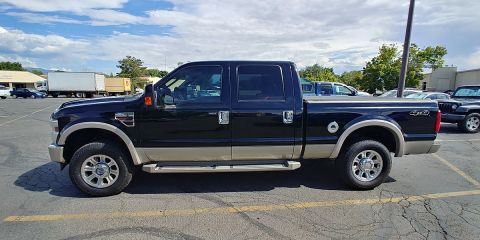
The 2008 model year brought the second-generation Ford F-250 Super Duty, with a new front end, a redesigned interior, and updated instrumentation on Ford's heavy-duty platform. The defining mechanical change was the diesel. The 6.4L Power Stroke twin-turbo diesel V8 replaced the troubled 6.0L for 2008, using a compound sequential turbocharger arrangement, a high-pressure common-rail injection system with piezoelectric injectors, and roughly 350 horsepower and 650 lb-ft of torque. Built by International/Navistar, which sold its own version of this engine as the MaxxForce 7, the 6.4L was the last International/Navistar diesel in the F-250 before Ford's in-house 6.7L Power Stroke arrived for 2011. The gas engines carried over: the three-valve 5.4L Triton V8 and the three-valve 6.8L Triton V10. The four-wheel-drive 2008-2010 Ford F-250 Super Duty continued to use a solid front axle with coil-spring suspension. Transmissions were the 5R110W TorqShift automatic and a heavy-duty manual. This short generation bridged the first Super Duty body and the 2011 powertrain overhaul, which brought the 6.7L diesel and the 6.2L gas V8.
Other Ford F-250 generations
The 2008-2010 Ford F-250 Super Duty at a glance
- Generation: second-generation Super Duty, with a new front end, interior, and instrument cluster
- Years: 2008 through 2010, replaced by the 2011 trucks with the in-house 6.7L diesel
- Diesel: the 6.4L Power Stroke twin-turbo diesel (roughly 350 hp / 650 lb-ft), the last International/Navistar diesel in the F-250
- Gas engines: three-valve 5.4L Triton V8 and three-valve 6.8L Triton V10
- 4x4 front axle: solid front axle with coil-spring suspension
- Transmission: 5R110W TorqShift automatic; heavy-duty manual offered early
- Body styles: regular cab, SuperCab, and Crew Cab
Ford F-250 Super Duty 2008-2010 year by year
| Year | Ford F-250 Super Duty changes | Engines offered |
|---|---|---|
| 2008 | Second-generation Super Duty arrives with a new front end and interior; the 6.4L Power Stroke twin-turbo diesel replaces the 6.0L | 5.4L 3V V8; 6.8L V10; 6.4L Power Stroke diesel |
| 2009 | The Ford F-250 Super Duty carries over with the 6.4L Power Stroke twin-turbo diesel and the gas V8 and V10 | 5.4L 3V V8; 6.8L V10; 6.4L Power Stroke diesel |
| 2010 | Final year of the 6.4L Power Stroke generation before the 2011 in-house 6.7L diesel and 6.2L gas V8 arrive | 5.4L 3V V8; 6.8L V10; 6.4L Power Stroke diesel |
The second-generation Super Duty
The 2008 Ford F-250 Super Duty introduced the second generation of the heavy-duty platform, with a new, taller front-end design, a redesigned interior, and a new instrument cluster. The truck kept the underlying Super Duty platform lineage from 1999 but presented a substantially new look and updated cabin, and it is conventionally counted as the second Super Duty generation. As with the first generation, the Super Duty F-250 remained engineered separately from the F-150, with a heavier frame and a solid front axle on four-wheel-drive models.
The 6.4L Power Stroke twin-turbo diesel
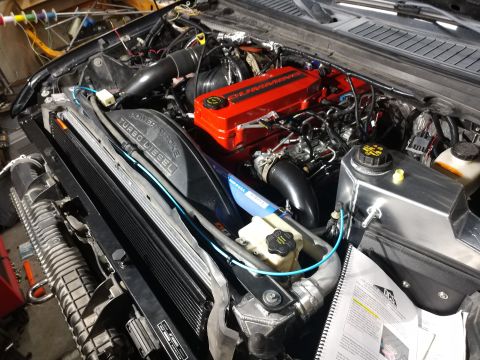
The headline change for 2008 was the 6.4L Power Stroke turbodiesel V8, which replaced the 6.0L. The 6.4L used a compound sequential turbocharging system, with a smaller high-pressure turbo and a larger low-pressure turbo working in series, along with a high-pressure common-rail injection system and piezoelectric injectors. It produced roughly 350 horsepower at 3,000 rpm and 650 lb-ft of torque at 2,000 rpm. Built by International/Navistar, which sold its own version of this engine as the MaxxForce 7, the 6.4L was the last International/Navistar diesel in the Ford F-250; Ford brought diesel design in-house for the 6.7L Power Stroke that replaced it for 2011. The 6.4L added a diesel particulate filter to meet tightening emissions standards, and its fuel-economy and emissions-system characteristics are part of why Ford moved to its own design.
Gas engines, transmissions, and the front axle
The gas engines of the 2008-2010 Ford F-250 Super Duty carried over from the previous trucks: the three-valve 5.4L Triton V8 and the three-valve 6.8L Triton V10, the larger gas option for buyers who did not want diesel. The 5R110W TorqShift automatic was the main transmission, with a heavy-duty manual available early in the run. The four-wheel-drive 2008-2010 Ford F-250 Super Duty used a solid front axle with coil-spring suspension, continuing the arrangement adopted in the 2005 restyle. The solid front axle remained a defining heavy-duty trait separating the Super Duty F-250 from the independently sprung F-150.
Frequently asked questions
What is the 2008-2010 Ford F-250 Super Duty?
The 2008-2010 Ford F-250 Super Duty is the second generation of Ford's heavy-duty Super Duty, with a new front end, redesigned interior, and the 6.4L Power Stroke twin-turbo diesel. It bridged the first Super Duty and the 2011 trucks that introduced Ford's in-house 6.7L diesel.
What diesel did the 2008-2010 Ford F-250 Super Duty use?
The 2008-2010 Ford F-250 Super Duty used the 6.4L Power Stroke twin-turbo diesel V8, rated at roughly 350 horsepower and 650 lb-ft of torque, with a compound sequential turbocharger and piezoelectric common-rail injection. Built by International/Navistar, it was the last International/Navistar diesel in the F-250.
What gas engines did the 2008-2010 Ford F-250 Super Duty use?
The 2008-2010 Ford F-250 Super Duty used the three-valve 5.4L Triton V8 and the three-valve 6.8L Triton V10 as its gas engines, carried over from the previous Super Duty trucks.
Does the 2008-2010 Ford F-250 Super Duty have a solid front axle?
Yes. The four-wheel-drive 2008-2010 Ford F-250 Super Duty used a solid front axle with coil-spring suspension, continuing the arrangement from the 2005 restyle. The solid front axle is a key difference from the independently sprung F-150.
Why was the 6.4L Power Stroke the last International diesel?
The 6.4L Power Stroke was the last diesel International/Navistar built for the Ford F-250 because Ford moved diesel engineering in-house for the 2011 model year, replacing the 6.4L with its own 6.7L Power Stroke V8, nicknamed the "Scorpion."
Sources
- Ford factory specification sheets for the 2008-2010 F-250 Super Duty
- Wikipedia, Ford Super Duty and Ford Power Stroke engine
- DieselHub reference, 6.4L Power Stroke
- International/Navistar MaxxForce 7 references
Asked all the time
What is the 2008-2010 Ford F-250 Super Duty?
The 2008-2010 Ford F-250 Super Duty is the second generation of Ford's heavy-duty Super Duty, with a new front end, redesigned interior, and the 6.4L Power Stroke twin-turbo diesel. It bridged the first Super Duty and the 2011 trucks that introduced Ford's in-house 6.7L diesel.
What diesel did the 2008-2010 Ford F-250 Super Duty use?
The 2008-2010 Ford F-250 Super Duty used the 6.4L Power Stroke twin-turbo diesel V8, rated at roughly 350 horsepower and 650 lb-ft of torque, with a compound sequential turbocharger and piezoelectric common-rail injection. Built by International/Navistar, it was the last International/Navistar diesel in the F-250.
What gas engines did the 2008-2010 Ford F-250 Super Duty use?
The 2008-2010 Ford F-250 Super Duty used the three-valve 5.4L Triton V8 and the three-valve 6.8L Triton V10 as its gas engines, carried over from the previous Super Duty trucks.
Does the 2008-2010 Ford F-250 Super Duty have a solid front axle?
Yes. The four-wheel-drive 2008-2010 Ford F-250 Super Duty used a solid front axle with coil-spring suspension, continuing the arrangement from the 2005 restyle. The solid front axle is a key difference from the independently sprung F-150.
Why was the 6.4L Power Stroke the last International diesel?
The 6.4L Power Stroke was the last diesel International/Navistar built for the Ford F-250 because Ford moved diesel engineering in-house for the 2011 model year, replacing the 6.4L with its own 6.7L Power Stroke V8, nicknamed the "Scorpion."
Technical Reference
Member-uploaded diagrams & documents for this generation. AI-classified; community-verified where badged.
Blueprints (2)
- Hand-Dimensioned Metal Bar Profile Sketch - 7 3/4" & 5 1/4" Taper, 1/2" HeightThis image is not a printed reference document but a photograph of a flat metal bar or strip laid on a white background, annotated by hand in blue ink to serve as a dimensioned sketch (site-classified as a blueprint)…
- Hand-Drawn Metal Bracket Cut Template with Dimensions - 2008 Ford F-250 ProjectThis image is a hand-drawn fabrication sketch (blueprint-style template) drawn in blue ink on white paper, photographed together with the end of a flat metal bar or strap. The sketch defines the profile of a notch or…
The wall · registered 2008-2010 F-250s
Sorted by depth of documentation. Click any vehicle to open its permanent record.