Home/
Registry/
Ford/
Mustang/
1964-1973/
“Race Car Tope”/
Photo
supermotors.net/registry/media/1162754
Ford Boss 302 Engine Safety Wiring Procedure - Oil Pump, Main Cap & Pan Baffle
Reference · 1964-1973 MustangAll 6 service procedures
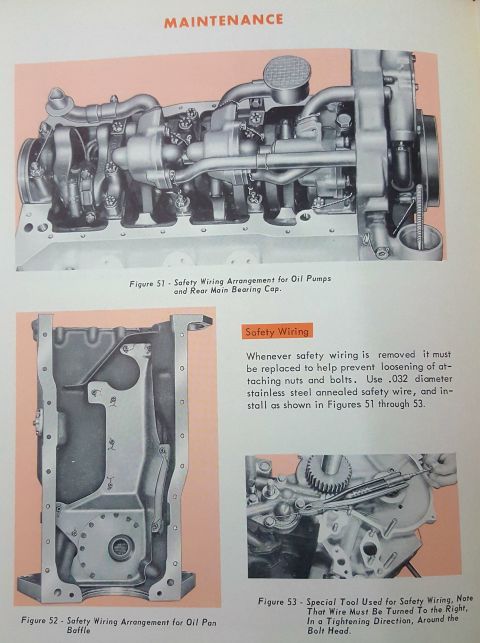
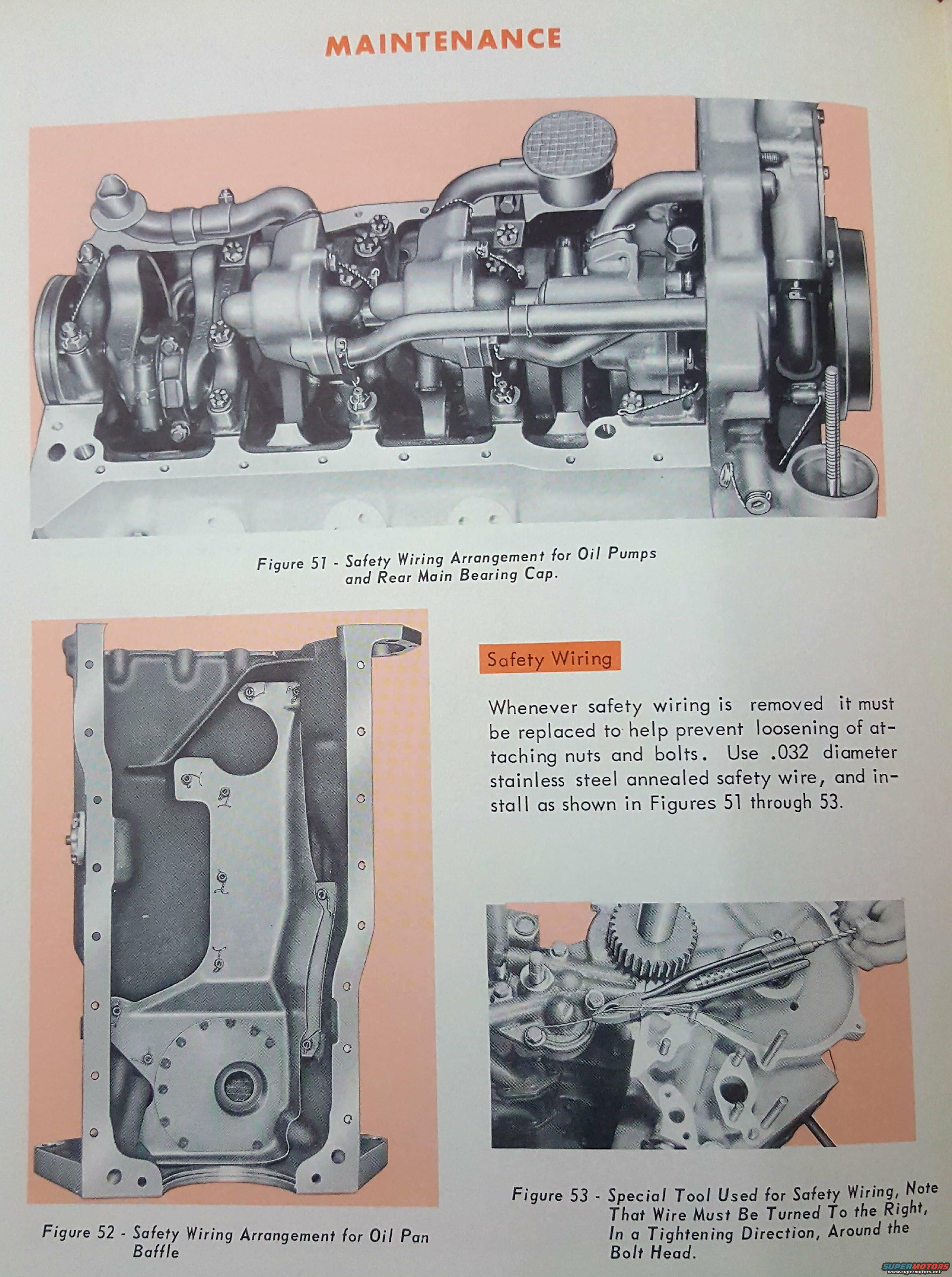
Service manual page explaining engine safety-wiring procedures with arrangement figures.
Part of 1964-1973 Ford Mustang Service Procedures
This is a single page from a vintage engine maintenance manual, headed "MAINTENANCE," covering the topic of safety wiring on engine fasteners. The text instructs that whenever safety wiring is removed it must be replaced to help prevent loosening of attaching nuts and bolts, specifying the use of.032 inch diameter stainless steel annealed safety wire installed as shown in the accompanying figures. Three black-and-white photographs illustrate the procedure: Figure 51 shows the safety wiring arrangement for the oil pumps and rear main bearing cap on the underside of an engine block; Figure 52 shows the safety wiring arrangement for the oil pan baffle inside the oil pan; and Figure 53 shows a special safety-wiring tool (twisting pliers) in use, with the note that the wire must be turned to the right, in a tightening direction, around the bolt head. The page gives no year, model, engine, part numbers, or torque values, but from the album context it is part of a multi-page performance/racing engine maintenance document (other album files reference "inline B302"). It teaches a reader the correct wire gauge, material, locations, and wrapping direction for safety wiring critical bottom-end and oiling-system fasteners.
Is this accurate? Sign in to help verify it.
Frequently asked questions
- What size and type of safety wire should be used on the engine fasteners?
- The document specifies.032 diameter stainless steel annealed safety wire.
- Which engine components are shown with safety wiring in this manual page?
- Figure 51 shows the safety wiring arrangement for the oil pumps and rear main bearing cap, and Figure 52 shows the arrangement for the oil pan baffle.
- Which direction must the safety wire be wrapped around the bolt head?
- Per Figure 53, the wire must be turned to the right, in a tightening direction, around the bolt head, using a special safety-wiring tool.
- Does safety wiring need to be replaced after removal?
- Yes. Whenever safety wiring is removed it must be replaced to help prevent loosening of the attaching nuts and bolts.

No comments yet.