Home/
Registry/
Ford/
Mustang/
1964-1973/
“Race Car Tope”/
Photo
supermotors.net/registry/media/1161896
Ford 427 SOHC & GT Engine Induction System Development - Cylinder Head Design

Reference · 1964-1973 MustangAll 16 manual pages
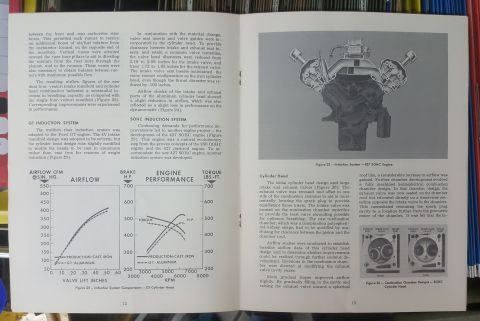


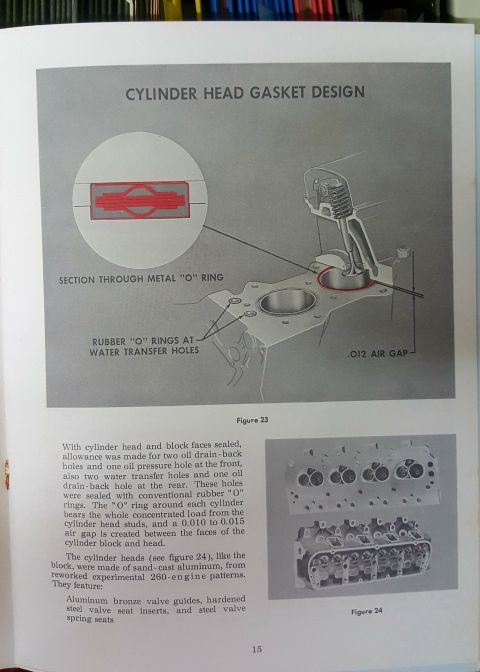
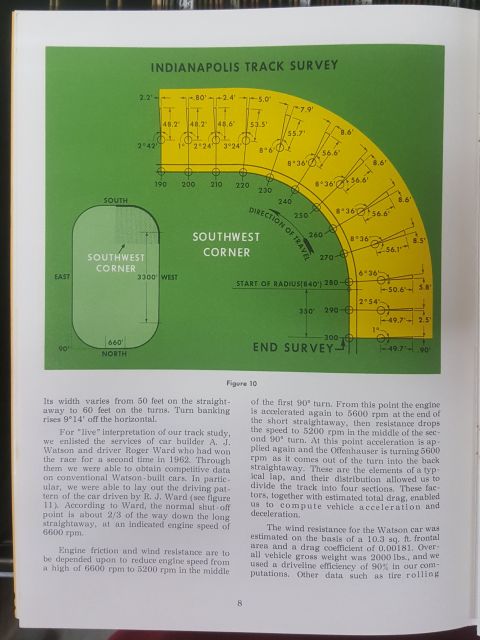



Manual page on the induction system and cylinder head featuring an airflow/performance graph and combustion chamber photographs.
Part of 1964-1973 Ford Mustang Manual Pages
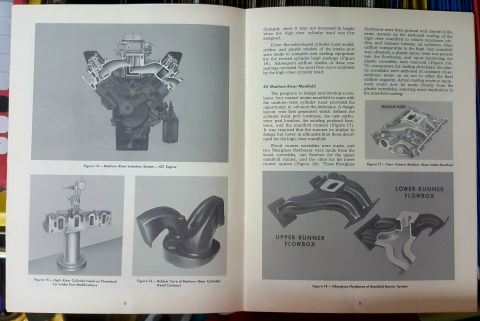
This is a two-page spread (pages 12-13) from a Ford engineering/performance publication describing the development of Ford's high-performance 427 engine induction systems. Page 12 covers the dual four-venturi intake manifold design with vertical vanes around the riser bore pillars, then details the GT Induction System: the medium-riser 4V manifold adapted to the Ford GT engine with aluminum cylinder heads for weight reduction, requiring valve seat inserts and guides, with intake valve diameter reduced from 2.19 to 2.09 inches and exhaust from 1.72 to 1.65 inches, and throat diameter reduced by.100 inch. Figure 24 presents comparison charts of airflow (CFM at 5 in. Hg vs. valve lift) and engine performance (brake horsepower and torque vs. RPM) for production cast-iron versus GT-aluminum heads. The SOHC Induction System section introduces the 427 SOHC engine, an evolution of the 256 DOHC and 427 pushrod engines. Page 13 shows a cutaway illustration of the 427 SOHC engine (Figure 25) and discusses cylinder head development: the initial polyspherical-kidney cast combustion chamber with recessed offset exhaust valve, airflow studies, and evolution to a fully machined hemispherical chamber with the exhaust valve seated on the chamber roof and relocated spark plug cavity (Figure 26, initial vs. final designs).
Is this accurate? Sign in to help verify it.
Frequently asked questions
- Why were the GT engine cylinder heads cast in aluminum?
- The cylinder head design was slightly modified so heads could be cast in aluminum rather than cast iron for reasons of weight reduction.
- How were valve sizes changed for the aluminum GT cylinder head?
- To provide clearance between intake and exhaust seat inserts and retain a common valve centerline, valve head diameters were reduced from 2.19 to 2.09 inches for the intake valve and from 1.72 to 1.65 inches for the exhaust valve. The throat diameter was also reduced by.100 inches.
- What engines did the 427 SOHC evolve from?
- The 427 SOHC engine was a natural evolutionary step from the proven concepts of the 256 DOHC engine and the 427 pushrod engine.
- How did the SOHC combustion chamber design evolve?
- The initial cast polyspherical-kidney chamber had a recessed, offset exhaust valve. By filling in the cavity and raising the exhaust valve toward a spherical roof line, airflow increased considerably, and development evolved into a fully machined hemispherical combustion chamber with the exhaust valve seated on the chamber roof opposite the intake valve, and the spark plug cavity relocated further from the chamber's geometric center.
- Did the aluminum GT cylinder head flow as well as the cast-iron head?
- No: airflow checks of the intake and exhaust ports of the aluminum head showed a slight reduction in airflow, which was reflected as a slight loss in performance on the dynamometer (Figure 24).




No comments yet.