Nissan EGR Thermal Vacuum Valve (TVV) Inspection & Torque Spec - EF & EC-27
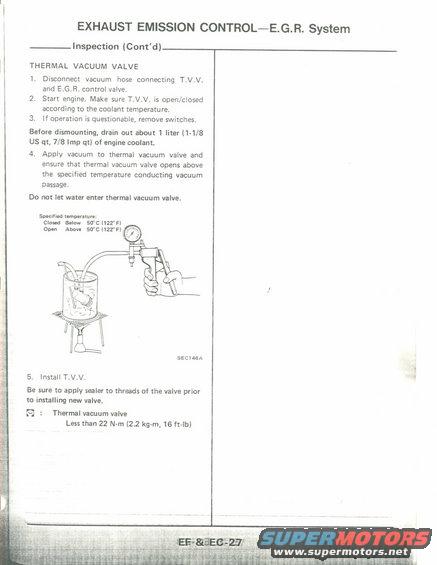
Thermal vacuum valve test: valve closed below 50C (122F), open above 50C; apply sealer to threads and tighten to less than 22 N-m (2.2 kg-m, 16 ft-lb).
This page is from a factory service manual section titled "Exhaust Emission Control: E.G.R. System, Inspection (Cont'd)" and covers inspection and replacement of the Thermal Vacuum Valve (T.V.V.). The procedure instructs the technician to disconnect the vacuum hose connecting the T.V.V. and E.G.R. control valve, start the engine, and verify that the T.V.V. opens and closes according to coolant temperature. If operation is questionable, the switches are to be removed; before dismounting, about 1 liter (1-1/8 US qt, 7/8 Imp qt) of engine coolant must be drained. The valve is then bench-tested by applying vacuum with a hand pump while the valve is heated in a beaker of water (illustration SEC146A), confirming the valve is closed below 50°C (122°F) and open above 50°C (122°F). A caution warns not to let water enter the thermal vacuum valve. Finally, the T.V.V. is installed with sealer applied to the threads of the new valve, tightened to less than 22 N·m (2.2 kg-m, 16 ft-lb). The page is numbered EF & EC-27.
Is this accurate? Sign in to help verify it.
Frequently asked questions
- At what temperature does the thermal vacuum valve open and close?
- The specified temperature is: closed below 50°C (122°F) and open above 50°C (122°F).
- How much coolant must be drained before removing the thermal vacuum valve?
- Before dismounting, drain out about 1 liter (1-1/8 US qt, 7/8 Imp qt) of engine coolant.
- What is the torque specification for the thermal vacuum valve?
- Tighten the thermal vacuum valve to less than 22 N·m (2.2 kg-m, 16 ft-lb).
- What must be applied when installing a new thermal vacuum valve?
- Apply sealer to the threads of the valve prior to installing the new valve.
- How is the thermal vacuum valve bench-tested?
- Apply vacuum to the thermal vacuum valve (heated in water, per the illustration) and ensure it opens above the specified temperature, conducting vacuum through the passage. Do not let water enter the valve.
Comments
More from this build
No comments yet.