Common Tire Wear Patterns & Causes Chart - Diagnosis and Corrections
Reference · 1968-1982 CorvetteAll 1 service procedures
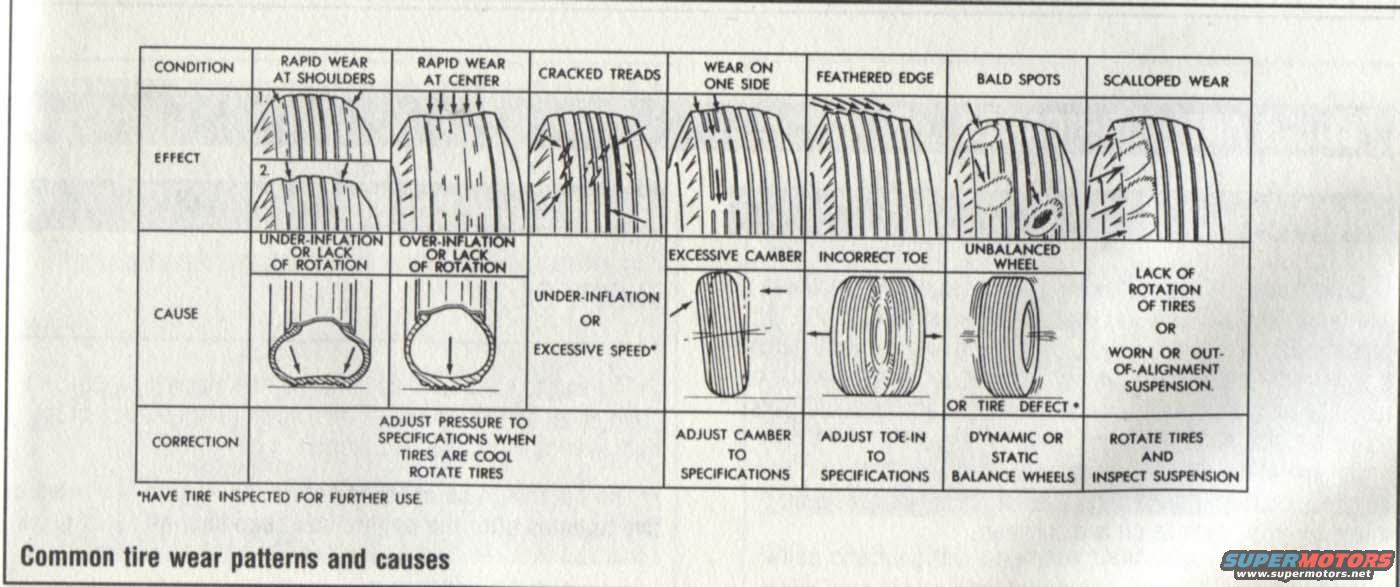
Diagnostic chart of common tire wear patterns listing condition, effect, cause and correction for each.
Part of 1968-1982 Chevrolet Corvette Service Procedures
This document is a scanned reference chart titled "Common tire wear patterns and causes." It is organized as a table with three rows, Condition, Effect (shown via illustrations), Cause, and Correction, across seven tire wear conditions: rapid wear at shoulders, rapid wear at center, cracked treads, wear on one side, feathered edge, bald spots, and scalloped wear. For each condition, the chart identifies the underlying cause: under-inflation or lack of rotation (shoulder wear), over-inflation or lack of rotation (center wear), under-inflation or excessive speed (cracked treads), excessive camber (one-side wear), incorrect toe (feathered edge), unbalanced wheel or tire defect (bald spots), and lack of tire rotation or worn/out-of-alignment suspension (scalloped wear). Corrections listed include adjusting tire pressure to specifications when tires are cool and rotating tires; adjusting camber to specifications; adjusting toe-in to specifications; dynamic or static wheel balancing; and rotating tires plus inspecting the suspension. A footnote advises having the tire inspected for further use in cases marked with an asterisk (cracked treads and tire defect). Illustrations depict each wear pattern on the tread and cross-section views showing inflation effects and alignment conditions. The chart is a general diagnostic aid useful for identifying alignment, inflation, balance, and rotation problems from visible tread wear.
Is this accurate? Sign in to help verify it.
Frequently asked questions
- What causes rapid tire wear at the shoulders?
- Under-inflation or lack of rotation. The correction is to adjust pressure to specifications when tires are cool and rotate the tires.
- What causes rapid tire wear at the center of the tread?
- Over-inflation or lack of rotation. Correct by adjusting pressure to specifications when tires are cool and rotating tires.
- What does a feathered edge on tires indicate?
- Incorrect toe. The correction is to adjust toe-in to specifications.
- What causes bald spots on a tire and how are they fixed?
- An unbalanced wheel or a tire defect. The correction is dynamic or static wheel balancing, and per the footnote the tire should be inspected for further use.
- What causes scalloped (cupped) tire wear?
- Lack of rotation of tires or worn/out-of-alignment suspension. The correction is to rotate tires and inspect the suspension.
No comments yet.