Home/
Registry/
Hyundai/
Genesis Coupe/
2010-2016/
“Coupe”/
Photo
supermotors.net/registry/media/1090729
DOT Brake Pad Edge Codes Explained - EE FE FF GG HH Friction Ratings Chart

Reference · 2010-2016 Genesis CoupeAll 1 data & spec plates
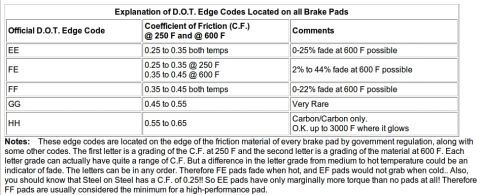
Reference chart explaining DOT brake pad edge codes: friction coefficient ranges by letter (EE 0.25-0.35 to HH 0.55-0.65), first letter rated at 250F and second at 600F, used to gauge fade.
Part of 2010-2016 Hyundai Genesis Coupe Data & Spec Plates
This document is a reference table explaining D.O.T. edge codes found on all brake pads, as required by government regulation. The table lists five common edge code combinations (EE, FE, FF, GG, HH) along with their corresponding coefficient of friction (C.F.) ranges measured at 250°F and 600°F, plus comments about fade behavior. EE pads have a C.F. of 0.25-0.35 at both temperatures with 0-25% fade possible at 600°F; FE pads range from 0.25-0.35 at 250°F to 0.35-0.45 at 600°F with 2-44% fade possible; FF pads are 0.35-0.45 at both temps with 0-22% fade possible; GG (0.45-0.55) is very rare; and HH (0.55-0.65) applies to carbon/carbon pads usable up to 3000°F. The notes explain that the first letter grades cold (250°F) friction and the second grades hot (600°F) friction, that a grade difference between temperatures can indicate fade, and that steel-on-steel friction is 0.25: making EE pads only marginally better than no pads. FF is described as the usual minimum grade for a high-performance brake pad. The document is generic and not specific to any vehicle make, model, or year.
Is this accurate? Sign in to help verify it.
Frequently asked questions
- What do the letters in a brake pad's D.O.T. edge code mean?
- The first letter is a grading of the coefficient of friction (C.F.) at 250°F, and the second letter grades the material at 600°F. The letters can be in any order, FE pads fade when hot, while EF pads would not grab when cold.
- What coefficient of friction does an FF edge code indicate?
- FF-rated pads have a coefficient of friction of 0.35 to 0.45 at both 250°F and 600°F, with 0-22% fade at 600°F possible. FF is usually considered the minimum for a high-performance pad.
- Are EE-rated brake pads good?
- According to the document, steel on steel has a C.F. of 0.25, so EE pads (0.25 to 0.35) have only marginally more torque than no pads at all.
- What is an HH edge code on brake pads?
- HH indicates a coefficient of friction of 0.55 to 0.65 and applies to carbon/carbon pads only, which are O.K. up to 3000°F where the material glows.
- How common are GG-rated brake pads?
- The document lists GG (C.F. of 0.45 to 0.55) as 'Very Rare.'
No comments yet.