Home/
Registry/
Ford/
Ranchero/
1972-1976/
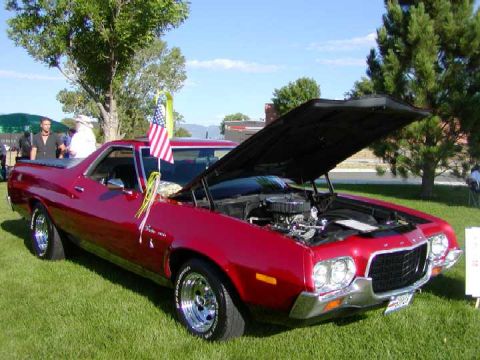
1972 Ford Ranchero/
Photo
supermotors.net/registry/media/1094443
Cylinder Wall Wear vs Engine Operating Temperature Graph - 60-Hour Test Chart

Manual chart plotting cylinder-wall wear in inches against engine operating temperature for a 60-hour test.
This scanned manual page presents a graph titled "Cylinder-Wall Wear vs Operating Temperature, 60-Hour Test." The chart plots cylinder bore wear in inches (from 0.001 to 0.010 in.) on the vertical axis against engine operating temperature in degrees Fahrenheit (40°F to 200°F) on the horizontal axis. The curve shows that cylinder-wall wear is dramatically higher at low operating temperatures, approaching 0.010 in. near 40°F, and drops off steeply as temperature rises, flattening to roughly 0.001 in. or less near 160-200°F. The caption explains that a thermostat does more than provide quick warmup: bore wear increases dramatically at lower engine operating temperatures. The data is credited to Continental Motors. From this document a reader learns why maintaining proper engine operating temperature (via a functioning thermostat) is important for engine longevity, since running an engine cold for extended periods causes far greater cylinder-wall wear than running it at normal operating temperature. The document is generic engine reference material and contains no vehicle-specific year, make, model, or part number information, so it applies broadly rather than to any single vehicle such as the uploader's 1972 Ford Ranchero.
Is this accurate? Sign in to help verify it.
Frequently asked questions
- What does this graph show?
- It shows cylinder-wall wear (in inches) versus engine operating temperature (°F) over a 60-hour test, with wear rising dramatically as operating temperature drops.
- How much does cylinder bore wear increase at low temperatures?
- The curve shows wear approaching about 0.009-0.010 in. near 40°F, compared with roughly 0.001 in. at temperatures near 160-200°F.
- Why is the thermostat important according to this document?
- The caption states the thermostat does more than provide quick warmup, bore wear increases dramatically at lower engine operating temperature.
- Who provided the data for this chart?
- The data is credited to Continental Motors.
- What temperature range is covered in the test?
- The graph covers operating temperatures from 40°F to 200°F.
Comments
More from this build



No comments yet.