Home/
Registry/
Ford/
Mustang/
1964-1973/
“Race Car Tope”/
Photo
supermotors.net/registry/media/1161884
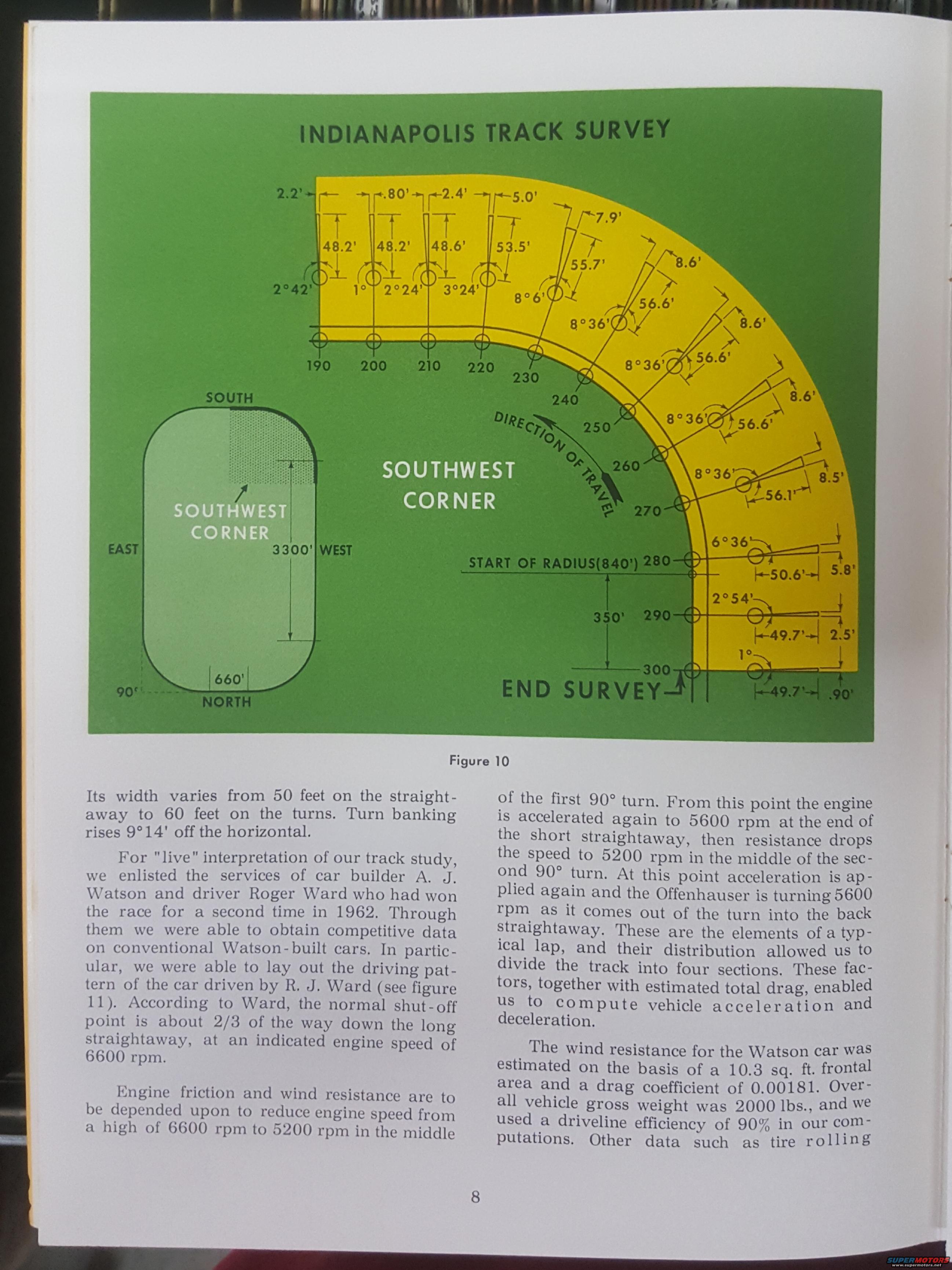
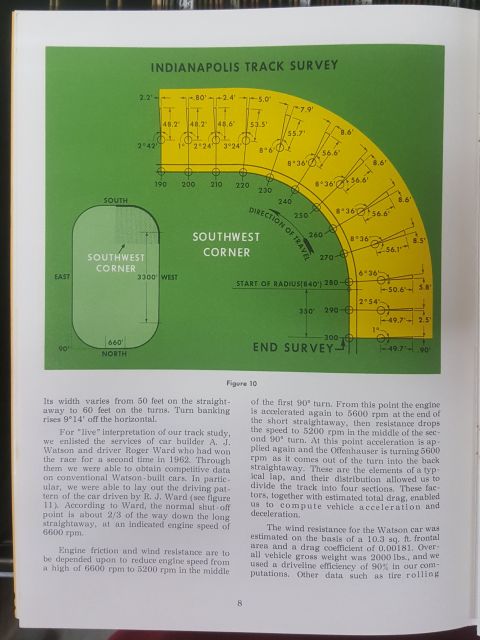
Indianapolis Track Survey Figure 10 - Southwest Corner Banking & Watson Indy Data
Reference · 1964-1973 MustangAll 16 manual pages
Manual/book page featuring an Indianapolis track survey diagram with corner radii and accompanying text on race car drag and speed.
Part of 1964-1973 Ford Mustang Manual Pages
This is page 8 of a printed technical publication describing a survey of the Indianapolis Motor Speedway, headlined 'Indianapolis Track Survey' (Figure 10). The large diagram details the Southwest Corner of the track, with surveyed station numbers (190 through 300), track width dimensions (approximately 48.2' to 56.6'), banking angles (from 1° up to 8°36'), the start of the 840-foot turn radius, and the end-of-survey point, along with a small inset map of the full oval showing 3300' and 660' dimensions. The accompanying text explains that track width varies from 50 feet on the straightaway to 60 feet in the turns with 9°14' banking, and describes how the authors enlisted car builder A. J. Watson and driver Roger Ward (a two-time race winner as of 1962) to establish a typical driving pattern: shut-off at about 2/3 of the long straightaway at 6600 rpm, slowing to 5200 rpm mid-turn, accelerating to 5600 rpm, with the Offenhauser engine at 5600 rpm exiting onto the back straightaway. Computation inputs are given: 10.3 sq. ft. frontal area, 0.00181 drag coefficient, 2000 lbs gross weight, and 90% driveline efficiency, used to compute acceleration and deceleration around the track.
Is this accurate? Sign in to help verify it.
Frequently asked questions
- What are the dimensions and banking of the Indianapolis track according to this survey?
- Track width varies from 50 feet on the straightaway to 60 feet on the turns, and turn banking rises 9°14' off the horizontal. The Southwest Corner diagram shows banking angles ranging from 1° up to 8°36' and a turn radius of 840 feet.
- Who provided the driving data for the track study?
- Car builder A. J. Watson and driver Roger Ward, who had won the race for a second time in 1962, provided competitive data on conventional Watson-built cars.
- What engine speeds were recorded during a typical lap?
- The normal shut-off point is about 2/3 of the way down the long straightaway at an indicated 6600 rpm; speed drops to 5200 rpm in the middle of each 90° turn, and the Offenhauser turns 5600 rpm at the end of the short straightaway and coming out of the second turn onto the back straightaway.
- What specifications were used to estimate the Watson car's wind resistance and performance?
- A 10.3 sq. ft. frontal area, a drag coefficient of 0.00181, overall vehicle gross weight of 2000 lbs., and a driveline efficiency of 90%.
- What is the radius of the Southwest Corner turn shown in Figure 10?
- The diagram marks 'START OF RADIUS (840')' at station 280, indicating an 840-foot turn radius.
No comments yet.