Nissan Micra Crankcase Emission Control (PCV) System - Description & Inspection
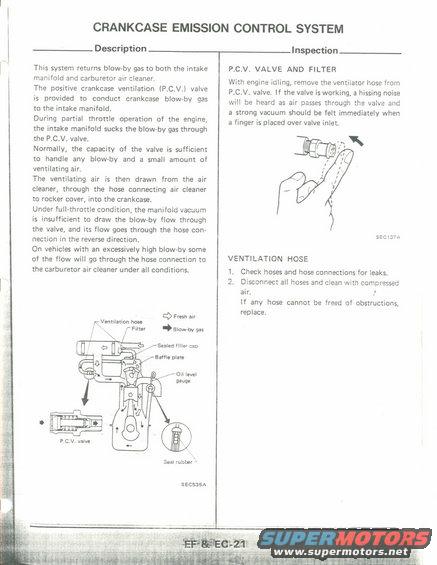
Crankcase emission (PCV) system: blow-by gas routed to intake manifold and air cleaner through the PCV valve; inspection checks for a hissing/vacuum at the valve inlet.
This is page EF & EC-21 from a factory service manual, covering the Crankcase Emission Control System. The Description section explains how the system returns blow-by gas to both the intake manifold and carburetor air cleaner via the positive crankcase ventilation (P.C.V.) valve. It describes flow behavior during partial throttle (blow-by drawn through the P.C.V. valve to the intake manifold), full throttle (manifold vacuum insufficient, flow reverses through the hose connection), and high blow-by conditions (some flow goes to the carburetor air cleaner at all times). A schematic diagram (SEC535A) illustrates fresh air and blow-by gas flow paths, labeling the ventilation hose, filter, sealed filler cap, baffle plate, oil level gauge, P.C.V. valve, and seal rubber. The Inspection section gives two procedures: (1) P.C.V. valve and filter test, with the engine idling, remove the ventilator hose from the P.C.V. valve; a hissing noise and strong vacuum on a finger placed over the valve inlet indicate a working valve (illustration SEC137A); and (2) ventilation hose inspection, check hoses and connections for leaks, disconnect and clean with compressed air, and replace any hose that cannot be freed of obstructions.
Is this accurate? Sign in to help verify it.
Frequently asked questions
- How do I test the P.C.V. valve?
- With the engine idling, remove the ventilator hose from the P.C.V. valve. If the valve is working, a hissing noise will be heard as air passes through the valve, and a strong vacuum should be felt immediately when a finger is placed over the valve inlet.
- How should the crankcase ventilation hoses be inspected?
- Check hoses and hose connections for leaks, then disconnect all hoses and clean them with compressed air. If any hose cannot be freed of obstructions, replace it.
- What does the crankcase emission control system do?
- It returns blow-by gas to both the intake manifold and the carburetor air cleaner. The P.C.V. valve conducts crankcase blow-by gas to the intake manifold.
- What happens to blow-by flow at full throttle?
- Under full-throttle conditions, manifold vacuum is insufficient to draw the blow-by flow through the P.C.V. valve, so the flow goes through the hose connection in the reverse direction.
- What components are shown in the PCV system diagram?
- The diagram shows the ventilation hose, filter, sealed filler cap, baffle plate, oil level gauge, P.C.V. valve, and seal rubber, with arrows indicating fresh air and blow-by gas flow.
Comments
More from this build
No comments yet.