Nissan Micra EGR System Description & Vacuum Diagram - Carbureted Engine (EF & EC-24)
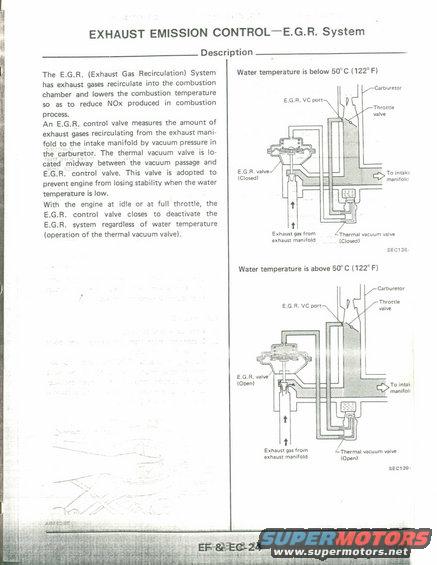
EGR system description with two vacuum-routing diagrams showing thermal vacuum valve closed below 50C (122F) and open above 50C controlling the EGR control valve.
This is a page (EF & EC-24) from a factory service manual's Emission Control section, describing the E.G.R. (Exhaust Gas Recirculation) System on a carbureted engine. The text explains that the EGR system recirculates exhaust gases into the combustion chamber to lower combustion temperature and reduce NOx emissions. An EGR control valve meters exhaust gas flow from the exhaust manifold to the intake manifold using carburetor vacuum (via the E.G.R. VC port), and a thermal vacuum valve located between the vacuum passage and the EGR control valve keeps the system deactivated when engine coolant is cold to prevent poor engine stability. At idle or full throttle, the EGR control valve closes regardless of water temperature. Two schematic diagrams illustrate system operation: one with water temperature below 50°C (122°F), showing the EGR valve and thermal vacuum valve both closed, and one above 50°C (122°F), showing both open and exhaust gas flowing to the intake manifold. Callouts identify the carburetor, throttle valve, E.G.R. VC port, EGR valve, thermal vacuum valve, and exhaust/intake gas paths. Figure references SEC138 and SEC139 appear beside the diagrams. A reader learns how and when the EGR system activates on this carbureted application.
Is this accurate? Sign in to help verify it.
Frequently asked questions
- At what coolant temperature does the EGR system become active?
- According to the diagrams, when water temperature is below 50°C (122°F) the EGR valve and thermal vacuum valve are closed; above 50°C (122°F) both are open and exhaust gas recirculates to the intake manifold.
- What does the EGR system do?
- It recirculates exhaust gases into the combustion chamber to lower combustion temperature and reduce NOx produced in the combustion process.
- What is the purpose of the thermal vacuum valve in the EGR system?
- It is located midway between the vacuum passage and the EGR control valve and prevents the engine from losing stability when the water temperature is low, by keeping the EGR system deactivated until the engine warms up.
- Does the EGR valve operate at idle or full throttle?
- No. With the engine at idle or at full throttle, the EGR control valve closes to deactivate the EGR system regardless of water temperature.
- What controls the EGR valve on this engine?
- The EGR control valve is operated by vacuum pressure taken from the carburetor (via the E.G.R. VC port near the throttle valve).
Comments
More from this build


No comments yet.