Nissan Automatic Transmission Low & Reverse Brake Inspection - Exploded Diagram
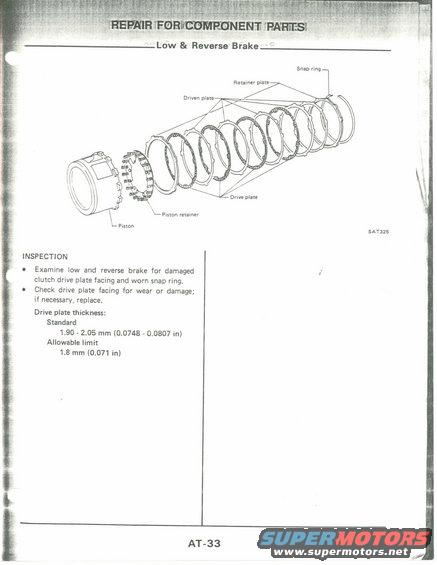
Service manual page AT-33 with an exploded low and reverse brake assembly and inspection notes.
This page (AT-33) from a service manual's 'Repair for Component Parts' section covers the Low & Reverse Brake assembly of an automatic transmission. It features an exploded-view diagram (figure SAT325) identifying the components of the low and reverse brake in assembly order: piston, piston retainer, alternating drive plates and driven plates, retainer plate, and snap ring. The inspection procedure instructs the technician to examine the low and reverse brake for damaged clutch drive plate facing and a worn snap ring, and to check drive plate facing for wear or damage, replacing parts if necessary. Key specifications given are drive plate thickness: standard 1.90 - 2.05 mm (0.0748 - 0.0807 in), with an allowable (wear) limit of 1.8 mm (0.071 in). A reader can learn the component layout of the brake pack, which parts to inspect during transmission overhaul, and the measurable criterion for deciding whether drive plates must be replaced. The page contains no vehicle year, model, or engine identification, though the styling and 'SAT' figure code are consistent with a Nissan service manual automatic transmission (AT) section.
Is this accurate? Sign in to help verify it.
Frequently asked questions
- What is the standard drive plate thickness for the low and reverse brake?
- Standard thickness is 1.90 - 2.05 mm (0.0748 - 0.0807 in).
- What is the wear (allowable) limit for the low and reverse brake drive plates?
- The allowable limit is 1.8 mm (0.071 in); check the drive plate facing for wear or damage and replace if necessary.
- What components make up the low and reverse brake assembly?
- The exploded diagram shows the piston, piston retainer, alternating drive plates and driven plates, retainer plate, and snap ring.
- What should be inspected on the low and reverse brake?
- Examine it for damaged clutch drive plate facing and a worn snap ring, and check the drive plate facing for wear or damage.
Comments
More from this build

No comments yet.