Home/
Registry/
Nissan/
Micra/
1983-1992/
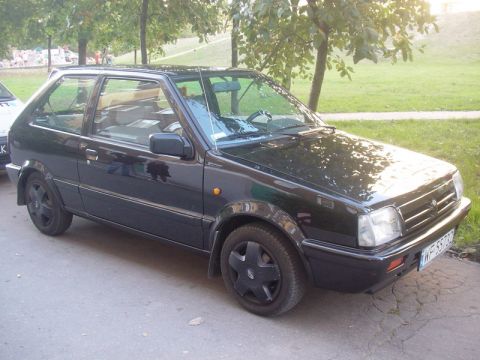
1990 Nissan Micra/
Photo
supermotors.net/registry/media/253020
Nissan Micra Rear Suspension Exploded Diagram - Torque Specs & Parts (RA-5)

Exploded parts diagram of rear suspension showing coil spring, shock absorber, upper and lower links, bushings and torque values.
Part of 1983-1992 Nissan Micra Exploded Parts Diagrams
This scanned service manual page covers the rear suspension of a Nissan vehicle (section code RA-5). It presents an exploded parts diagram of the rear strut/shock absorber assembly and links, identifying components such as the coil spring, shock absorber, mounting cover, lock nut, washers, rubber bushings A and B, spring rubber seat, bumper seat, bumper rubber, bound bumper cover, and the upper and lower links. Tightening torque specifications are given in N·m (kg-m, ft-lb): upper and lower link fasteners at 77-98 N·m (7.9-10.0 kg-m, 57-72 ft-lb), the shock absorber lower mounting at 48-60 N·m (4.9-6.1 kg-m, 35-44 ft-lb), and the piston rod lock nut at 19-25 N·m (1.9-2.6 kg-m, 14-19 ft-lb). Notes state that final tightening must be carried out at curb weight with tires on the ground, and that oil or grease must not contact rubber parts (marked with an asterisk). Caution items warn against damaging or bending the piston rod during operation and instruct that the spring rubber seat be fitted correctly on the wheel house bracket, illustrated with a second figure showing upper/lower orientation of the spring rubber seat. Figure reference codes SRA440 and SRA419 appear on the page.
Is this accurate? Sign in to help verify it.
Frequently asked questions
- What is the torque spec for the rear upper and lower link bolts?
- 77 - 98 N·m (7.9 - 10.0 kg-m, 57 - 72 ft-lb).
- What is the torque for the shock absorber lower mounting bolt?
- 48 - 60 N·m (4.9 - 6.1 kg-m, 35 - 44 ft-lb).
- What is the torque for the shock absorber piston rod lock nut?
- 19 - 25 N·m (1.9 - 2.6 kg-m, 14 - 19 ft-lb).
- When should final tightening of the rear suspension fasteners be done?
- Final tightening needs to be carried out at curb weight with the tires on the ground.
- What precautions does this page give for rear suspension work?
- Do not allow oil or grease to contact rubber parts (marked *), be careful not to damage or bend the piston rod during operation, and correctly fit the spring rubber seat on the bracket of the wheel house.
Comments
More from this build
No comments yet.