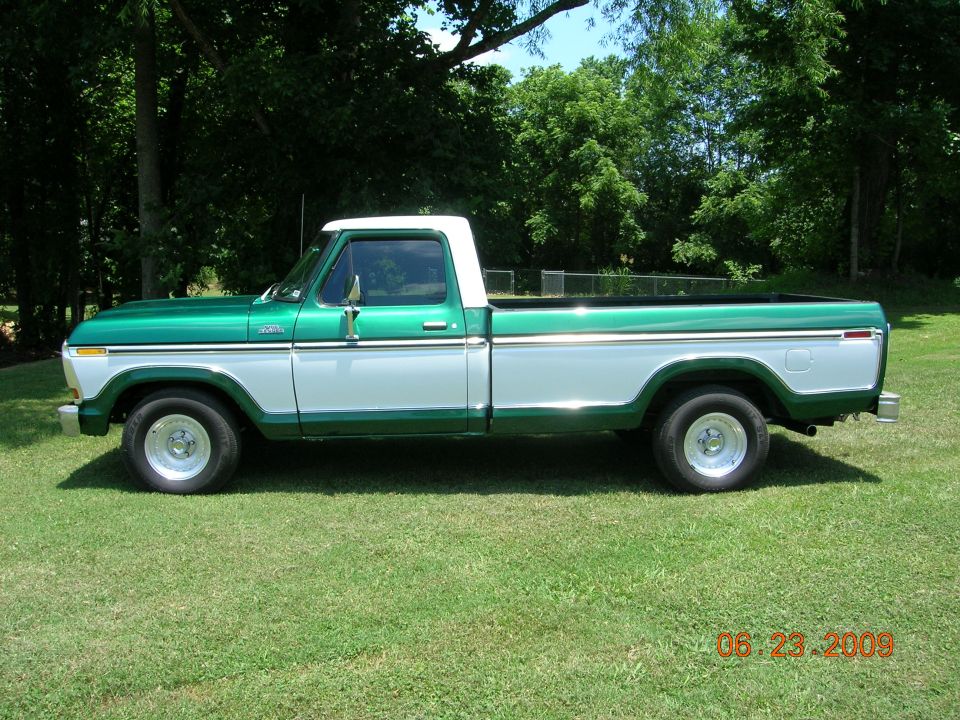
The 1973-1979 Ford F-100 was the sixth generation of Ford's F-Series, nicknamed the "Dentside" for the horizontal crease pressed into its body sides. This Ford F-100 used the 240-cubic-inch and 300-cubic-inch inline-sixes as base engines, the 302-cubic-inch Windsor small-block V8, and larger V8s including the 360 and 390, plus the 460-cubic-inch big-block that was optional on two-wheel-drive trucks for 1974. All horsepower in this generation was reported in SAE net figures, the standard since the 1972 model year, so the numbers read lower than the earlier gross ratings. The defining event of the period was the 1975 arrival of the F-150 above the F-100. Ford introduced the F-150 as a heavier half-ton with a gross vehicle weight rating set just above 6,000 pounds, which placed it in the heavy-duty emissions class and exempted it from the 1975 catalytic converter and unleaded-fuel rule that applied to the lighter F-100. From 1975 the F-100 and F-150 were sold side by side, with the F-150 gradually taking over half-ton sales. The 1973-1979 Ford F-100 used Twin-I-Beam front suspension on two-wheel-drive trucks and a solid front axle on four-wheel drive.
Other Ford F-100 generations
Ford F-100 1973-1979 at a glance
- Generation: Sixth-generation Ford F-Series, the "Dentside," named for the horizontal crease in the body sides.
- Sixes: 240-cubic-inch and 300-cubic-inch inline-sixes.
- V8 options: 302-cubic-inch Windsor; 360 and 390 FE V8s (through 1976); 351M and 400 of the 335 ("Modified") family (from 1977); 460-cubic-inch big-block (1974 only, 2WD).
- Horsepower basis: SAE net figures (1972 onward), lower than the earlier gross ratings.
- F-150 arrives: the F-150 was added above the F-100 for 1975 as a heavier half-ton, set just over 6,000 lb GVWR to skip the catalytic converter.
- Front suspension: Twin-I-Beam independent front on two-wheel-drive trucks; solid front axle on four-wheel drive.
- Body styles: regular cab and extended SuperCab; Styleside and Flareside beds.
- Generation end: 1979 was the final year before the 1980 "Bullnose" seventh generation.
Year-by-year changes
| Model year | Standard six | V8 options | Key changes |
|---|---|---|---|
| 1973 Ford F-100 | 240 cu in six (300 cu in optional) | 302, 360, 390 | Sixth-generation "Dentside" redesign; engines carried net horsepower ratings. The 460 big-block was offered on the F-250 and F-350, not yet the F-100. |
| 1974 Ford F-100 | 240 cu in six (300 cu in optional) | 302, 360, 390; 460 (2WD) | The extended SuperCab body was introduced for the F-Series in 1974. Final year for the 240 six. The 460 big-block became optional on two-wheel-drive trucks this year, its only year in the F-100. |
| 1975 Ford F-100 | 300 cu in six | 302, 360, 390 | The F-150 was added above the F-100 as a heavier half-ton. The 1975 F-100, as the lighter half-ton, received a catalytic converter and unleaded-fuel requirement that the F-150 avoided. The 300 became the standard six after the 240 was dropped. |
| 1976 Ford F-100 | 300 cu in six | 302, 360, 390 | Final year for the 360 and 390 FE V8s in the light-duty trucks. |
| 1977 Ford F-100 | 300 cu in six | 302, 351M, 400 | The 360 and 390 FE V8s were dropped; the 351M and 400 V8s of the 335 ("Modified") family replaced them. The F-Series became the best-selling truck line in the United States in 1977. |
| 1978 Ford F-100 | 300 cu in six | 302, 351M, 400 | Rectangular headlamps appeared on higher trims while the base Custom kept round lamps. Trim updates across the range. |
| 1979 Ford F-100 | 300 cu in six | 302, 351M, 400 | Final year of the "Dentside" sixth generation; rectangular headlamps were used across the range. The 1980 "Bullnose" seventh generation followed. |
The "Dentside" redesign and the F-150 arriving for 1975
The 1973 Ford F-100 introduced the sixth-generation F-Series, nicknamed the "Dentside" for the horizontal crease pressed into the body sides. The defining change of the generation came for 1975, when Ford added the F-150 above the F-100. The F-150 was a heavier half-ton with a gross vehicle weight rating set just above 6,000 pounds, which placed it in the heavy-duty emissions class and exempted it from the 1975 catalytic converter and unleaded-fuel requirement that applied to lighter vehicles. The 1975 Ford F-100, as the lighter half-ton, did receive a catalytic converter. From 1975 the F-100 and F-150 were sold side by side as Ford's two half-tons, and the F-150 gradually took over half-ton volume in the years that followed.
Engines of the 1973-1979 Ford F-100
The base engines of the 1973-1979 Ford F-100 were the 240-cubic-inch and 300-cubic-inch inline-sixes, with the 240 dropped after the 1974 model year and the 300 continuing as the standard six from 1975. The 302-cubic-inch Windsor V8 was the entry V8 across the run. The larger V8 menu changed mid-generation: through 1976 the F-100 offered the FE-family 360 and 390 V8s, and for 1977 Ford replaced those with the 351M and 400 V8s of the 335 ("Modified") engine family. The 460-cubic-inch big-block of the 385-engine family reached the two-wheel-drive F-100 only for 1974; in other years Ford reserved it for the heavier F-Series models. All of these figures were reported in SAE net horsepower, the standard since 1972; for example, the 300-cubic-inch six produced roughly 115 to 120 net horsepower depending on year and configuration.
Drivetrain, axles, and four-wheel drive
The 1973-1979 Ford F-100 used a body-on-frame layout with a leaf-sprung live rear axle. Two-wheel-drive trucks used the Twin-I-Beam independent front suspension, while four-wheel-drive trucks used a solid front axle. Transmissions included three-speed and four-speed manuals plus an automatic. The extended SuperCab body, which the F-Series introduced for 1974, was available on the Ford F-100, in addition to the regular cab. Bed choices were the smooth-sided Styleside and the fendered Flareside.
Trims and body styles
The 1973-1979 Ford F-100 was sold in trim levels that ranged from the base Custom up through the Ranger and Ranger XLT, with the higher trims adding carpeting and upgraded interior materials. For 1978 the higher Ford F-100 trims switched to rectangular headlamps while the Custom kept round lamps, and for 1979 the rectangular lamps were used across the range. Throughout this generation the F-100 was the lighter of Ford's two half-tons, positioned below the F-150 from 1975 onward.
Frequently asked questions
What is the "Dentside" Ford F-100?
"Dentside" is the collector nickname for the 1973-1979 sixth-generation Ford F-Series, named for the horizontal crease pressed into the body sides. The Ford F-100 versions of this body run from the 1973 redesign through the 1979 model year.
When was the F-150 added above the F-100?
Ford added the F-150 above the F-100 for the 1975 model year as a heavier half-ton. Ford set the F-150 gross vehicle weight rating just above 6,000 pounds so it fell in the heavy-duty emissions class and avoided the 1975 catalytic converter requirement that applied to the lighter F-100.
What engines did the 1973-1979 Ford F-100 use?
The 1973-1979 Ford F-100 used the 240 inline-six (through 1974) and the 300 inline-six, plus the 302 Windsor V8, the 360 and 390 FE V8s through 1976, the 351M and 400 V8s from 1977, and the 460 big-block on two-wheel-drive trucks for 1974. All figures were SAE net horsepower.
Were the 1973-1979 Ford F-100 horsepower figures gross or net?
Net. From the 1972 model year onward the industry reported SAE net horsepower, so all 1973-1979 Ford F-100 figures are net, which read lower than the gross figures used through 1971.
Did the 1973-1979 Ford F-100 have Twin-I-Beam suspension?
Two-wheel-drive 1973-1979 Ford F-100 trucks used the Twin-I-Beam independent front suspension. Four-wheel-drive F-100 trucks used a solid front axle.
Sources
Asked all the time
What is the "Dentside" Ford F-100?
"Dentside" is the collector nickname for the 1973-1979 sixth-generation Ford F-Series, named for the horizontal crease pressed into the body sides. The Ford F-100 versions of this body run from the 1973 redesign through the 1979 model year.
When was the F-150 added above the F-100?
Ford added the F-150 above the F-100 for the 1975 model year as a heavier half-ton. Ford set the F-150 gross vehicle weight rating just above 6,000 pounds so it fell in the heavy-duty emissions class and avoided the 1975 catalytic converter requirement that applied to the lighter F-100.
What engines did the 1973-1979 Ford F-100 use?
The 1973-1979 Ford F-100 used the 240 inline-six (through 1974) and the 300 inline-six, plus the 302 Windsor V8, the 360 and 390 FE V8s through 1976, the 351M and 400 V8s from 1977, and the 460 big-block on two-wheel-drive trucks for 1974. All figures were SAE net horsepower.
Were the 1973-1979 Ford F-100 horsepower figures gross or net?
Net. From the 1972 model year onward the industry reported SAE net horsepower, so all 1973-1979 Ford F-100 figures are net, which read lower than the gross figures used through 1971.
Did the 1973-1979 Ford F-100 have Twin-I-Beam suspension?
Two-wheel-drive 1973-1979 Ford F-100 trucks used the Twin-I-Beam independent front suspension. Four-wheel-drive F-100 trucks used a solid front axle.
Technical Reference
Member-uploaded diagrams & documents for this generation. AI-classified; community-verified where badged.
Brochures & Literature (3)
- Brochure panel with specifications for the Sea Horse and Surf Sailer sail boards and an introduction to the canoe.
- Skyjacker catalog page of '66-'79 early Ford lift kits from 2" to 9", with 179PKS system, radius arm brackets, steering arms and fitment chart.
- M/T Power-Ram manifold ad for the Ford 332-427 and Chevy 283-327, with 8 to 11 inch ram tubes and dual-quad carburetor mounting.
Schematics (2)
- Ford F-100 Body Mount Cross-Section Diagram - Punch, Bushing & Bolt LayoutThis document is a single cross-section schematic illustration, apparently one page from a multi-page instruction set. The diagram shows a vertical punch tool passing down through a vehicle's body panel and frame…
- Hand-Drawn Dash Gauge Panel Sketch (Front & Back Views) - 1974 Ford F-100This document is a simple hand-drawn schematic sketch, not a text-based reference. It shows two views of what appears to be a dashboard or instrument panel section. The view labeled "Front" shows the face of the panel…
Data/Spec Plates (2)
- Ford Parts Shipping Label 1982 - Part No. C6DZ 6675A, Carrollton TX DepotThis is a scan of a vintage Ford Motor Company parts shipping/carton label (Ford form FPS-7084M, form dated Sept. 80). The label documents a parts shipment dated 7-16-82 for Ford part number C6DZ 6675A. The shipment…
- Ford 428 Cobra Jet Engine ID Tag C9ZE 6009 C - 428 CJ Block PhotoThis is a photograph (not a paper document) showing a stamped metal engine identification tag attached to a bare cast-iron engine block sitting in a cardboard shipping box with plastic wrapping. The small…
Service Procedures (1)
- Toyota Tundra Fog Light Harness Wiring - Pin 3/4 Connections, No Alarm (Fig 10)This document is an annotated installation photograph (labeled 'Figure 10 - No Alarm') from TundraPart.com showing how to connect a pre-wired plug-and-play fog light harness inside a Toyota Tundra dash/kick-panel area…
Manual Pages (1)
The wall · registered 1973-1979 F-100s
Sorted by depth of documentation. Click any vehicle to open its permanent record.