Home/
Registry/
Ford/
Bronco/
1978-1979/
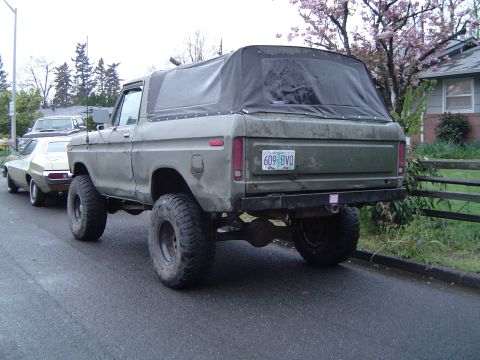
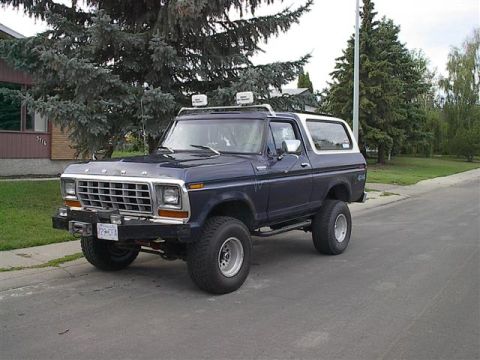
1979 Ford Bronco/
Photo
supermotors.net/registry/media/1032622
1979 Ford Bronco/F100-F350 Electrical Troubleshooting Tools - Test Light Guide

Ford troubleshooting manual page explaining electrical test tools - unpowered test light, self-powered test light, and jumper wire - with how-to steps for checking power and continuity.
This page, titled "Tools for Electrical System Trouble-Shooting," is from a multi-page reference set filed for a 1979 Ford Bronco (covering Bronco and F100 through F350 trucks). It explains three basic diagnostic tools and how to use them. First, the unpowered 12-volt test light: how to check for power at wires and connectors, a step-by-step procedure (steps a-d) for investigating a blown fuse condition, and how to locate a wiring short to ground by disconnecting connectors (C-1, C-2, C-3) one at a time, illustrated with a simple circuit diagram showing a fuse holder, battery, and test light. Second, the self-powered test light: a caution to disconnect the negative battery cable first, then instructions for checking circuit continuity, switch continuity, and grounds. Third, the jumper wire: how to make one from 16-gauge automotive primary wire with alligator clips, how to use it to check a switch circuit, and a caution never to bypass a high-resistance load such as a lamp or motor, which would create a direct short circuit and could cause injury, fire, or vehicle damage. The page includes photos of each tool in use with captions. A reader learns fundamental DC electrical troubleshooting technique applicable to the vehicle's fuse, ground, and switch circuits.
Is this accurate? Sign in to help verify it.
Frequently asked questions
- How do I check for power with an unpowered test light?
- Connect one test lead to a good ground or the NEGATIVE battery terminal, then use the other lead to check wires, connectors, or components. When the light comes on, there is power at that location.
- How do I investigate a blown fuse condition?
- Turn off all equipment powered through the fuse, disconnect unswitched components (unplug motor connectors, remove light bulbs), turn the ignition to RUN if needed, then connect a test lead to the hot end of the blown fuse and the other to ground. If the light glows, power reaches the fuse; move the grounded lead to the other end of the fuse, OFF indicates a short in a component, ON indicates a short to ground in the wiring.
- What precaution must I take before using a self-powered test light?
- CAUTION: Disconnect the NEGATIVE battery cable from the battery before using the self-powered test light.
- How do I make my own jumper wire?
- Attach alligator clips to each end of a length of heavy wire, such as 16 gauge automotive primary wire, so extra resistance isn't placed into the circuit. For momentary jumping, insert a small nail into one of the clips as a probe.
- Why shouldn't a jumper wire be used to bypass a lamp or motor?
- Bypassing a high-resistance load connected between the hot circuit and ground creates a direct short circuit and may cause personal injury, fire, or other damage to the vehicle.
Comments
More from this build
No comments yet.