Home/
Registry/
Ford/
Taurus/
1996-1999/
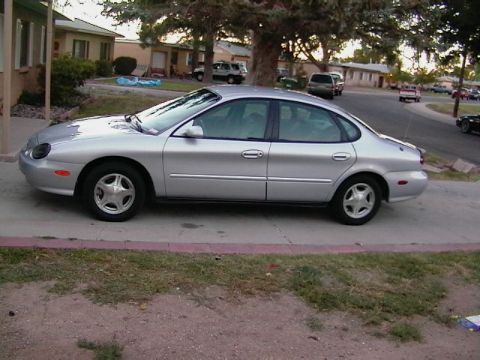
1997 Ford Taurus/
Photo
supermotors.net/registry/media/468188
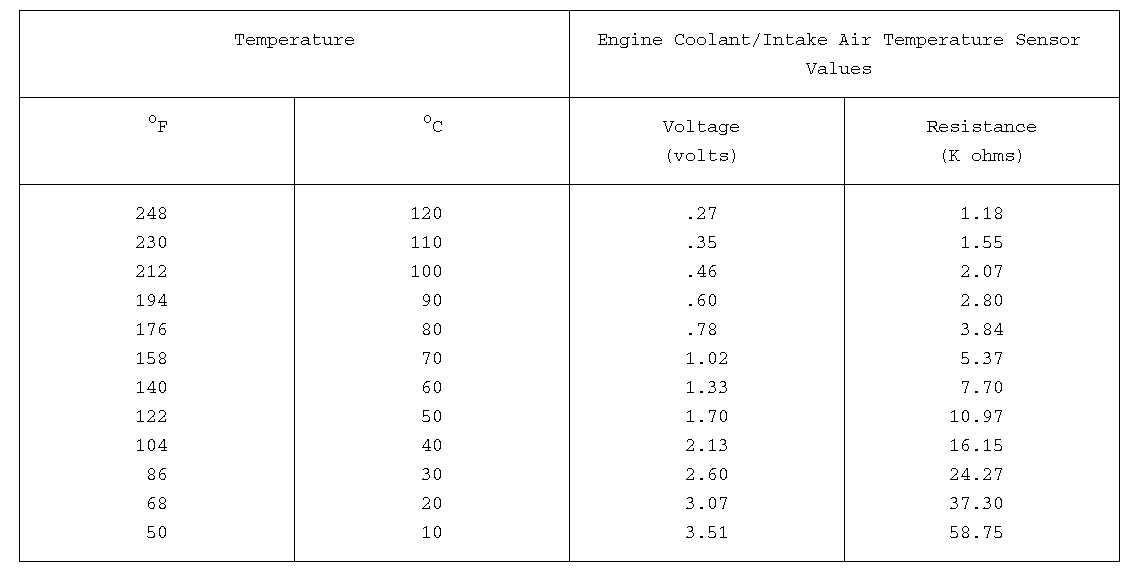
Ford ECT/IAT Sensor Voltage & Resistance Chart - Temperature Values Table
Reference · 1996-1999 TaurusAll 20 manual pages
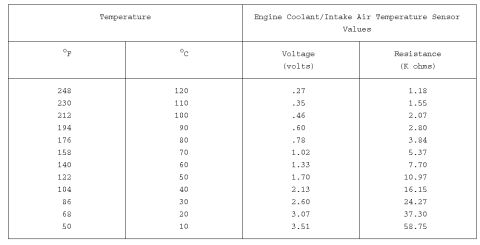
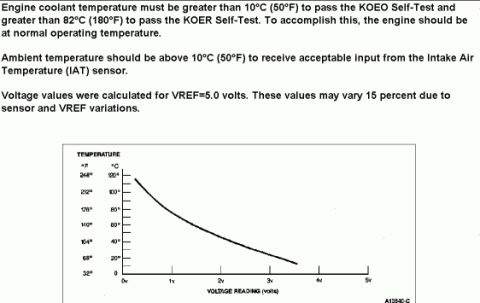

Sensor specification table listing engine coolant/intake air temperature sensor voltage and resistance values across a range of temperatures.
Part of 1996-1999 Ford Taurus Manual Pages
This document is a reference table listing expected Engine Coolant Temperature (ECT) and Intake Air Temperature (IAT) sensor values across a range of temperatures. The left side gives temperature in both Fahrenheit (248°F down to 50°F) and Celsius (120°C down to 10°C) in 10°C increments. The right side lists the corresponding sensor signal voltage (in volts) and sensor resistance (in kilo-ohms). Values range from 0.27 V and 1.18 K ohms at 248°F/120°C (fully hot) to 3.51 V and 58.75 K ohms at 50°F/10°C (cool). The table demonstrates the negative temperature coefficient behavior of the sensor: as temperature rises, resistance and voltage drop. A technician can use this chart to diagnose an ECT or IAT sensor by measuring its resistance with an ohmmeter or the signal voltage with the sensor connected, then comparing the reading against the value expected for the current engine or intake air temperature. Readings that deviate significantly from the chart indicate a faulty sensor, wiring problem, or reference-voltage issue. The document itself carries no year, model, or part-number information; it was uploaded as part of a set of 1996-1997 Ford Taurus diagnostic documents.
Is this accurate? Sign in to help verify it.
Frequently asked questions
- What resistance should the ECT/IAT sensor read at normal operating temperature (around 194°F / 90°C)?
- At 194°F (90°C) the chart lists 0.60 volts and 2.80 K ohms.
- What voltage should the coolant temperature sensor show on a cold engine at 68°F (20°C)?
- At 68°F (20°C) the expected signal voltage is 3.07 volts, with a resistance of 37.30 K ohms.
- Does the sensor's resistance increase or decrease as temperature rises?
- Resistance decreases as temperature rises, from 58.75 K ohms at 50°F (10°C) down to 1.18 K ohms at 248°F (120°C). Voltage decreases similarly, from 3.51 V to 0.27 V.
- Do the same values apply to both the coolant and intake air temperature sensors?
- Yes, the table is titled 'Engine Coolant/Intake Air Temperature Sensor Values,' covering both sensors with one set of values.
- What temperature range does the chart cover?
- It covers 50°F to 248°F (10°C to 120°C) in 10°C steps.





No comments yet.