Bosch Gasoline Engine Management: SI Engine Torque & Primary Functions (Page 1)

Reference · 1992-1995 TaurusAll 37 manual pages
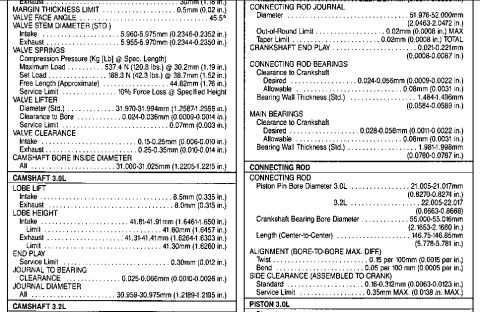
Bosch reference page on spark-ignition engine management: net flywheel torque factors, primary engine-management functions, cylinder-charge control with ETC, and mixture formation.
Part of 1992-1995 Ford Taurus Manual Pages
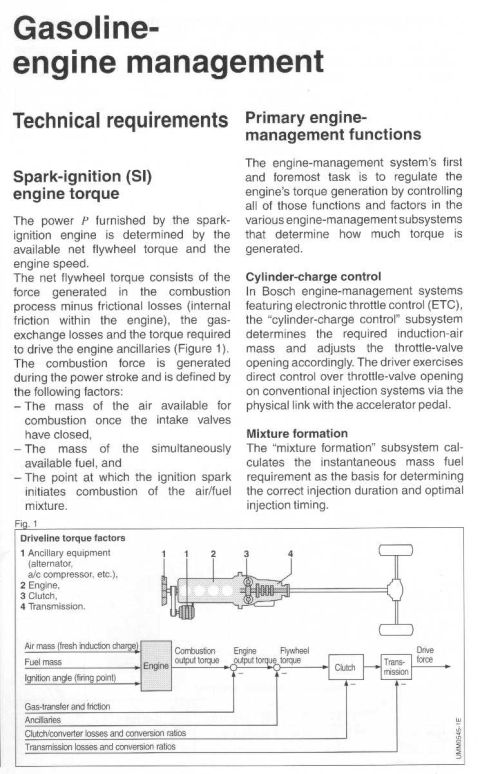
This is a scanned page from a Bosch gasoline-engine management reference (likely a Bosch technical handbook). It opens the chapter "Gasoline-engine management" with two sections. "Technical requirements, Spark-ignition (SI) engine torque" explains that engine power is determined by net flywheel torque and engine speed, and that net flywheel torque equals combustion force minus internal friction, gas-exchange losses, and torque consumed by engine ancillaries. Combustion force depends on three factors: air mass trapped after intake-valve closure, the simultaneously available fuel mass, and ignition timing. "Primary engine-management functions" describes the system's core task of regulating torque generation, then covers two subsystems: cylinder-charge control (in Bosch systems with electronic throttle control, ETC, the subsystem sets required induction-air mass and throttle opening; on conventional injection systems the driver controls the throttle directly via the accelerator pedal) and mixture formation (calculating instantaneous mass fuel requirement to set injection duration and timing). Figure 1, "Driveline torque factors," diagrams the torque path from engine inputs (air mass, fuel mass, ignition angle) through combustion output torque, subtracting gas-transfer/friction and ancillary losses to give flywheel torque, then through clutch and transmission losses/conversion ratios to final drive force. Legend items: 1 ancillary equipment (alternator, A/C compressor), 2 engine, 3 clutch, 4 transmission.
Is this accurate? Sign in to help verify it.
Frequently asked questions
- What determines the power output of a spark-ignition engine?
- The power P furnished by the spark-ignition engine is determined by the available net flywheel torque and the engine speed.
- What losses reduce combustion force to net flywheel torque?
- Frictional losses (internal friction within the engine), gas-exchange losses, and the torque required to drive the engine ancillaries such as the alternator and A/C compressor.
- What three factors define the combustion force generated during the power stroke?
- The mass of air available for combustion once the intake valves have closed, the mass of simultaneously available fuel, and the point at which the ignition spark initiates combustion of the air/fuel mixture.
- How does cylinder-charge control work in Bosch systems with electronic throttle control (ETC)?
- The cylinder-charge control subsystem determines the required induction-air mass and adjusts the throttle-valve opening accordingly. On conventional injection systems, the driver controls throttle-valve opening directly via the physical link with the accelerator pedal.
- What does the mixture formation subsystem do?
- It calculates the instantaneous mass fuel requirement as the basis for determining the correct injection duration and optimal injection timing.


No comments yet.