Home/
Registry/
Ford/
Taurus/
1992-1995/
1993 Ford Taurus/
Photo
supermotors.net/registry/media/643790
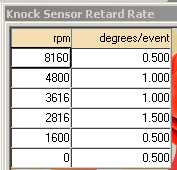
Ford B9B1 Calibration Knock Sensor Retard Rate Table (RPM vs Degrees/Event)
Reference · 1992-1995 TaurusAll 4 torque specs
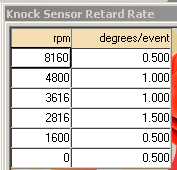
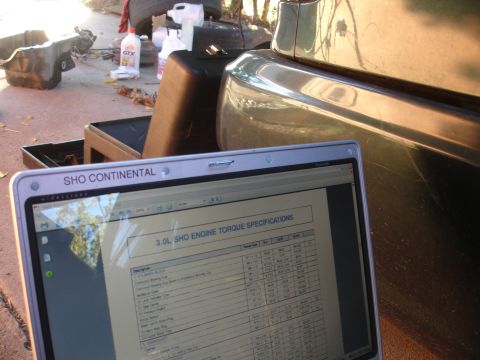
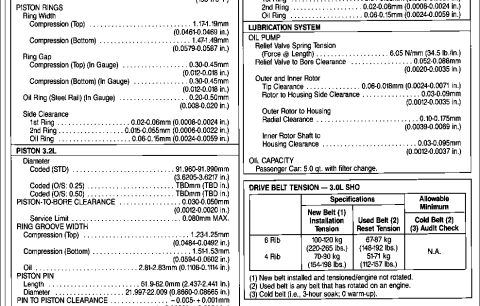
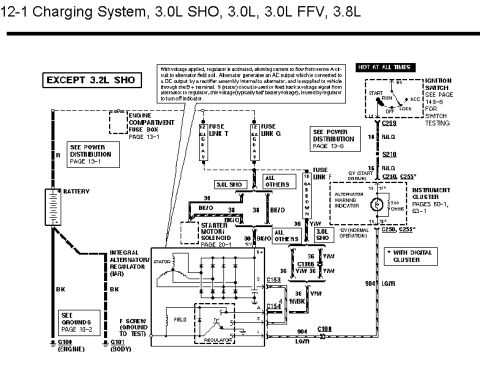
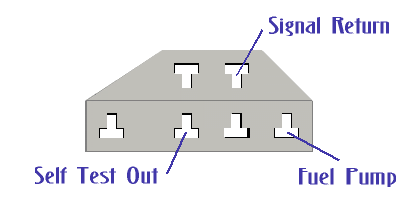
Calibration table titled Knock Sensor Retard Rate listing rpm against degrees per event.
Part of 1992-1995 Ford Taurus Torque Specs
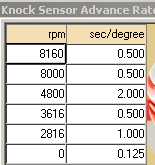
This document is a screenshot of a calibration table titled 'Knock Sensor Retard Rate,' apparently taken from engine tuning/calibration software. The table maps engine speed (rpm) to the ignition timing retard rate applied per knock event (degrees/event). Six rows of data are shown: at 8160 rpm the retard rate is 0.500 degrees per event; at 4800 rpm it is 1.000; at 3616 rpm it is 1.000; at 2816 rpm it is 1.500; at 1600 rpm it is 0.500; and at 0 rpm it is 0.500. From this a reader can learn how aggressively the PCM pulls ignition timing in response to detected knock across the rpm range, most aggressively (1.5 degrees per knock event) around 2816 rpm, and least aggressively (0.5 degrees per event) at very low rpm and near redline. The upload filename references calibration 'B9B1,' and a companion file in the same album covers the corresponding knock sensor advance (timing recovery) rate. The album context associates this with a 1993 Ford Taurus, likely the SHO given other album contents, though the image itself states no vehicle, year, or calibration ID.
Is this accurate? Sign in to help verify it.
Frequently asked questions
- What is the knock sensor retard rate at 2816 rpm in this table?
- 1.500 degrees per knock event, the highest retard rate shown in the table.
- How much timing is retarded per knock event at high rpm (8160)?
- 0.500 degrees per event at 8160 rpm.
- What retard rate applies at idle/low rpm?
- At 0 rpm and 1600 rpm the table shows 0.500 degrees per event.
- What rpm breakpoints are used in this knock retard table?
- 8160, 4800, 3616, 2816, 1600, and 0 rpm.
No comments yet.