Home/
Registry/
Ford/
F-150/
1975-1979/
1979 Ford F-150/
Photo
supermotors.net/registry/media/516745
Ford 406 Budget Street Engine Build - 382 HP, Comp Cams 268 Specs (Hot Rod)
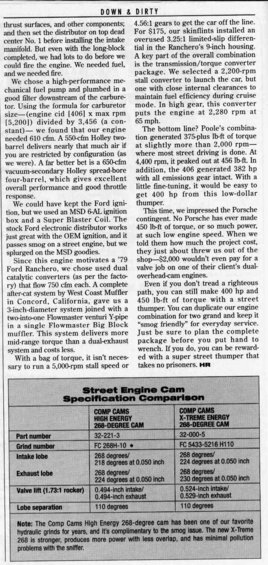
Engine-build page calculating carburetor cfm (406 cid x 5,200 rpm / 3,456 = 610 cfm), choosing a 550 cfm Holley two-barrel, an MSD 6AL box and Blaster coil, and dual 750-cfm catalytic converters for a 1979 Ford Ranchero.
This is a page from a magazine article ("Down & Dirty", credited HR/Hot Rod) covering a budget Ford 406-cubic-inch street engine build installed in a 1979 Ford Ranchero. The text describes final assembly and support systems: setting the distributor at TDC No. 1 before installing the intake, choosing a high-performance mechanical fuel pump, and sizing the carburetor using the formula (cid x max rpm) / 3,456, which yielded a 610-cfm requirement (a 550-cfm Holley two-barrel was used; a 650-cfm vacuum-secondary spread-bore is recommended). Ignition was upgraded to an MSD 6-AL box and Super Blaster Coil. The exhaust used dual catalytic converters, a 3-inch West Coast Muffler system with a Flowmaster Y-pipe and Big Block muffler. Drivetrain choices included a 3.25:1 limited-slip in a 9-inch housing and a 2,200-rpm stall converter (2,280 rpm at 65 mph). Results: 375+ lb-ft at just over 2,000 rpm, a 456 lb-ft peak at 4,400 rpm, and 382 hp with full emissions equipment, for about $2,000. A table compares Comp Cams High Energy 268 and X-Treme Energy 268 camshaft specs, including part numbers, grind numbers, duration, valve lift, and lobe separation.
Is this accurate? Sign in to help verify it.
Frequently asked questions
- How much horsepower and torque did the Ford 406 build make?
- The 406 generated 382 hp with all emissions gear intact, made 375-plus lb-ft of torque at slightly more than 2,000 rpm, and peaked at 456 lb-ft at 4,400 rpm. The article says a little fine-tuning could get it to 400 hp.
- What carburetor size does the article recommend for the 406?
- Using the formula (engine cid [406] x max rpm [5,200]) divided by 3,456, the engine needed 610 cfm. A 550-cfm Holley two-barrel was used due to configuration restrictions, but a 650-cfm vacuum-secondary Holley spread-bore four-barrel is called a far better bet.
- What ignition components were used?
- An MSD 6-AL ignition box and a Super Blaster Coil, driven by the stock Ford electronic distributor, which the article says works great with OEM ignition and passes smog on a street engine.
- What are the specs of the Comp Cams X-Treme Energy 268 cam?
- Part number 32-000-5, grind number FC 5433-5216 H110, intake lobe 268 degrees/224 degrees at 0.050 inch, exhaust lobe 268 degrees/230 degrees at 0.050 inch, valve lift 0.524-inch intake/0.529-inch exhaust with a 1.73:1 rocker, and 110-degree lobe separation.
- What exhaust and drivetrain combination was used?
- Used dual catalytic converters flowing 750 cfm each, a 3-inch West Coast Muffler after-cat system with a two-into-one Flowmaster venturi Y-pipe into a single Flowmaster Big Block muffler, a 3.25:1 limited-slip in a 9-inch housing, and a 2,200-rpm stall converter that puts the engine at 2,280 rpm at 65 mph.
Comments
More from this build
No comments yet.