Home/
Registry/
Ford/
Bronco/
1992-1996/
“pukin' dogII”/
Photo
supermotors.net/registry/media/877867
Ford EEC Warm Cruise Strategy: EGR, Thermactor, Spark Timing & Throttle Bypass

Reference · 1992-1996 BroncoAll 98 manual pages
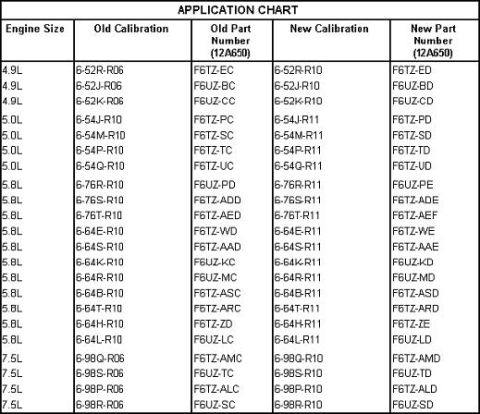
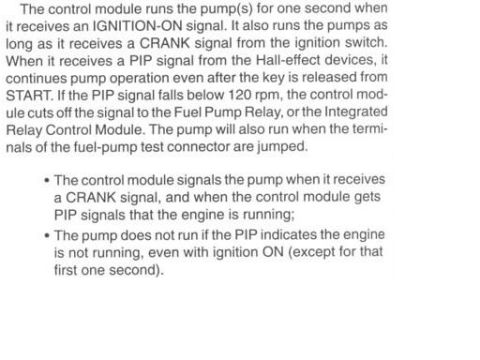
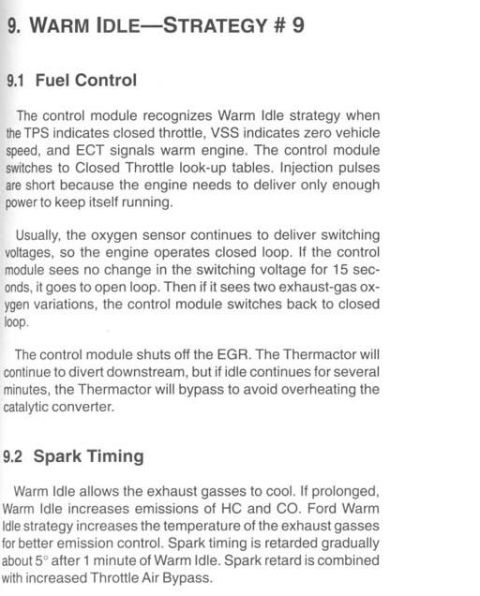
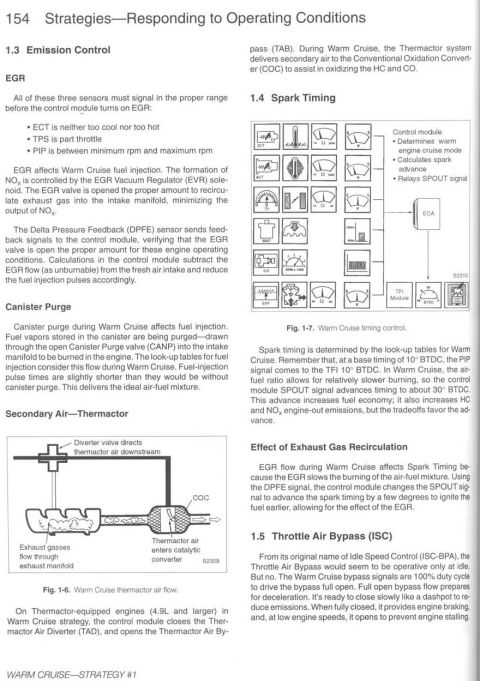
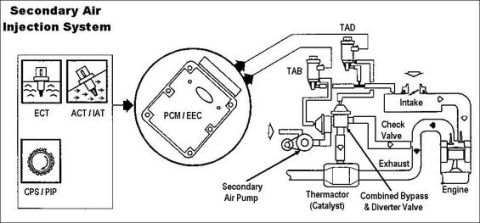
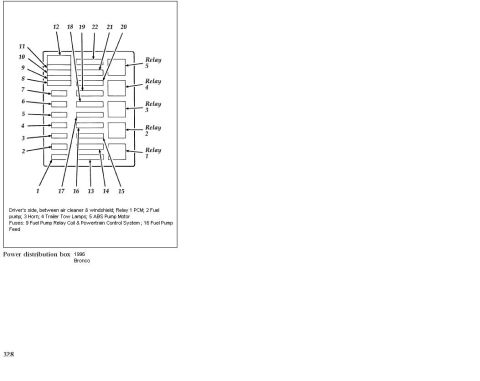
Manual page on emission control during Warm Cruise: EGR via EVR solenoid and DPFE sensor, canister purge through CANP valve, spark timing via SPOUT, secondary air/Thermactor, and ISC throttle air bypass.
Part of 1992-1996 Ford Bronco Manual Pages
This is page 154 of an automotive strategies reference book covering how Ford engine control systems respond during Warm Cruise operating conditions (Strategy #1). Section 1.3 (Emission Control) explains that EGR is enabled only when ECT, TPS, and PIP sensors are within range, that the EGR Vacuum Regulator (EVR) solenoid controls the EGR valve to minimize NOx, and that the Delta Pressure Feedback (DPFE) sensor verifies EGR flow so the control module can shorten fuel injection pulses. Canister purge through the CANP valve is also factored into fuel injection look-up tables. A Secondary Air: Thermactor section with Fig. 1-6 shows how, on Thermactor-equipped engines (4.9L and larger), the module closes the TAD and opens the TAB so secondary air reaches the Conventional Oxidation Converter (COC) to oxidize HC and CO. Section 1.4 (Spark Timing) with Fig. 1-7 shows sensor inputs (ECT, ACT, TP, MAP, PIP, EVP) to the ECA and TFI module; the SPOUT signal advances timing from a base of 10° BTDC to about 30° BTDC during Warm Cruise, and EGR flow prompts additional advance via the DPFE signal. Section 1.5 explains the Throttle Air Bypass (ISC-BPA) is driven fully open at 100% duty cycle during Warm Cruise to prepare for deceleration, closing slowly like a dashpot.
Is this accurate? Sign in to help verify it.
Frequently asked questions
- What sensors must be in range before the control module turns on EGR?
- All three must signal in the proper range: ECT (neither too cool nor too hot), TPS (part throttle), and PIP (between minimum rpm and maximum rpm).
- What does the DPFE sensor do during Warm Cruise?
- The Delta Pressure Feedback (DPFE) sensor sends feedback signals to the control module verifying the EGR valve is open the proper amount. The module subtracts EGR flow (as unburnable) from fresh air intake and reduces fuel injection pulses accordingly.
- What happens to the Thermactor system during Warm Cruise?
- On Thermactor-equipped engines (4.9L and larger), the control module closes the Thermactor Air Diverter (TAD) and opens the Thermactor Air Bypass (TAB), delivering secondary air to the Conventional Oxidation Converter (COC) to help oxidize HC and CO.
- How much does spark timing advance during Warm Cruise?
- From a base timing of 10° BTDC, the control module's SPOUT signal advances timing to about 30° BTDC, which increases fuel economy but also increases HC and NOx engine-out emissions.
- Is the Throttle Air Bypass (ISC) only active at idle?
- No. During Warm Cruise the bypass signals are 100% duty cycle, driving the bypass fully open to prepare for deceleration; it closes slowly like a dashpot to reduce emissions, provides engine braking when fully closed, and opens at low engine speeds to prevent stalling.



No comments yet.