Home/
Registry/
Ford/
Bronco/
1992-1996/
“pukin' dogII”/
Photo
supermotors.net/registry/media/877866
Vacuum Gauge Diagnosis Chart - Engine Readings & What They Mean

Reference · 1992-1996 BroncoAll 142 service procedures
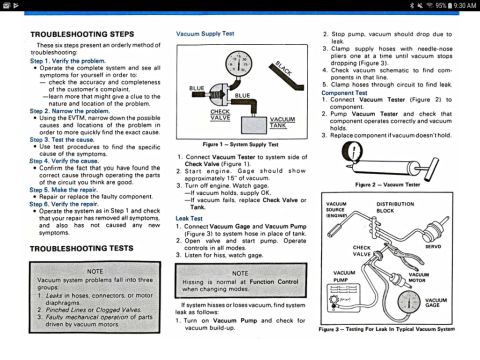
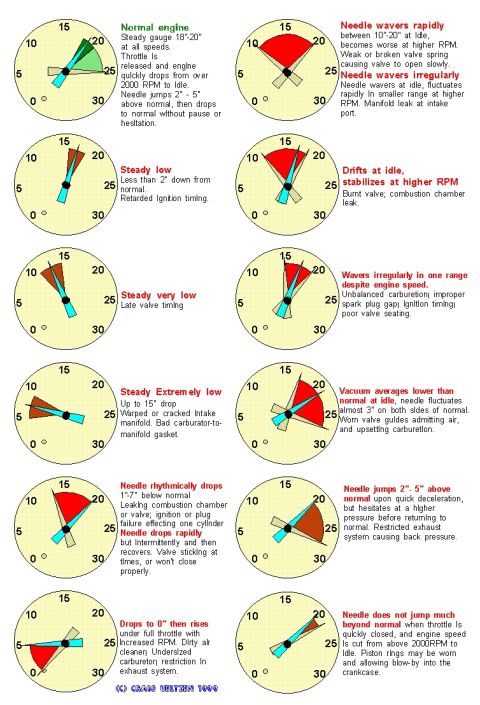
Vacuum gauge diagnostic reference: 12 gauge-needle patterns and their meaning, e.g. normal 18-20 in-Hg, retarded ignition timing (steady low), worn valve guides, burnt valve, sticking valves, leaking gasket.
Part of 1992-1996 Ford Bronco Service Procedures
This is a vacuum gauge diagnosis chart (© Craig Ueltzen, 1999) showing twelve illustrated gauge readings (0-30 in Hg scale) with color-coded needle behavior and the engine conditions each pattern indicates. A normal engine reads a steady 18"-20" at all speeds and briefly jumps 2"-5" above normal on quick deceleration. Abnormal readings and their diagnoses include: rapid wavering between 10"-20" (weak/broken valve spring); irregular wavering (intake port manifold leak); steady low reading under 2" below normal (retarded ignition timing); drifting at idle that stabilizes at higher RPM (burnt valve or combustion chamber leak); steady very low (late valve timing); wavering in one range regardless of engine speed (unbalanced carburetion, improper plug gap, ignition timing, poor valve seating); extremely low reading up to 15" drop (warped/cracked intake manifold or bad carburetor-to-manifold gasket); low average with ~3" fluctuation (worn valve guides); rhythmic 1"-7" drops (leaking chamber/valve or ignition failure in one cylinder) versus intermittent drops (sticking valve); needle hesitating above normal on deceleration (restricted exhaust/back pressure); drop to 0" under full throttle (dirty air cleaner, undersized carburetor, exhaust restriction); and little jump above normal when throttle is closed (worn piston rings causing blow-by). It is a general gasoline-engine diagnostic reference, not vehicle-specific.
Is this accurate? Sign in to help verify it.
Frequently asked questions
- What should a healthy engine read on a vacuum gauge?
- A normal engine shows a steady 18"-20" at all speeds. When the throttle is released and engine speed drops quickly from over 2000 RPM to idle, the needle jumps 2"-5" above normal, then returns to normal without pause or hesitation.
- What does it mean if the vacuum needle wavers rapidly between 10" and 20" at idle?
- If it becomes worse at higher RPM, it indicates a weak or broken valve spring causing a valve to open slowly.
- What causes a steady but very low vacuum reading?
- A steady very low reading indicates late valve timing. An extremely low reading (up to a 15" drop) points to a warped or cracked intake manifold or a bad carburetor-to-manifold gasket.
- What does it mean if vacuum drops to 0" under full throttle then rises with RPM?
- It indicates a dirty air cleaner, an undersized carburetor, or a restriction in the exhaust system.
- How does a vacuum gauge show worn piston rings?
- The needle does not jump much beyond normal when the throttle is quickly closed from above 2000 RPM to idle; worn rings allow blow-by into the crankcase.






No comments yet.