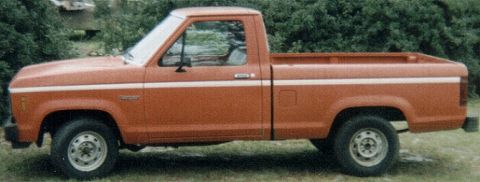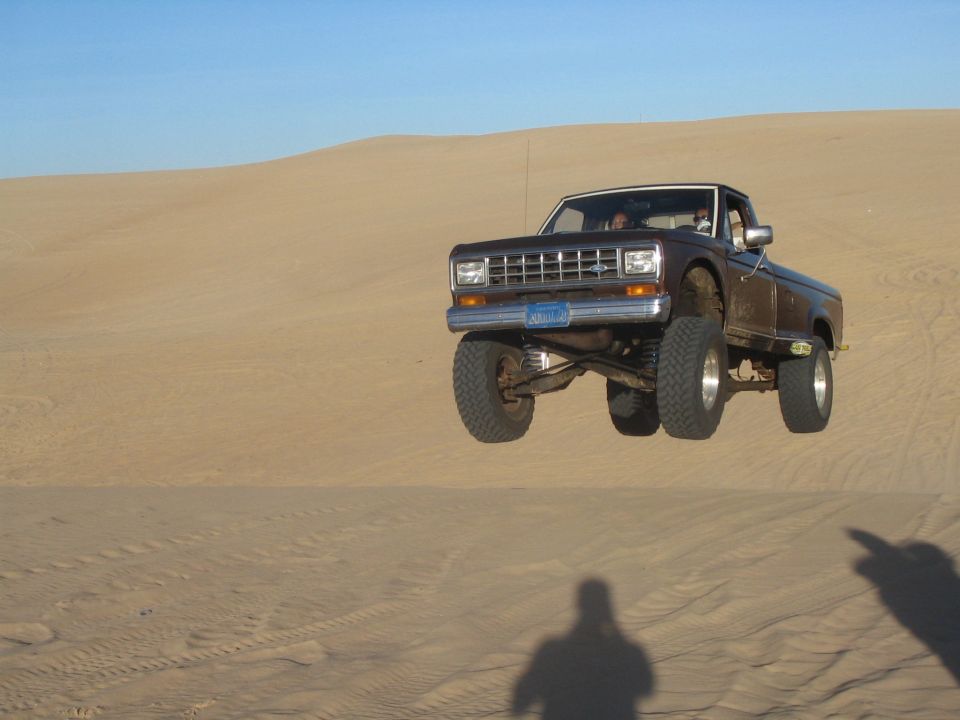
The 1983 model year introduced the first-generation Ford Ranger, a compact pickup engineered and built in North America to replace the Mazda-built Ford Courier. The 1983 Ford Ranger used Ford's Twin-I-Beam independent front suspension on two-wheel-drive trucks and the Twin-Traction-Beam layout on four-wheel-drive trucks built around a Dana 28 front axle. The base engines were the 2.0 and 2.3 Lima four-cylinders, with the 2.8 Cologne V6 as the optional six. Early first-generation Rangers also offered diesel options sourced from Mazda and Mitsubishi. For 1986 the 2.8 V6 was replaced by the larger 2.9 Cologne V6, and the 3.0 Vulcan V6 joined the lineup for 1991. For 1990 the 4.0 Cologne V6 arrived as the top engine, and the four-wheel-drive front axle grew to a Dana 35. The first-generation Ranger also provided the platform for the Bronco II compact SUV introduced for 1984 and later the Ford Explorer. Transmissions ranged from four-speed and five-speed manuals to three-speed and four-speed automatics depending on engine and year. The first generation ran through 1992 before the restyled second-generation Ranger arrived for 1993.
Other Ford Ranger generations
The 1983-1992 Ford Ranger at a glance
- Generation: first-generation Ford Ranger, the compact pickup that replaced the Ford Courier
- Years: 1983 through 1992, replaced by the second-generation Ranger for 1993
- Four-cylinders: 2.0 Lima I4 (early, carbureted) and 2.3 Lima I4
- V6 engines: 2.8 Cologne (1983-1985), 2.9 Cologne (from 1986), 3.0 Vulcan (from 1991), 4.0 Cologne OHV (from 1990)
- Diesels: Mazda-sourced and Mitsubishi-sourced diesels offered on early first-generation trucks
- Front suspension: Twin-I-Beam on 2WD, Twin-Traction-Beam on 4WD (Dana 28 early, Dana 35 from 1990)
- Transmissions: four-speed and five-speed manuals; three-speed and four-speed automatics
- Related models: the platform underpinned the Bronco II (from 1984) and later the Ford Explorer
Ford Ranger 1983-1992 year by year
| Year | Ford Ranger changes | Engines offered |
|---|---|---|
| 1983 | First-generation Ford Ranger launches as the compact pickup replacing the Ford Courier; Twin-I-Beam front on 2WD and Twin-Traction-Beam on 4WD | 2.0 I4; 2.3 I4; 2.8 Cologne V6; Mazda diesel |
| 1984 | The Ranger platform spawns the Bronco II compact SUV; engine and diesel options carry over | 2.0 I4; 2.3 I4; 2.8 Cologne V6; diesel |
| 1985 | Final year of the 2.8 Cologne V6 in the Ford Ranger; the five-speed manual becomes the standard transmission | 2.0 I4; 2.3 I4; 2.8 Cologne V6; diesel |
| 1986 | The 2.9 Cologne V6 replaces the 2.8 as the optional V6 | 2.0 I4; 2.3 I4; 2.9 Cologne V6; 2.3 Mitsubishi turbodiesel |
| 1987 | The Ford Ranger carries over with drivetrain and equipment updates as fuel injection spreads across the engine range; final year for the diesel option | 2.0 I4; 2.3 I4; 2.9 Cologne V6; 2.3 Mitsubishi turbodiesel |
| 1988 | The Ford Ranger continues with its fuel-injected engines | 2.0 I4; 2.3 I4; 2.9 Cologne V6 |
| 1989 | The first-generation Ford Ranger receives an exterior and interior facelift with revised front sheetmetal and grille and headlamp treatment | 2.3 I4; 2.9 Cologne V6 |
| 1990 | The 4.0 Cologne OHV V6 arrives as the top Ford Ranger engine; the 4WD front axle grows to a Dana 35 Twin-Traction-Beam | 2.3 I4; 2.9 Cologne V6; 4.0 Cologne V6 |
| 1991 | The 3.0 Vulcan V6 joins the Ford Ranger lineup | 2.3 I4; 2.9 Cologne V6; 3.0 Vulcan V6; 4.0 Cologne V6 |
| 1992 | Final model year of the first-generation Ford Ranger before the 1993 restyle | 2.3 I4; 2.9 Cologne V6; 3.0 Vulcan V6; 4.0 Cologne V6 |
How the first-generation Ranger replaced the Courier
The first-generation Ford Ranger arrived for 1983 as Ford's own compact pickup, replacing the Ford Courier, which had been a rebadged Mazda truck. Unlike the Courier, the 1983 Ranger was designed and built by Ford in North America. The Ranger quickly became the platform basis for other Ford light trucks: the Bronco II compact SUV launched for 1984 on a shortened Ranger chassis, and the Ford Explorer that replaced the Bronco II for 1991 was also Ranger-derived. The first-generation Ranger established the compact-truck formula Ford would carry through 2011.
Engines and diesels of the 1983-1992 Ford Ranger
The base engines of the early first-generation Ford Ranger were the 2.0 and 2.3 Lima four-cylinders, with the 2.0 a carbureted unit used in the lightest trucks and the 2.3 serving as the volume four-cylinder. The optional six for 1983 through 1985 was the 2.8 Cologne V6, a German-designed pushrod engine. For 1986 Ford replaced the 2.8 with the larger 2.9 Cologne V6, and the domestic 3.0 Vulcan V6 followed for 1991. The 4.0 Cologne OHV V6 arrived for 1990 as the top engine. Early first-generation Rangers also offered diesel options: a Mazda-sourced 2.2 diesel and a Mitsubishi-sourced 2.3 turbodiesel, both low-volume offerings phased out during the 1980s. Across the generation, fuel injection progressively replaced carburetors on the gasoline engines.
The Twin-I-Beam and Twin-Traction-Beam front suspension
The first-generation Ford Ranger used Ford's Twin-I-Beam independent front suspension on two-wheel-drive models, a layout that uses two long beams pivoting from the opposite frame rails. Four-wheel-drive Rangers used the related Twin-Traction-Beam (TTB) arrangement, which adds drive axles to the beams. The 4WD Ranger used a Dana 28 TTB front axle early in the generation, then a larger Dana 35 TTB after the 4.0 V6 arrived for 1990 to handle the added power. This Twin-I-Beam and TTB front-suspension family stayed with the Ranger through the 1993-1997 second generation before the 1998 redesign switched to a short-and-long-arm independent front.
Transmissions and trims
The first-generation Ford Ranger offered four-speed and five-speed manual transmissions and three-speed and four-speed automatics, with availability depending on the engine and model year. A four-speed manual was standard for the earliest 1983 and 1984 trucks, and the five-speed manual became standard for 1985. Trim levels through the generation included the base S and Ranger work trucks, the XL and XLT, the off-road-oriented STX, and a sporty Ranger GT offered from 1987 to 1989.
Frequently asked questions
What did the first-generation Ford Ranger replace?
The first-generation Ford Ranger, launched for 1983, replaced the Ford Courier, a rebadged Mazda compact pickup. The 1983 Ranger was Ford's own compact truck designed and built in North America.
What engines did the 1983-1992 Ford Ranger use?
The 1983-1992 Ford Ranger used the 2.0 and 2.3 Lima four-cylinders, the 2.8 Cologne V6 (1983-1985) replaced by the 2.9 Cologne V6 (from 1986), the 3.0 Vulcan V6 (from 1991), and the 4.0 Cologne OHV V6 (from 1990). Early trucks also offered Mazda-sourced and Mitsubishi-sourced diesels.
When did the Ford Ranger get the 4.0 V6?
The Ford Ranger gained the 4.0 Cologne OHV V6 for the 1990 model year as its top engine. At the same time the four-wheel-drive front axle grew from a Dana 28 to a larger Dana 35 Twin-Traction-Beam unit to handle the added power.
Does the first-generation Ford Ranger 4x4 have a solid front axle?
No. The first-generation Ford Ranger 4x4 used the Twin-Traction-Beam (TTB) independent front suspension, with a Dana 28 axle early and a Dana 35 from 1990, while two-wheel-drive trucks used the Twin-I-Beam layout. The Ranger did not use a short-and-long-arm independent front until the 1998 redesign.
What models share the first-generation Ranger platform?
The first-generation Ford Ranger platform underpinned the Bronco II compact SUV introduced for 1984 and the Ford Explorer that replaced the Bronco II for 1991. Both were derived from the Ranger chassis.
Sources
- Ford factory specification sheets and shop manuals for the 1983-1992 Ranger
- Wikipedia, Ford Ranger (Americas), first generation
- The Ranger Station, Ranger engine and 4x4 front-axle histories
- VIN and data-plate decoding for engine and axle identification
Asked all the time
What did the first-generation Ford Ranger replace?
The first-generation Ford Ranger, launched for 1983, replaced the Ford Courier, a rebadged Mazda compact pickup. The 1983 Ranger was Ford's own compact truck designed and built in North America.
What engines did the 1983-1992 Ford Ranger use?
The 1983-1992 Ford Ranger used the 2.0 and 2.3 Lima four-cylinders, the 2.8 Cologne V6 (1983-1985) replaced by the 2.9 Cologne V6 (from 1986), the 3.0 Vulcan V6 (from 1991), and the 4.0 Cologne OHV V6 (from 1990). Early trucks also offered Mazda-sourced and Mitsubishi-sourced diesels.
When did the Ford Ranger get the 4.0 V6?
The Ford Ranger gained the 4.0 Cologne OHV V6 for the 1990 model year as its top engine. At the same time the four-wheel-drive front axle grew from a Dana 28 to a larger Dana 35 Twin-Traction-Beam unit to handle the added power.
Does the first-generation Ford Ranger 4x4 have a solid front axle?
No. The first-generation Ford Ranger 4x4 used the Twin-Traction-Beam (TTB) independent front suspension, with a Dana 28 axle early and a Dana 35 from 1990, while two-wheel-drive trucks used the Twin-I-Beam layout. The Ranger did not use a short-and-long-arm independent front until the 1998 redesign.
What models share the first-generation Ranger platform?
The first-generation Ford Ranger platform underpinned the Bronco II compact SUV introduced for 1984 and the Ford Explorer that replaced the Bronco II for 1991. Both were derived from the Ranger chassis.
Technical Reference
Member-uploaded diagrams & documents for this generation. AI-classified; community-verified where badged.
Schematics (6)
- 1990 Ford Ranger Belt Routing Diagram - Hand-Drawn Pulley & Drive Belt PathThis document is a simple hand-drawn belt routing diagram, uploaded to SuperMotors.net as 'belt.jpg' in the gallery of a 1990 Ford Ranger. The drawing shows four black circles of different sizes, which represent engine…
- 4-Link Suspension Calculator - 1987 Ford Ranger Link Geometry & Anti-SquatThis document is a screenshot of a spreadsheet-based 4-link rear suspension geometry calculator, apparently used to design or analyze a link suspension setup for a truck. Input parameters include a 110.0 in wheelbase…
- 4 Bar Linkage Calculator v3.0 - 4-Link Suspension Geometry (Ford Ranger Build)This document is a screenshot of a spreadsheet-based "4 Bar Linkage Calculator v3.0" used for designing a 4-link suspension, uploaded to the gallery of a 1987 Ford Ranger. The calculator's input sections include…
- 4 Bar Linkage Calculator v3.0 - 4-Link Suspension Geometry & Anti-Squat DataThis document is a screenshot of a spreadsheet-based '4 Bar Linkage Calculator v3.0' used to design and analyze a four-link rear suspension, uploaded to a 1987 Ford Ranger gallery. It shows link geometry inputs and…
- 4 Bar Linkage Calculator v3.0 - Suspension Anti-Squat & Roll Center SpreadsheetThis document is a screenshot of a spreadsheet tool titled "4 Bar Linkage Calculator v3.0," used for designing and analyzing a 4-link suspension geometry. It shows side-by-side "Static Geometry" and "Bump Geometry"…
- Transmission Removal Method Diagram - Ratchet Strap Support Sling SketchThis is a simple hand-drawn (computer sketch) schematic illustrating a DIY method for supporting or lowering a transmission during removal using a ratchet strap. The drawing shows a green oval labeled 'transmission'…
Wiring Diagrams (4)
- Haynes chart of ignition module connector terminals 2, 3 and 4: coil (-) terminal in Run, run circuit in Run and Start, start circuit in Start.
- 1989 Ford Ranger/Bronco II Wiring Diagram - Wipers, Lighting, Windows, Locks, A/CThis is page 12-39 from Chapter 12 (Chassis electrical system) of a Haynes repair manual, showing the full-page wiring diagram captioned "1989 Ranger/Bronco II wipers, lighting, power windows/locks and heating/air…
- Ford Ranger & Bronco II Power Door Lock Wiring Diagram - Factory SchematicThis is a scanned page (01-14-10) from a Ford factory service manual section titled 'Handles, Locks, Latches and Mechanisms, TESTING (Continued)'. It presents the Power Door Lock Electrical Schematic for the Ford…
- Ford EGR Valve Position Sensor (EVP) Wiring Diagram - VREF, SIG RTN, EVP PinsThis document is a simple wiring/test diagram for a Ford EGR Valve Position Sensor (EVP). It shows the sensor's three-pin connector (drawn as a round connector face) and identifies the three circuits by EEC pin number…
Manual Pages (3)
- Ford TFI-IV Remote ICM 8-Pin Connector Pinout Diagram - Haynes Manual Page 5-8This is a scanned page (page 5-8) from a Haynes repair manual, Chapter 5, 'Engine ele[ctrical systems]' (title partially cut off). The page shows illustration 7.36, a pin-location diagram for the connector used on…
- Ford TFI Module / ICM Connector Pinout Diagram - PIP, SPOUT, TACH TerminalsThis is a scanned page from Chapter 5 ("Engine electrical") of an automotive repair manual (Haynes-style layout). The page contains figure 7.60, an illustration of a distributor-mounted TFI (Thick Film Ignition)…
- Haynes resistance chart for TFI module terminal pairs, from less than 5 ohms GND to IGN GND up to 900-1.5k ohms PIP PWR to PIP IN.
Exploded Parts (1)
- Ford 2-Barrel Carburetor Exploded Parts Diagram - Motorcraft 2150 ComponentsThis document is an exploded-view parts diagram of a two-barrel carburetor, showing every major component and its relative assembly position. The illustration is fully labeled with callouts identifying the main body…
Service Procedures (1)
- Ford EEC Self-Test Connector Hookup Diagram - Read Codes with Test LightThis document is a line-art diagram titled "TEST HOOKUPS" showing how to connect test equipment to a vehicle's self-test connectors to read diagnostic trouble codes. It identifies the self-test connectors (a larger…
The wall · registered 1983-1992 Rangers
Sorted by depth of documentation. Click any vehicle to open its permanent record.