Home/
Registry/
Ford/
Bronco/
1992-1996/
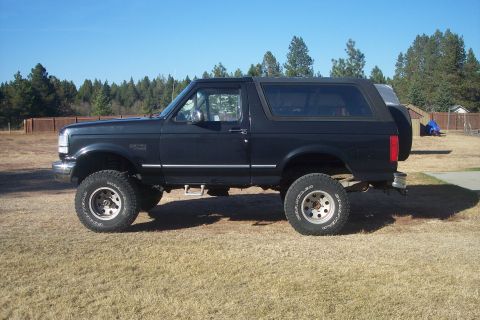
“Black Beauty”/
Photo
supermotors.net/registry/media/1130905
Crankshaft Repair Sleeve Installation Instructions - Rear Main Seal Wear Sleeve
.jpg)
Crankshaft repair sleeve installation instructions (one-piece full-circle seals): 45-degree .050 in chamfer recommendation, .010 in finger grind clearance, lubricate full 360 degrees over contact surface.
This document is a photographed instruction panel printed on product packaging for a crankshaft repair sleeve (rear main seal wear sleeve), uploaded to a 1995 Ford Bronco gallery. It lists eight numbered installation steps. Key points: the sleeve is for use with one-piece full-circle seals only (two-piece seal applications require checking the catalog); the seal surface must be clean, burr-free, and no stud-lock type material should be used. A 45-degree, .050"-wide chamfer on the receiving edge of the crank flange is recommended, though field practice often omits it (install without chamfer at your own risk). If the seal block has three aluminum fingers extending toward the crankshaft, they should be ground approximately .010" for sleeve clearance. The sleeve must be installed with a proper installation tool, aligned with the crankshaft flange, and tapped sharply to seat as it bottoms out. The rear main seal's "wet lip" must be square with the crank flange, and seal and sleeve must be lubricated over the full 360° contact surface for start-up. Step 8 covers undersize sleeves: the crankshaft must be ground at the seal groove area to a finished diameter listed in the catalog, restoring the wear area to standard diameter. Marked "MADE IN U.S.A."; a partially visible box behind reads "Rear Main Seal."
Is this accurate? Sign in to help verify it.
Frequently asked questions
- Can this crankshaft repair sleeve be used with two-piece rear main seals?
- No. The instructions say to use with one-piece full circle seals only, and to check the catalog for applications on two-piece seals.
- Is a chamfer required on the crankshaft flange before installing the repair sleeve?
- A 45-degree, .050"-wide chamfer on the receiving edge is recommended, and most crankshafts have a sufficient chamfer. Field practice often skips the chamfer since the thin sleeve material doesn't seem to interfere when the flex plate/flywheel is torqued to the crank flange, but installing without a chamfer is at your own risk.
- What if the seal block's aluminum fingers interfere with the sleeve?
- If the seal block has 3 aluminum fingers extending toward the crankshaft that interfere with the installed sleeve, grind the end of the fingers approximately .010" for sleeve clearance.
- What extra step is required for an undersize repair sleeve?
- Step 8: the crankshaft must be ground at the seal grooved area to the finished diameter noted in the catalog. Installing the undersize sleeve then brings the crankshaft seal wear area back to standard diameter.
- Does the seal need lubrication before installation?
- Yes. The seal and repair sleeve must be well lubricated over the full 360° of contact surface for proper start-up lubrication, and the seal's "wet lip" must be square with the rotating mass of the crankshaft flange.
Comments
More from this build



No comments yet.