Home/
Registry/
Ford/
Bronco/
1992-1996/
“Blastin' Assassin”/
Photo
supermotors.net/registry/media/771826
Leaf Spring Shackle Angle Force Vector Diagram - 1996 Ford Bronco Suspension
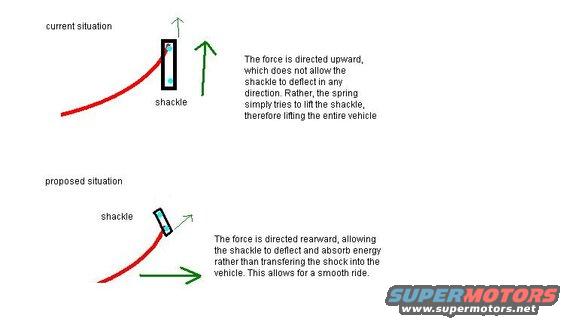
Schematic comparing current upward versus proposed rearward shackle force directions on a leaf spring with explanatory text.
This is a hand-drawn schematic diagram (not a scanned factory document) comparing two leaf spring shackle geometries and the resulting force vectors on a vehicle's suspension. The top illustration, labeled "current situation," shows a leaf spring (drawn in red) meeting a vertically oriented shackle, with green arrows indicating force directed straight upward. The accompanying note explains that with this geometry, the force does not allow the shackle to deflect in any direction; instead, the spring simply tries to lift the shackle and therefore the entire vehicle. The bottom illustration, labeled "proposed situation," shows the shackle angled rearward, with green arrows showing the force directed rearward. The note explains that this orientation allows the shackle to deflect and absorb energy rather than transferring shock into the vehicle, producing a smoother ride. A reader can learn the basic rationale for correcting leaf spring shackle angle: an angled shackle permits the spring to lengthen under compression and absorb road shock, while a vertical (bound) shackle transmits forces directly into the chassis. The diagram contains no part numbers, measurements, torque specs, or vehicle-specific identification.
Is this accurate? Sign in to help verify it.
Frequently asked questions
- What happens when the leaf spring shackle is vertical and the force is directed upward?
- The shackle cannot deflect in any direction; the spring simply tries to lift the shackle and therefore lifts the entire vehicle.
- What is the benefit of the proposed shackle orientation?
- With the force directed rearward, the shackle can deflect and absorb energy rather than transferring the shock into the vehicle, allowing for a smooth ride.
- What two scenarios does this diagram compare?
- A 'current situation' with a vertical shackle and upward-directed force, and a 'proposed situation' with an angled shackle and rearward-directed force.
- Why does the current shackle setup give a harsh ride?
- Because the upward force does not allow the shackle to deflect, the shock is transferred into the vehicle instead of being absorbed.
Comments
More from this build

No comments yet.