Home/
Registry/
Ford/
Bronco/
1980-1986/
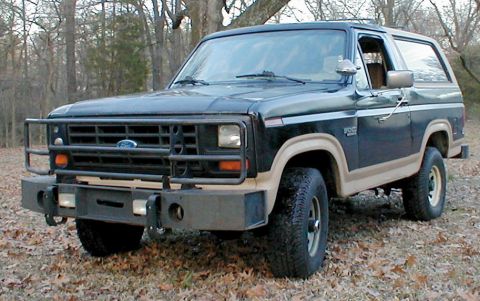
“Still Pending”/
Photo
supermotors.net/registry/media/825058
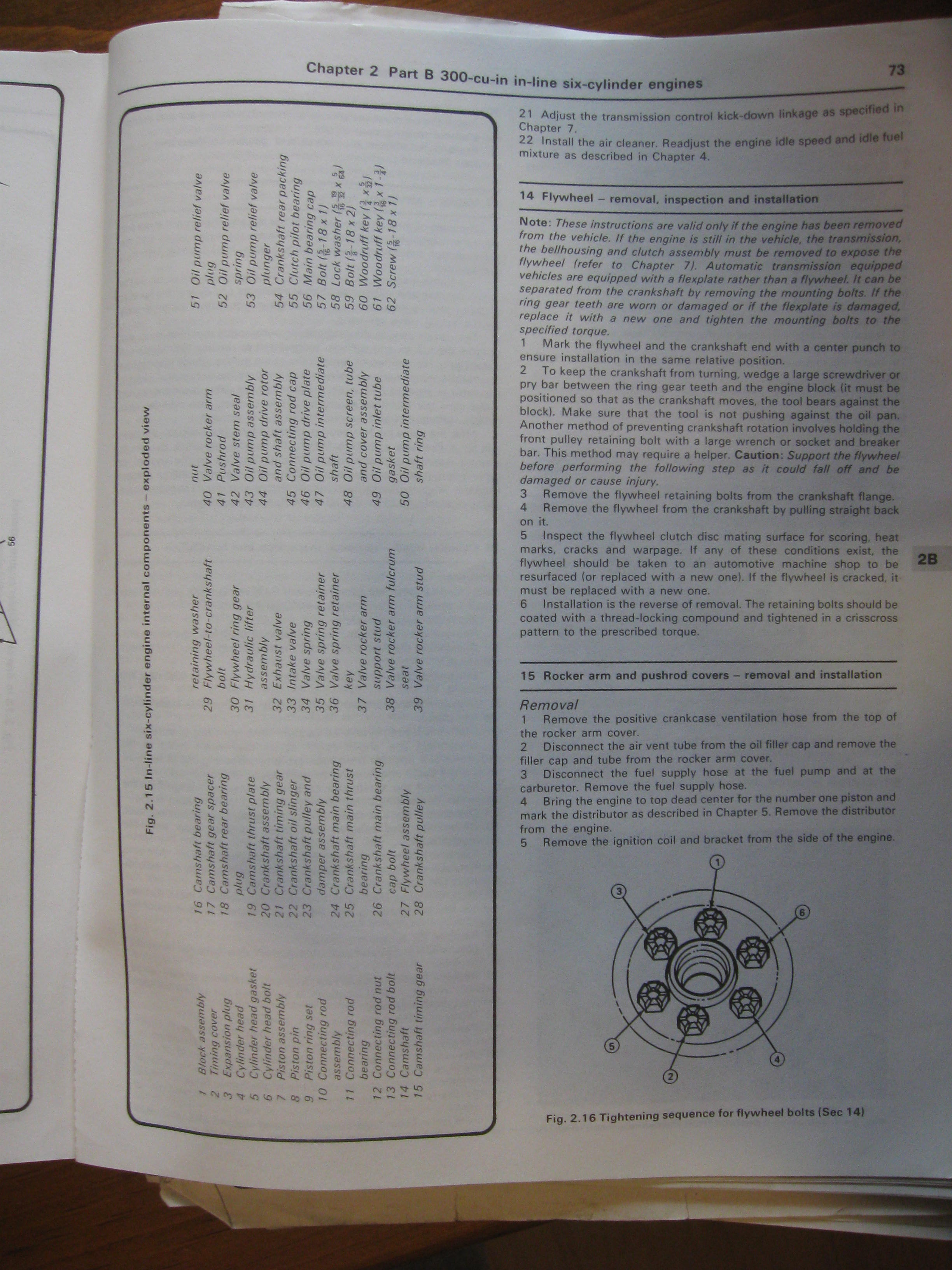
Ford 300 Inline Six Engine Exploded View & Flywheel Removal - Manual Page 73
Reference · 1980-1986 BroncoAll 28 manual pages
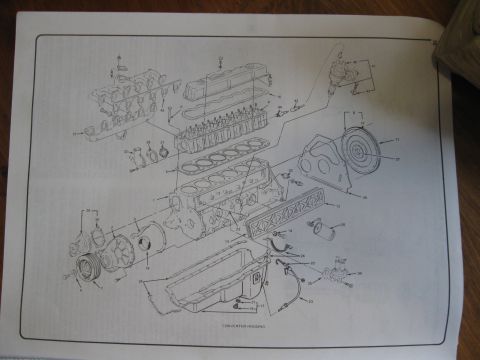
Haynes page for the Ford 300 cu-in inline-six listing exploded internal-component callouts (crankshaft, pistons, camshaft) plus flywheel removal/install and bolt tightening sequence.
Part of 1980-1986 Ford Bronco Manual Pages
This is page 73 from a repair manual, Chapter 2 Part B, covering the Ford 300-cu-in in-line six-cylinder engine. The left portion of the page contains the complete 62-item legend for Fig. 2.15, an exploded view of the engine's internal components, listing parts from the block assembly, pistons, connecting rods, camshaft and crankshaft components through the valve train (lifters, valves, springs, rocker arms, pushrods) and oil pump parts, including fastener sizes such as 5/16-18 x 1 bolts and Woodruff keys. The right column concludes an earlier procedure (adjusting the transmission kick-down linkage and reinstalling the air cleaner), then presents Section 14: Flywheel: removal, inspection and installation. This section explains marking the flywheel and crankshaft for alignment, methods of locking the crankshaft, removing retaining bolts, inspecting the clutch mating surface for scoring, heat marks, cracks and warpage, and reinstalling bolts with thread-locking compound in a crisscross pattern. A note covers flexplates on automatic-transmission vehicles. Section 15 begins the rocker arm and pushrod cover removal procedure: disconnecting the PCV hose, air vent tube, fuel supply hose, setting TDC for cylinder one, and removing the distributor and ignition coil. Fig. 2.16 illustrates the six-bolt flywheel tightening sequence.
Is this accurate? Sign in to help verify it.
Frequently asked questions
- How do I keep the crankshaft from turning when removing the flywheel bolts on a Ford 300 six?
- Wedge a large screwdriver or pry bar between the ring gear teeth and the engine block, positioned so the tool bears against the block (not the oil pan) as the crankshaft moves. Alternatively, hold the front pulley retaining bolt with a large wrench or socket and breaker bar, which may require a helper.
- What should I inspect the flywheel for after removal?
- Inspect the clutch disc mating surface for scoring, heat marks, cracks and warpage. If these conditions exist, have the flywheel resurfaced at an automotive machine shop or replace it. If the flywheel is cracked, it must be replaced with a new one.
- How should the flywheel retaining bolts be installed?
- The retaining bolts should be coated with a thread-locking compound and tightened in a crisscross pattern to the prescribed torque, following the six-bolt sequence shown in Fig. 2.16.
- Do automatic transmission vehicles have a flywheel on the 300 six?
- No, automatic transmission equipped vehicles have a flexplate rather than a flywheel. It can be separated from the crankshaft by removing the mounting bolts; replace it if the ring gear teeth are worn or the flexplate is damaged.
- What are the first steps for removing the rocker arm cover on the 300 inline six?
- Remove the positive crankcase ventilation hose from the top of the rocker arm cover, disconnect the air vent tube from the oil filler cap, remove the filler cap and tube, disconnect and remove the fuel supply hose, bring the engine to TDC for the number one piston, mark and remove the distributor, and remove the ignition coil and bracket.
No comments yet.