Home/
Registry/
Ford/
Bronco/
1978-1979/
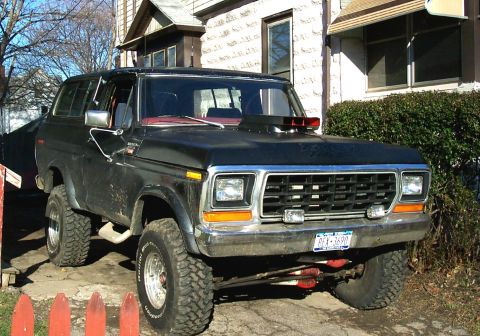
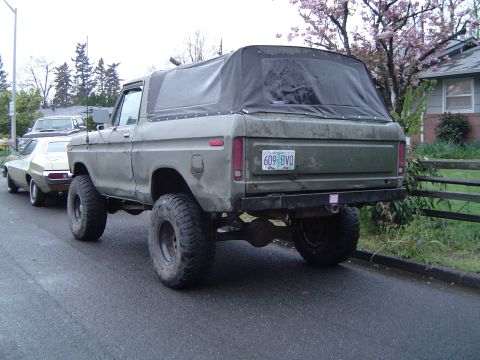
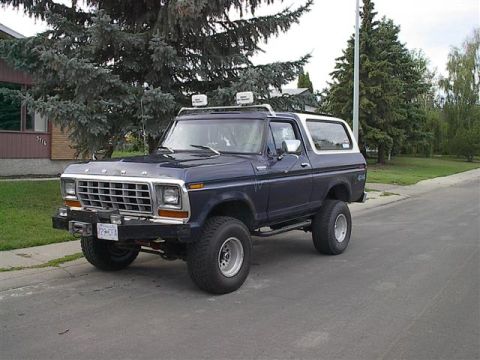
1979 Ford Bronco/
Photo
supermotors.net/registry/media/1032647
1979 Ford Bronco/F100-F350 Warning Lights Troubleshooting - Oil, Brake, Alt

How-it-works and troubleshooting for oil pressure, brake, alternator warning lights and seat belt warning light/buzzer: switch positions, continuity, ground and switch-replacement steps.
This is page 28 of a service reference booklet covering the Ford Bronco and F100 through F350 trucks, titled 'Warning System.' It explains how the vehicle's dashboard warning lights operate and provides step-by-step troubleshooting procedures for four systems: the Oil Pressure Warning Light, Brake Warning Light, Alternator Warning Light, and Seat Belt Warning Light and Buzzer. For each system, a 'How It Works' section describes normal operation (e.g., the oil pressure light comes on at START/RUN and goes out once oil pressure builds; the seat belt light stays on 4 to 8 seconds controlled by a thermal time-delay switch), followed by conditional trouble-shooting steps in an if/then format. Diagnostic actions include checking for burned-out bulbs, testing wiring continuity, grounding connector wires, disconnecting switches, verifying oil level and pressure, checking continuity between the battery and voltage regulator terminal I, and jumpering leads to test the buzzer. Recommended remedies include replacing the oil pressure switch, brake warning switch, alternator switch, buzzer unit, seat belt warning light/buzzer unit, or the seat belt assembly, depending on test results. A reader can learn systematic diagnosis procedures for warning-light circuits on these late-1970s Ford trucks without special tools beyond a jumper and continuity tester.
Is this accurate? Sign in to help verify it.
Frequently asked questions
- Why does my oil pressure warning light stay on after disconnecting the wire from the oil pressure switch?
- If the light remains on with the wire disconnected, check for a ground in the wire from the switch to the light. If disconnecting the wire causes the light to go out, check the oil pressure; if oil pressure is OK, replace the oil pressure switch.
- What causes the brake warning light to come on?
- The brake warning light comes on momentarily when the engine is started, when the brake pedal is applied and the brake system is low on fluid, and when the parking brake is applied.
- What should I check if the alternator light does not come on with the ignition in START or RUN (engine not running)?
- Check for a burned-out bulb. If the bulb is good, check continuity between the battery and terminal I of the voltage regulator.
- How long should the seat belt warning light and buzzer stay on?
- They come on whenever the ignition switch is turned from OFF to ON and stay on from 4 to 8 seconds. The light is controlled by a thermal time-delay switch and the buzzer by the seat belt switch.
- The seat belt light works but the buzzer doesn't, what do I do?
- Check for ground at the seat belt warning light and buzzer connector. If there is ground, replace the seat belt warning light and buzzer unit. If it is not grounded, check continuity through the seat belt buckle switch and verify the switch is properly installed and adjusted; if there is no continuity with the belt released and installation is correct, replace the seat belt assembly.
Comments
More from this build
No comments yet.