Home/
Registry/
Ford/
Bronco/
1978-1979/
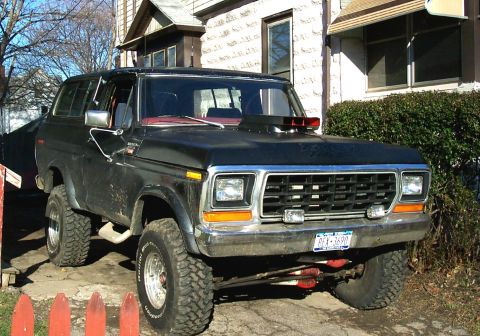
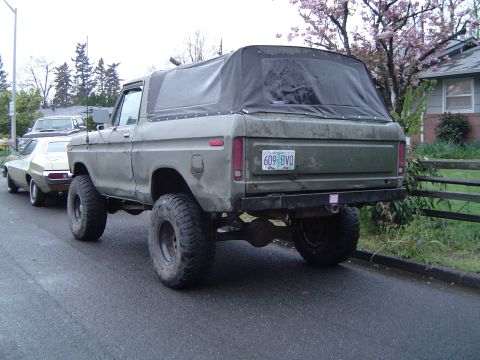
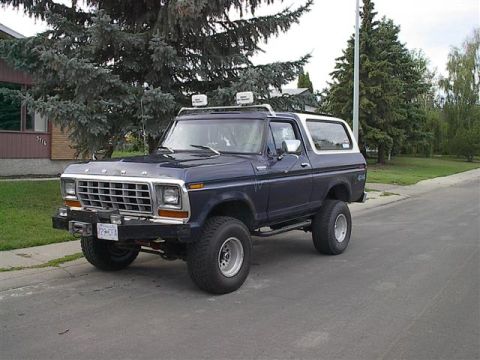
1979 Ford Bronco/
Photo
supermotors.net/registry/media/1032641
1979 Ford Bronco/F100-F350 Turn Signal, Hazard, Stoplight & Backup Light Guide

Troubleshooting text for turn signals, emergency warning flasher, stop lights, and backup lights: how each circuit works through fuse 9 (15A) plus step-by-step continuity and flasher replacement checks.
This is page 22 of a Ford light truck electrical troubleshooting guide covering the Turn Signals, Emergency Warning (hazard) Flasher, Stoplights, and Backup Lights circuits. For each system it explains how the circuit works and gives step-by-step trouble-shooting procedures. Turn signals are powered through fuse 9 (15 amps) with the flasher in series between the fuse and the turn signal switch; readers learn how to diagnose one-side blinking (burned bulbs, continuity, ground at socket), non-operation (flasher replacement), and how to test the turn signal switch for continuity in RH and LH positions using a self-powered test light on the white/black-stripe, green/white-stripe, and solid black wires. The emergency warning flasher is powered at all times through fuse 8; diagnosis follows the white-red striped wire from flasher to switch. Stoplights are fed through fuse 8 and routed through the turn signal switch; procedures include jumpering the stoplight switch terminals and checking red-black striped wires. Backup lights receive power through fuse 11 with the ignition in RUN and the transmission in REVERSE; the guide notes windshield washer pump operation confirms a good fuse. A photo shows checking a turn signal socket for continuity.
Is this accurate? Sign in to help verify it.
Frequently asked questions
- Which fuse powers the turn signal circuit?
- Fuse 9 (15 amps) supplies the turn signal circuit when the ignition switch is in the RUN position.
- What fuse feeds the emergency warning (hazard) flasher and stoplights?
- Fuse 8. The emergency flasher circuit has power at all times, and stoplight power is also routed through fuse 8 and the turn signal switch.
- Turn signals blink on one side only, what should I check?
- Check for burned out bulbs, check for continuity to that location(s), and check for ground at the socket.
- How do I test the turn signal switch for continuity?
- With the switch in the RH position, use a self-powered test light between the connector for the white wire with black stripes and the solid black wire. For LH, test between the green wire with white stripes and the solid black wire. If there is no continuity in either position, replace the turn signal switch.
- Why don't my backup lights work?
- Backup lights are powered through fuse 11 with the ignition in RUN and the shift lever in REVERSE. For a single light, check the bulb, ground at the socket, and power feed. For both, check the fuse (washer pump operation confirms a good fuse), check power to the backup light switch, then jumper across the switch terminals, if the lights come on, replace the backup light switch.
Comments
More from this build
No comments yet.