Lug Nut Seat Types Diagram - Acorn/Tapered 60°, Mag Seat w/Washer & Ball Seat
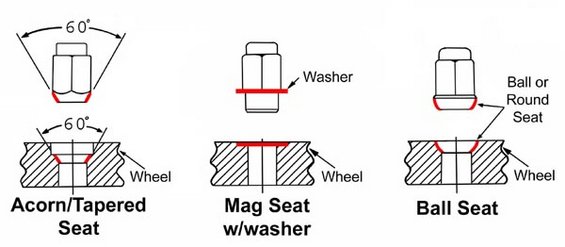
Diagram comparing three lug nut seat types (acorn/tapered, mag seat with washer, ball seat) with cross-sections of nut and wheel.
This document is a technical illustration comparing the three common lug nut seat styles used on automotive wheels. Three cross-section diagrams show each lug nut type above a corresponding cutaway of the wheel's lug hole, with the mating seat surfaces highlighted in red. The first diagram, labeled 'Acorn/Tapered Seat', shows a lug nut with a 60° conical (tapered) seat and a matching 60° tapered hole in the wheel. The second diagram, 'Mag Seat w/washer', shows a shank-style lug nut with a flat washer that seats against a flat surface on the wheel, with the shank extending into the lug hole. The third diagram, 'Ball Seat', shows a lug nut with a rounded (ball or radius) seat that mates with a matching rounded seat machined into the wheel. From this chart a reader can visually identify which lug nut style matches their wheels, understand that acorn/tapered seats use a 60-degree cone angle, and recognize that mag-style and ball-seat nuts require different wheel seat machining and are not interchangeable with tapered-seat nuts. The document contains no year, make, model, part numbers, or torque specifications, it is a generic reference diagram.
Is this accurate? Sign in to help verify it.
Frequently asked questions
- What are the three types of lug nut seats shown?
- Acorn/Tapered Seat, Mag Seat with washer, and Ball Seat.
- What angle is the taper on an acorn/tapered seat lug nut?
- The diagram shows a 60° taper on both the lug nut and the matching seat in the wheel.
- How does a mag seat lug nut contact the wheel?
- A mag seat lug nut uses a flat washer that sits against a flat surface on the wheel, with a shank extending into the lug hole.
- How is a ball seat lug nut different from a tapered seat?
- A ball seat lug nut has a rounded (ball or round) seat that mates with a matching rounded seat in the wheel, rather than a 60° cone.
Comments
More from this build
No comments yet.