Home/
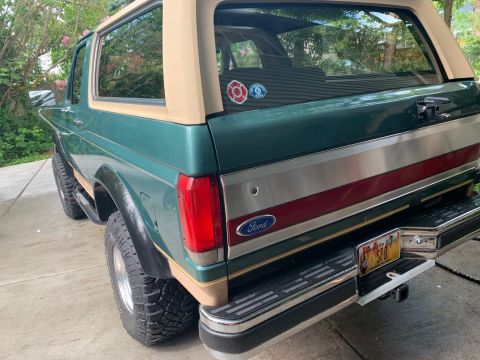
Registry/
Ford/
Bronco/
1987-1991/
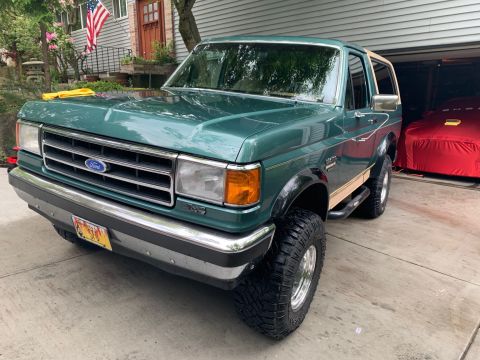
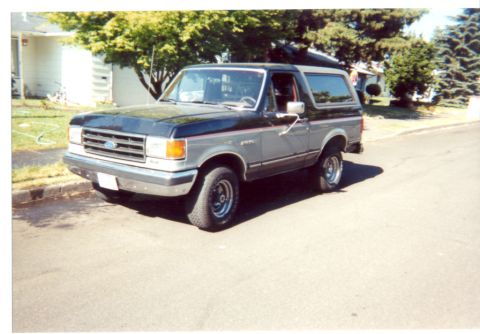
“Eddie Bauer”/
Photo
supermotors.net/registry/media/1069610
Ford VSS Signal Waveforms: Buffered Digital vs Unbuffered Analog Oscilloscope

Diagram comparing a typical buffered digital square-wave signal with a typical unbuffered analog sine-wave signal on an oscilloscope.
This document is a two-panel oscilloscope reference illustration comparing two types of vehicle speed sensor (VSS) signal waveforms. The top panel, labeled "TYPICAL BUFFERED DIGITAL SIGNAL," shows a clean square wave displayed on an oscilloscope with settings of 50ms per division, A-B:1V, and 1.00V. This represents a digital signal that has been processed (buffered) into distinct high/low voltage levels. The bottom panel, labeled "TYPICAL UNBUFFERED ANALOG SIGNAL," shows a continuous sine wave oscillating between approximately +10V and -10V around a 0V centerline, representing the raw AC output of a sensor before any buffering or signal conditioning. A reader can learn to visually distinguish a buffered (square-wave, digital) signal from an unbuffered (sine-wave, analog AC) signal when scoping a speed sensor circuit, useful for diagnosing whether a VSS or its buffer circuitry is producing the expected waveform. The document contains no vehicle-specific text, part numbers, wire colors, or year/model applicability; it is a generic waveform comparison chart. It was uploaded in an album alongside E4OD transmission documents for a 1990 Ford Bronco.
Is this accurate? Sign in to help verify it.
Frequently asked questions
- What does a buffered digital VSS signal look like on an oscilloscope?
- Per the top diagram, it appears as a clean square wave, shown here at 50ms per division with A-B:1V and 1.00V scope settings.
- What does an unbuffered analog speed sensor signal look like?
- The bottom diagram shows it as a continuous sine wave oscillating between about +10V and -10V around a 0V centerline.
- How can I tell a buffered signal from an unbuffered one when scoping?
- A buffered signal is a square (digital) waveform with flat high and low levels, while an unbuffered signal is a smooth analog sine wave, as illustrated in the two traces.
- What voltage range does the unbuffered analog signal span in this diagram?
- Approximately +10V to -10V, based on the labeled scale on the bottom oscilloscope trace.
Comments
More from this build

No comments yet.