How to Check Torque Wrench Calibration at Home - DIY Weight Test Procedure
Reference · 1980-1986 BroncoAll 40 service procedures




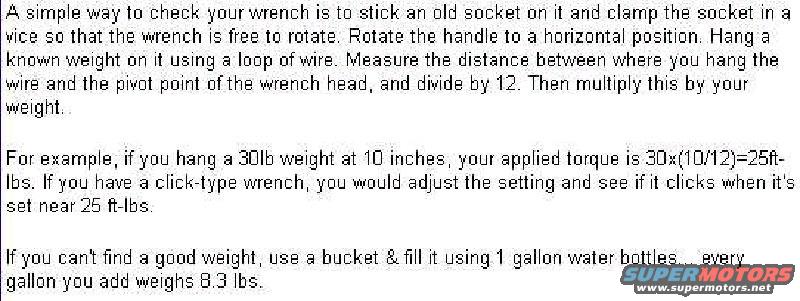
Text instructions for checking/calibrating a torque wrench by hanging a known weight on a socket and computing applied torque (e.g. 30lb at 10 in = 25 ft-lbs).
Part of 1980-1986 Ford Bronco Service Procedures
This document is a short DIY procedure explaining how to check the calibration of a torque wrench at home. The method involves attaching an old socket to the wrench, clamping the socket in a vice so the wrench can rotate freely, and rotating the handle to a horizontal position. A known weight is then hung from the handle using a loop of wire. The applied torque is calculated by measuring the distance in inches between the hanging point and the pivot point of the wrench head, dividing by 12 to convert to feet, and multiplying by the weight in pounds. A worked example is provided: a 30 lb weight hung at 10 inches produces 30 x (10/12) = 25 ft-lbs of torque. For click-type torque wrenches, the reader is instructed to adjust the setting and verify it clicks near the calculated value (25 ft-lbs in the example). As a practical tip, if no calibrated weight is available, the document suggests using a bucket filled with 1-gallon water bottles, noting that each gallon of water weighs 8.3 lbs. The document is generic and not specific to any vehicle make, model, or year.
Is this accurate? Sign in to help verify it.
Frequently asked questions
- How do I check if my torque wrench is accurate at home?
- Stick an old socket on the wrench and clamp the socket in a vice so the wrench can rotate freely. Rotate the handle to horizontal, hang a known weight from it with a loop of wire, measure the distance from the hanging point to the pivot point of the wrench head, divide by 12, and multiply by the weight to get the applied torque.
- How much torque does a 30 lb weight at 10 inches apply?
- 30 x (10/12) = 25 ft-lbs of applied torque.
- How do I test a click-type torque wrench with this method?
- Adjust the wrench setting and see if it clicks when it's set near the calculated torque, for example, near 25 ft-lbs with a 30 lb weight hung at 10 inches.
- What can I use as a known weight if I don't have one?
- Use a bucket and fill it with 1-gallon water bottles; every gallon of water added weighs 8.3 lbs.
No comments yet.