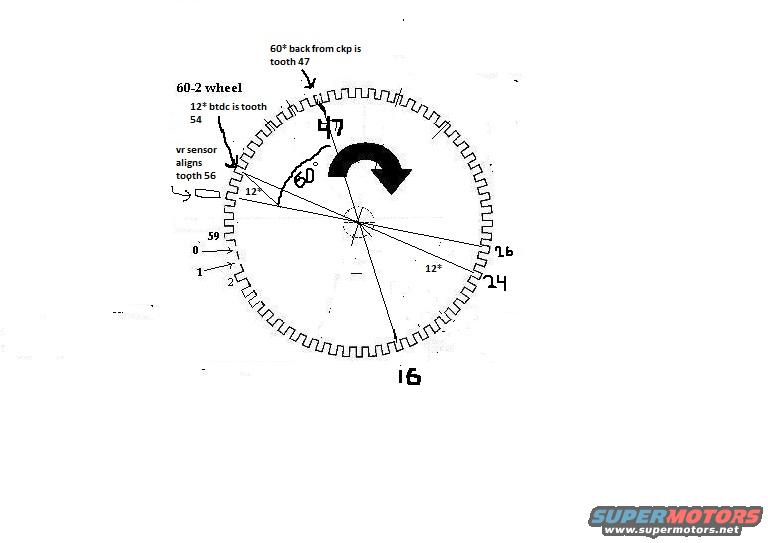
60-2 Crank Trigger Wheel Diagram - VR Sensor & Tooth Alignment (Ford Probe)
Reference · 1993-1997 ProbeAll 25 schematics
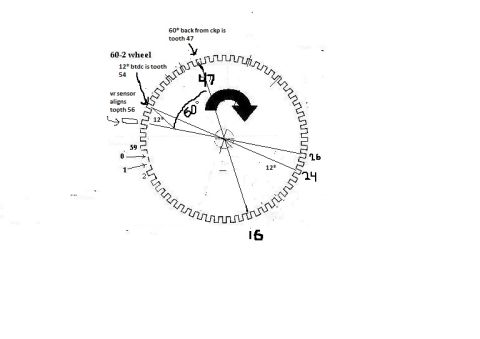
Hand-drawn schematic of a 60-2 crank trigger wheel with tooth numbering, VR sensor alignment and degree references for ignition timing.
Part of 1993-1997 Ford Probe Schematics
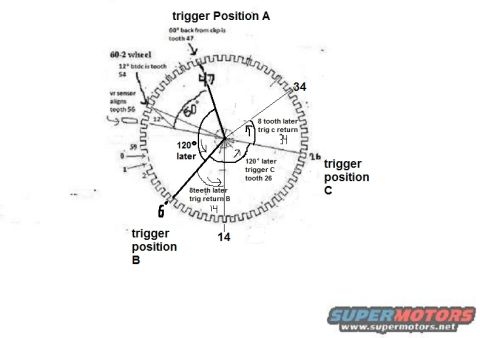
This is a hand-annotated schematic drawing of a 60-2 crankshaft trigger wheel (60 tooth positions with 2 teeth missing) used for engine position sensing with a VR (variable reluctance) sensor. The drawing shows the toothed wheel with a clockwise rotation arrow at its center and radial lines marking key angular positions. Annotations state that the VR sensor aligns with tooth 56, that 12° BTDC corresponds to tooth 54, and that a point 60° back from the CKP (crankshaft position sensor) is tooth 47. Teeth near the missing-tooth gap are numbered 59, 0, 1, and 2. Additional handwritten numbers 26, 24, and 16 mark other tooth positions on the right and bottom of the wheel, and 12° angle markings appear near the center on two radial lines. A reader can learn how tooth numbering on a 60-2 wheel relates to crank angle references (TDC, 12° BTDC, sensor alignment), useful for setting up aftermarket engine management or ignition timing on an engine using a 60-2 trigger pattern. The document was uploaded to a 1993 Ford Probe gallery but does not itself state a vehicle application.
Is this accurate? Sign in to help verify it.
Frequently asked questions
- Which tooth does the VR sensor align with on this 60-2 wheel?
- The diagram states the VR sensor aligns with tooth 56.
- What tooth corresponds to 12° BTDC on this 60-2 trigger wheel?
- According to the annotation, 12° BTDC is tooth 54.
- What tooth is 60° back from the CKP sensor?
- The diagram notes that 60° back from the CKP is tooth 47.
- How are the teeth numbered around the missing-tooth gap?
- Teeth near the gap are labeled 59, 0, 1, and 2, indicating numbering restarts at 0 after tooth 59 at the missing-tooth location.
- Which direction does the wheel rotate in this diagram?
- A large curved arrow at the center of the wheel indicates clockwise rotation.

No comments yet.