1992 Ford E4OD Transmission Fault Code Diagnosis Chart - DTC List & Symptoms
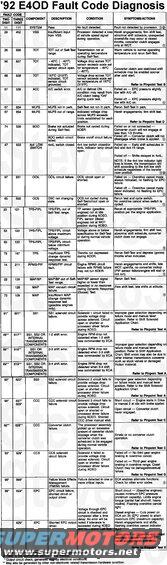
'92 E4OD Diagnostic Trouble Code (DTC) Diagnosis List
IF THE IMAGE IS TOO SMALL, click it.
Drive Cycle Test
After performing the EEC-IV Quick- Test, the following drive cycle test for checking E4OD continuous codes should be performed.
NOTE: Faults have to appear four times consecutively for continuous codes 49, 59 and 69 to be set, and five times consecutively for continuous code 62.
1. Record and zero EEC-IV Quick-Test codes.
2. Verify that the transmission fluid level is correct.
3. Warm engine to operating temperature.
4. With transmission in (D) range, press the overdrive cancel switch (LED light should illuminate) and moderately accelerate from stop to 64 km/h (40 mph). This will allow the transmission to shift into third gear. Hold speed and throttle opening steady for a minimum of 15 seconds (30 seconds above 4000 feet altitude).
5. Press overdrive cancel switch (LED light should turn off) and accelerate from 65 km/h (40 mph) to 80 km/h (50 mph). This will allow the transmission to shift into fourth gear. Hold speed and throttle position steady for a minimum of 15 seconds.
6. With transmission in fourth and maintaining steady speed and throttle opening, lightly apply and release brake (to operate stoplamps). Then hold speed and throttle steady for an additional five seconds minimum.
7. Brake to a stop and remain stopped for a minimum of 20 seconds with the transmission in (D) range.
8. Repeat Steps 4 through 6 at least five times.
9. Perform EEC-IV Quick-Test and record continuous codes.
NOTE: If any other fault codes appear, service those codes first as they could affect the electrical operation of the transmission.
NOTE: After the servicing of any fault codes resulting from the Quick- Test, the Quick-Test should be repeated.
Automotive Terms & Abbreviations
See also: .
.  .
.  .
.  .
. 
This document covers 1992, which may differ from this 1983 Ford Bronco.
Is this accurate? Sign in to help verify it.
Frequently asked questions
- What does E4OD code 452 (two-digit 29) mean?
- Insufficient input from the VSS, the processor detected a loss of vehicle speed signal during operation. Symptoms include harsh engagements, firm shift feel, abnormal shift schedule, unexpected downshifts at closed throttle, and the converter clutch engaging only at WOT.
- What causes E4OD codes 621 and 622?
- Code 621 (91) is an SS1 solenoid circuit failure and 622 (92) is an SS2 solenoid circuit failure, the solenoid circuit failed to provide a voltage drop across the solenoid due to an open, short, or processor driver failure during KOEO. Both cause improper gear selection and direct you to Pinpoint Test A and the Shift Solenoid Application Chart.
- What does code 111 mean on a '92 E4OD?
- Code 111 (two-digit 11) is a system pass, no fault was detected by the processor.
- What do codes 617, 618, and 619 indicate?
- They are 1-2, 2-3, and 3-4 shift errors respectively: engine RPM drop was not detected when the shift was commanded by the ECA. They can involve SS1, SS2, or internal transmission components such as stuck valves or damaged friction material.
- What are the symptoms of an EPC circuit failure (code 624/625)?
- A short circuit on gasoline engines causes minimum EPC pressure, limited engine torque (partial fuel shut-off, heavy misfire) and a flashing overdrive cancel light; on diesels it cuts power on ECA pin 35 to attain maximum EPC, causing harsh engagements/shifts. An open circuit causes maximum EPC and harsh engagements and shifts on both engine types. Refer to Pinpoint Test E.
Comments
More from this build

No comments yet.