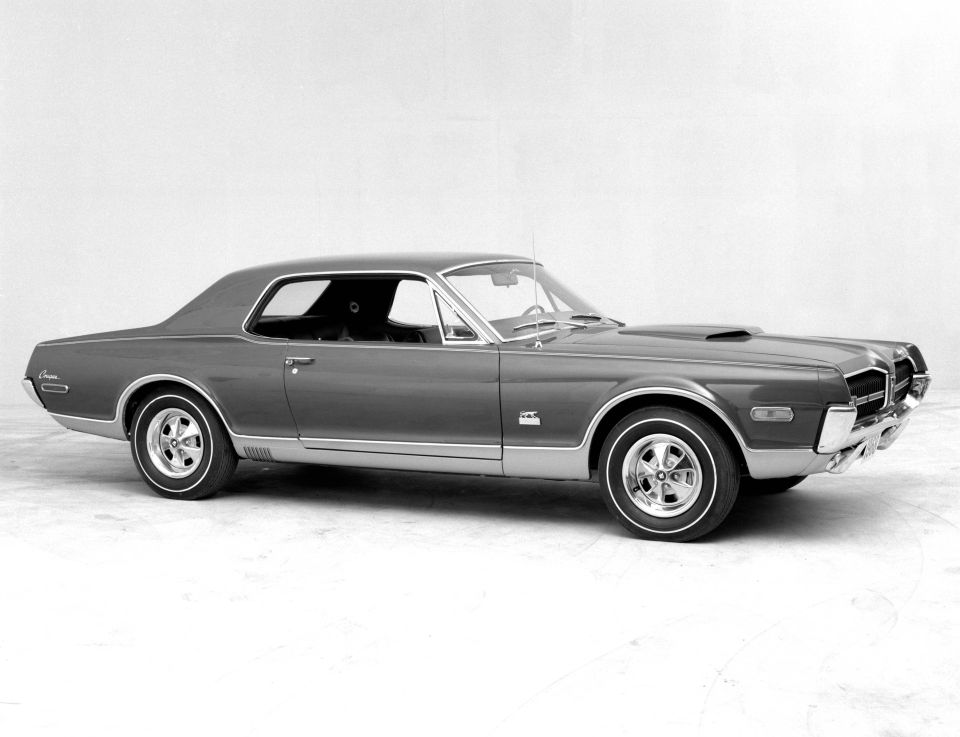
The first-generation Mercury Cougar (1967-1970) is a pony car built on a stretched Ford Mustang platform, with the wheelbase lengthened 3 inches to 111. Every Cougar left the factory with a V8, starting with the 289 and running up through the 302, 351, 390, and the 427 and 428 Cobra Jet big blocks. Hidden headlamps behind a full-width electric-shaver grille and sequential rear turn signals set it apart from the Mustang, and Motor Trend named it Car of the Year for 1967.
Other Mercury Cougar generations
Platform
The 1967-1970 Mercury Cougar shares its unibody structure, front suspension, and rear leaf-spring layout with the Ford Mustang, but rides on a 111-inch wheelbase, 3 inches longer than the Mustang's 108. The extra length sits between the firewall and the rear axle, which gives the Cougar a smoother ride and slightly more rear-seat room. Through 1968 the only body style was a two-door hardtop. A convertible joined the line for 1969, when the body was restyled larger and wider along with the Mustang. No fastback Cougar was ever built.
Engines
No first-generation Cougar came with a six. The base engine in 1967 was the 289 cubic inch V8 with a 2-barrel carburetor at 200 hp gross, and a 4-barrel 289 rated 225 hp was optional. The 1968 model year opened with the 289 2V, now rated 195 hp, and during the year the 302 took its place, rated 210 hp with a 2-barrel or 230 hp with a 4-barrel. For 1969 the 351 Windsor 2V at 250 hp became the standard engine, with a 4-barrel version at 290 hp optional; for 1970 the 4-barrel car switched to the 351 Cleveland at 300 hp. All figures for these cars are gross ratings, since net ratings did not take over until 1972.
- 289, 200 hp 2V standard and 225 hp 4V optional in 1967; the 2V dropped to 195 hp for early 1968
- 302, 210 hp 2V or 230 hp 4V, replaced the 289 during 1968
- 351 Windsor, standard for 1969, 250 hp (2V) or 290 hp (4V)
- 351 Cleveland 4V, 1970, 300 hp
- 390 4V, 320 hp in 1967 (GT option), continued through 1969
- 427, 390 hp, GT-E only, 1968
- 428 Cobra Jet, rated 335 hp, from spring 1968 through 1970
The rare GT-E package appeared for 1968 only. It launched with the 427 side-oiler wearing a 4-barrel and a hydraulic cam, rated at 390 hp and sold only with an automatic. Partway through the 1968 model year the 427 was dropped and the 428 Cobra Jet took its place in the GT-E. Total GT-E production was 394 cars, 357 with the 427 and 37 with the 428 CJ.
Drivetrain and transmissions
All first-generation Cougars are front-engine, rear-wheel drive. Small blocks used a 3-speed manual as the base transmission, with a 4-speed manual and a 3-speed automatic optional. The automatic was the C4 behind the 289 and 302, the cast-iron FMX behind the 351, and the C6 behind the 390 and 428. The 427 GT-E came only with the automatic, but once the 428 CJ replaced it a 4-speed became available. Rear axles are Ford 8-inch on most small-block cars and the 9-inch behind the big blocks, with optional Traction-Lok limited slip. 428 CJ cars ordered with the Drag Pak got 3.91 or 4.30 gears and an oil cooler, making the engine a Super Cobra Jet.
Year-by-year changes
- 1967: Launch year. 289 standard, 390 optional, GT handling package available. Hidden headlamps and sequential turn signals from the start.
- 1968: 289 (now 195 hp) starts the year, then the 302 replaces it. GT-E package with the 427, then the 428 CJ mid-year. XR7-G appears, a Dan Gurney-themed dress-up package built with hood scoop, fog lamps, and optional sunroof. Side marker lights added per federal rule.
- 1969: Full restyle, wider and about 3 inches longer overall, headlamp doors now horizontal. Convertible added. 351 Windsor 2V becomes the standard engine. Eliminator introduced in spring 1969.
- 1970: Front-end refresh with a vertical center grille section. 351 Cleveland replaces the Windsor 4V. Eliminator continues. Last year of the first generation before the bigger 1971 body.
Trims and variants
The XR-7 was the luxury trim all four years, with a wood-rimmed steering wheel, full instrumentation including a tachometer, toggle switches, and leather-and-vinyl seating. It could be combined with any engine, which means an XR-7 with a 428 CJ is a real factory combination.
The Eliminator ran 1969-1970 as the performance package, answering the Mustang Mach 1. It came with a blacked-out grille, front and rear spoilers, hood scoop, side stripes, and high-back buckets, offered in bright colors like Competition Orange and Bright Blue. Engine choices ran from the 351 4V up through the 390 (1969 only) and 428 Cobra Jet, plus the solid-lifter Boss 302 at 290 hp, the same engine as the Boss 302 Mustang. Eliminators are far scarcer than their Mustang counterparts: 2,250 built for 1969 and 2,268 for 1970.
Asked all the time
What engines came in the 1967-1970 Mercury Cougar?
Every first-generation Mercury Cougar (1967-1970) has a V8. The base engine was the 289 in 1967, replaced during 1968 by the 302, with the 351 Windsor becoming standard for 1969 and the 351 Cleveland 4V arriving for 1970. Big-block options were the 390 (1967-1969), the 427 in the 1968 GT-E only, and the 428 Cobra Jet from spring 1968 through 1970.
Which years did the Cougar GT-E use the 427 versus the 428 Cobra Jet?
The Mercury Cougar GT-E was a 1968-only package. It started the model year with the 427 rated at 390 hp gross, automatic only. Partway through 1968 the 427 was discontinued and the 428 Cobra Jet replaced it in the GT-E. Only 394 GT-Es were built in total, 357 with the 427 and just 37 with the 428 CJ.
What is a Cougar Eliminator and what years was it made?
The Cougar Eliminator was Mercury's performance package for 1969 and 1970, introduced in spring 1969. It added spoilers, a hood scoop, stripes, and a blacked-out grille. Engines ranged from the 351 4V to the 428 Cobra Jet (335 hp gross), plus the solid-lifter Boss 302 at 290 hp. Production was 2,250 for 1969 and 2,268 for 1970.
When could you buy a Cougar convertible?
The first Mercury Cougar convertible arrived for the 1969 model year, when the body was restyled larger. For 1967 and 1968 the Cougar was sold only as a two-door hardtop. Convertibles continued through 1970 in both base and XR-7 trim.
What made the Cougar XR-7 different from a base Cougar?
The XR-7 was the luxury trim of the 1967-1970 Mercury Cougar. It added leather-and-vinyl upholstery, a wood-rimmed steering wheel, full gauges with a tachometer, and toggle switches on the dash. Any engine could be ordered in an XR-7, including the 428 Cobra Jet, so luxury trim and big-block power were not mutually exclusive.
How is the first-generation Cougar different from the Mustang it is based on?
The 1967-1970 Mercury Cougar uses the Ford Mustang's unibody and suspension but stretches the wheelbase 3 inches to 111, all of it added between the firewall and rear axle for a better ride. It also got hidden headlamps, sequential rear turn signals, more sound insulation, and V8-only engine lineups. The Mustang's six-cylinder and fastback body were never offered on the Cougar.
Technical Reference
Member-uploaded diagrams & documents for this generation. AI-classified; community-verified where badged.
Brochures & Literature (9)
- 1968 Mercury Cougar Hertz/Shelby XR7-G Show Board - History, 390 GT & OptionsThis is a car show display board for a 1968 Mercury Cougar Hertz/Shelby XR7-G owned by Allan Steinbock of Pittsburgh, PA. It explains the Hertz Rent-A-Racer program (tag line: "Every man should drive a sports-car even…
- 1968 Mercury Cyclone Cobra Jet Road Test - Car Life July 1968 Specs & DataThis is page 19 of the July 1968 issue of Car Life magazine, part of a multi-page road test of the Mercury Cyclone equipped with the 428 Cobra Jet engine. The narrative text discusses the car's rapid acceleration…
- 1968 Mercury Cyclone 428 Cobra Jet - Car Life Road Test Specs & DataThis is a page (page 18) from Car Life magazine featuring a road test continuation and full specification table for the 1968 Mercury Cyclone equipped with the 428 Cobra Jet V-8. The article text discusses the Cyclone's…
- 1968 Mercury Cyclone 428 Cobra Jet Road Test - Car Life July 1968, Page 17This is page 17 of the July 1968 issue of Car Life magazine, part of a road test article on the 1968 Mercury Cyclone equipped with the 428-cid Cobra Jet V-8. The article explains that the Cobra Jet engine combines the…
- 1968 Mercury 428 Street Cyclone Road Test - Car Life Magazine Page 16This is a scanned page (page 16) from Car Life magazine featuring a road test article titled "Can Mercury's Daytona Image Maker Deliver? 428 STREET CYCLONE." The page shows two black-and-white photographs by Paul E…
- 1968 Mercury Cougar GT-E 427 V8 Specs - Muscle Cars Card #89This document is a collector-series reference card (Muscle Cars series, Group 4, Number 89) covering the 1968 Mercury Cougar GT-E, produced by Ford Motor Co. of Dearborn, Michigan. It explains that the Cougar debuted…
- Mecum Auctions Friday Lot Sheet - Classic Car Run List F1-F69 (State Farm)This document is a Mecum Auctions Friday lot sheet (run list), sponsored by State Farm, listing collector vehicles by lot number for a Friday auction session. The notation "NR = NO RESERVE" appears at the top…
- Ford Engine Paint Colors 1959-1962: Block, Valve Cover & Air Cleaner ChartThis document is a printed page (dated 8/27/2018) from a Scale Auto Magazine forum/article titled "'59 Ford Engine color," aimed at builders of plastic and resin scale model cars. It explains that Ford engine colors on…
- Ruger Mark II .22 LR Pistol Instruction Manual Envelope - Sturm Ruger & Co.This image shows a photograph of an instruction manual packaging envelope from Sturm, Ruger & Company, Inc. of Southport, Connecticut 06490 U.S.A., resting on a yellow/orange box. The white envelope is printed with the…
Data/Spec Plates (2)
- 1968 Mercury Cougar XR7-G Hertz Marti Report - 390-4V, Cardinal Red, 1 of 188This is a Marti Auto Works Deluxe Report (an Official Licensed Product of Ford Motor Company, copyright Kevin Marti 2004) documenting a 1968 Mercury Cougar XR-7 Hardtop, serial number 8F93S545131. The report decodes…
- 1972 Oldsmobile Hurst/Olds Pace Car Edition 455 - Mecum Auction Lot T248 CardThis document is a Mecum Auctions windshield lot card (lot T248, Thursday) for a 1972 Oldsmobile Hurst/Olds Pace Car Edition with a 455 CI automatic drivetrain, offered as a Star C, No Reserve lot with a pre-auction…
Manual Pages (4)
- 1968 4-Pinion Locking Differential Shim Pack Chart - Traction-Lok Setup GuideThis is page 9 of a factory service/training publication introducing the "New 4-Pinion Locking Differential" (limited-slip / Traction-Lok type). The dominant element is Figure 4, a Shim Pack Usage Chart that converts a…
- 1967 Ford Telegram: 428 Cobra Jet Mustang Announcement - Specs & PricingThis document is a scanned Ford Motor Company internal telegram dated December 26, 1967, sent from Product Development to all Regional and District Sales Managers announcing the 428 Cobra Jet engine Mustang. It…
- 1967 Ford 428 Cobra Jet Program Memo - Special 50 Car Build RequirementsThis is a scanned Ford internal memorandum dated 12/1/67 titled "Requirements for Special (50) Car Build: Cobra Jet Program." It lists the build specifications for a special run of 50 428 Cobra Jet cars. The engine is…
- 1968-69 Ford/Mercury MPC Rear Axle Housing (4010) Part Numbers & HardwareThis is a cropped scan of a Ford/Mercury Master Parts Catalog (MPC) page listing rear axle housing assemblies (basic part number 4010) and their related hardware for 1967-1969 vehicles. The table cross-references axle…
Service Procedures (4)
- 1968 Ford 4-Pinion Locking Differential Assembly & Model Usage - Mustang CougarThis page is from a Ford service publication introducing the "New 4-Pinion Locking Differential" (Traction-Lok). It provides numbered assembly steps 6 through 20 covering installation of shaft lock pins, pre-load…
- Power Brake Booster Push Rod Adjustment - Bendix & Midland-Ross Gauge SpecsThis service procedure page describes how to check and adjust the push rod on a power brake booster (both Midland-Ross and Bendix types). The push rod's adjustment screw maintains the correct relationship between the…
- 1968 Ford 4-Pinion Locking Differential Service Procedure - 390/428 Traction-LokThis is page one of a Ford service publication introducing the new 4-pinion torque sensitive locking differential, offered as optional equipment on 1968 Mustang, Cougar, Fairlane and Montego models equipped with 390 or…
- 1968 Ford A/C Vacuum Actuator & Temp Door Cable Adjustment - Cougar, MustangThis is page 16-31 from a Ford factory shop manual, Part 16-2 (Air Conditioning), covering vacuum actuator and temperature door adjustment procedures. It describes adjusting single-acting vacuum actuators so return…
Schematics (2)
- Ford 390 V-8 Lubrication System Diagram - Oil Flow Schematic (Fig. 11)This is a scanned page from an automotive service manual showing Figure 11, a cutaway schematic of the lubrication system for the Ford 390 V-8 engine (illustration code A2023-D). The diagram depicts the engine block in…
- 1967-68 Mercury Cougar LED Gauge Cluster Bulb Conversion Kit FC6768MC-EL2This image shows an LED gauge cluster conversion kit and its accompanying instruction/reference sheet for the 1967-68 Mercury Cougar. The blister-packed kit, made by HiPo Parts, LLC (kit number FC6768MC-EL2, marketed…
Exploded Parts (3)
- Ford Autolite 2100 Carburetor Exploded Parts Diagram - 1967-68 CougarThis is a scanned page from a factory-style service manual showing 'FIG. 20: Carburetor Assembly,' an exploded parts diagram of a Ford/Autolite two-venturi (2100-type) carburetor. The uploader filed it in a 1967…
- 1967 Mercury Cougar 289 V8 A/C Engine Compartment Parts Exploded DiagramThis is a page (page 12, Illustration Section 197.2) from a Lincoln-Mercury Car Parts illustration catalog showing an exploded parts diagram of the Air Conditioner Parts (Engine Compartment) - Integral for the 1967…
- Shelby ID-1067 Manual Choke Installation Diagram - 428 CJ Holley Carburetor 1969This is a scanned Shelby Automotive, Inc. Product Engineering drawing (No. ID-1067), dated and released 9-19-69, drawn by L.C.G., titled "Installation - Manual Choke (428 C.V.)". It is an exploded-view instruction…
Wiring Diagrams (3)
- 1968 Mercury Cougar Sequential Turn Signal & Brake Light Wiring Diagram Fig. 42This document is page 19-59 from a Ford/Mercury factory shop manual schematic section (Group 19: Schematics), showing FIG. 42, 'Turn Signals, Emergency Warning and Brake Lights, Cougar (Continued).' It is a wiring…
- 1968 Mercury Cougar Turn Signal, Hazard & Brake Light Wiring Diagram (Fig. 42)This is page 19-58 from a factory service manual schematics section (Group 19: Schematics), showing FIG. 42: Turn Signals, Emergency Warning and Brake Lights, Cougar (drawing reference K 2257 A1). The schematic…
- 1967 Mercury Cougar XR-7 Wiring Diagram - Instrument Panel, Console & Turn SignalsThis is a scanned factory-style wiring diagram page titled 'Direction Signals' (page 3WD-589) covering the Ford Motor Co. sequential turn signals (continued), specifically the 1967 Cougar XR-7 instrument panel and…
Blueprints (5)
- Shelby American Blueprint S8MS 9C507A - Bearing Housing, Lucas Mark II Fuel InjThis is a scanned Shelby American, Inc. engineering blueprint (drawing number S8MS 9C507 A) for a machined aluminum part titled 'Bearing Housing, Timing Gear, Fuel Inj,' for the 'Lukas (Lucas) Mark II Fuel Injection'…
- 1968 Shelby Cobra Jet 428 Fender Emblem Blueprint S9MS-16C144-A DrawingThis is an original Shelby Automotive, Inc. Product Engineering blueprint (drawing no. S9MS-16C144-A), dated 9-12-68, for the "Cobra Jet Plaque", the emblem assembly for the front fender sides reading "COBRA 428 JET."…
- 1968 Shelby GT500J Rocker Panel Stripe Kit Blueprint S8MS-16A224 - DimensionsThis is a scan of an original Shelby Automotive, Inc. Product Engineering blueprint, drawing number S8MS-16A224, dated 3/27/68, titled "KIT - ROCKER PANEL STRIPE." It documents the rocker panel stripe kit for the…
- Shelby American Blueprint S8MS 9C501-A Timing Gear & Hub, Lucas Mark II Fuel InjThis is a scan of an original Shelby American, Inc. engineering blueprint (drawing number S8MS 9C501-A) titled "Timing Gear and Hub Assembly, Fuel Inj," drawn for the Lucas Mark II fuel injection model. Dated May 1967…
- Pushrod Check Gauge Template: Mustang, Cougar, Falcon, Bendix, Midland-RossThis document is a dimensioned blueprint/template for fabricating a homemade checking gauge from #16 gauge sheet steel. The gauge is a rectangular piece measuring 1 3/4 inches wide by 2 7/8 inches tall, with a notch…
Vacuum Routing (1)
- Vintage V8 Electronic Fuel Injection System Diagram - 1968 Mercury Cougar 428This document is a large hand-drawn schematic/installation diagram of an early electronic fuel injection (EFI) system for a V8 engine. It shows the complete layout of the system's electrical and fuel plumbing…
The wall · registered 1967-1970 Cougars
Sorted by depth of documentation. Click any vehicle to open its permanent record.