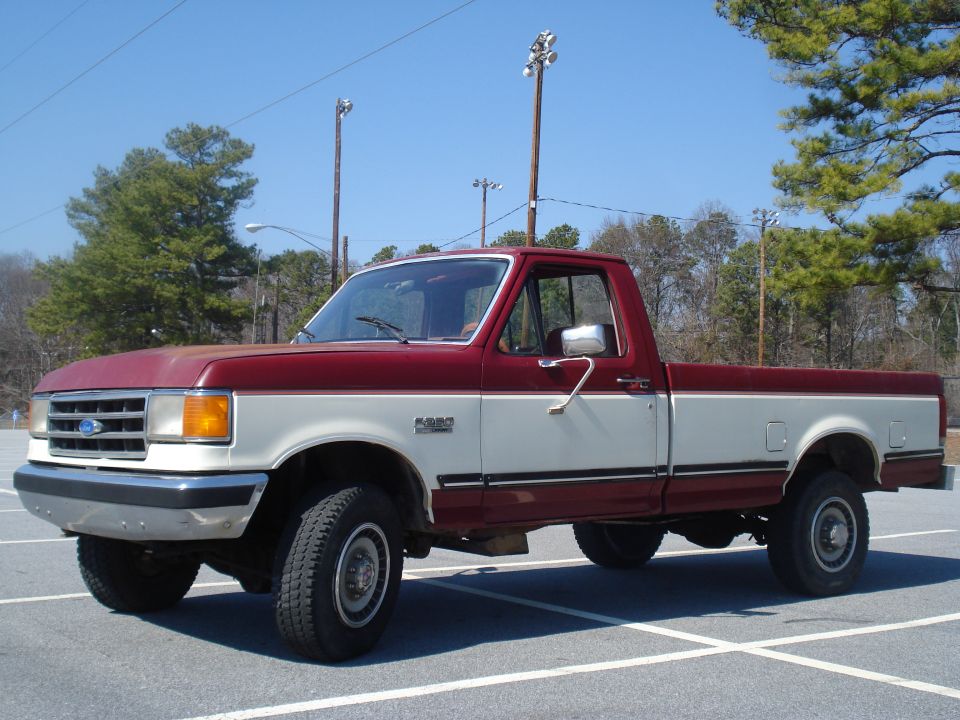
The 1987 model year brought the eighth-generation Ford F-Series, a major refresh of the Bullnose truck that softened the front end and updated the interior. The 1987-1991 Ford F-250 is the three-quarter-ton version, and along with the 1992-1997 trucks it is grouped by enthusiasts under the label "OBS," short for Old Body Style, because both share the same basic cab introduced for 1987. The 1987 redesign made the F-250 one of the first American trucks with flush composite headlamps and added standard rear-wheel anti-lock brakes. The diesel changed early in the generation: the 6.9L IDI V8 was offered for 1987, then the larger 7.3L IDI V8, also built by International Harvester, replaced it for 1988. The gas engines were the 300-cubic-inch (4.9L) inline-six, the 5.0L (302) and 5.8L (351 Windsor) V8s, and the 7.5L (460) big-block, with electronic fuel injection spreading across the V8 lineup by 1988. The four-wheel-drive 1987-1991 Ford F-250 used a Dana 50 Twin-Traction Beam independent front suspension, continuing the Twin-Traction Beam layout the F-250 adopted for 1980; the Dana 50 became the sole F-250 4x4 front axle for 1987. Transmissions included ZF five-speed manuals and, increasingly, the E4OD four-speed automatic for heavy-duty and diesel trucks.
Other Ford F-250 generations
The 1987-1991 Ford F-250 at a glance
- Generation: eighth-generation F-Series, grouped with the 1992-1997 trucks as "OBS" (Old Body Style)
- Years: 1987 through 1991, restyled into the ninth-generation "Aeronose" F-250 for 1992
- New for 1987: composite headlamps and standard rear-wheel anti-lock brakes
- Gas engines: 4.9L (300) I6; 5.0L (302); 5.8L (351 Windsor); 7.5L (460) big-block, with EFI spreading across the V8s by 1988
- Diesel: 6.9L IDI for 1987, then the 7.3L IDI (International Harvester) from 1988
- 4x4 front suspension: Dana 50 Twin-Traction Beam independent front, the sole F-250 4x4 axle from 1987
- Transmissions: ZF five-speed manuals; C6 then the E4OD four-speed automatic for heavy-duty and diesel trucks
- Body styles: regular cab, SuperCab, and Crew Cab; Camper Special offered
Ford F-250 1987-1991 year by year
| Year | Ford F-250 changes | Engines offered |
|---|---|---|
| 1987 | Eighth-generation refresh arrives: composite headlamps, redesigned interior, standard rear ABS; the Dana 50 Twin-Traction Beam becomes the sole F-250 4x4 front axle | 4.9L I6 (gains EFI); 5.0L (EFI); 5.8L; 7.5L; 6.9L IDI diesel |
| 1988 | The 7.3L IDI diesel replaces the 6.9L IDI in the Ford F-250; electronic fuel injection reaches the last carbureted gas engines, the 5.8L and 7.5L | 4.9L I6; 5.0L; 5.8L (EFI); 7.5L (EFI); 7.3L IDI diesel |
| 1989 | The E4OD four-speed automatic becomes available, adding overdrive to the Ford F-250 automatic lineup | 4.9L I6; 5.0L; 5.8L; 7.5L; 7.3L IDI diesel |
| 1990 | Minor trim and equipment changes to the Ford F-250; powertrain carries over | 4.9L I6; 5.0L; 5.8L; 7.5L; 7.3L IDI diesel |
| 1991 | Final year of the eighth-generation Ford F-250 before the 1992 "Aeronose" restyle | 4.9L I6; 5.0L; 5.8L; 7.5L; 7.3L IDI diesel |
What the "OBS" label means
The 1987 Ford F-250 introduced the eighth-generation F-Series, a major refresh that kept the underlying Bullnose chassis but gave the truck a smoother front end, flush composite headlamps, and a redesigned interior. Because the 1987-1991 and 1992-1996 trucks share the same basic cab, enthusiasts group them under the term "OBS," for Old Body Style, a label coined after the very different 1997 light-duty redesign. The 1987 Ford F-250 was among the first American trucks to use composite (aerodynamic, replaceable-bulb) headlamps and came with standard rear-wheel anti-lock brakes, an early adoption of ABS in the truck market. As before, the three-quarter-ton F-250 shared its cab with the lighter F-Series and was distinguished by its heavier chassis and higher ratings.
The diesel change: 6.9L IDI to 7.3L IDI
The 1987 Ford F-250 carried over the 6.9L IDI (indirect injection) diesel V8 from the Bullnose era, but for 1988 Ford replaced it with the larger 7.3L IDI V8, also built by International Harvester. Both were naturally aspirated indirect-injection diesels valued for durability and low-speed torque rather than peak output. The 7.3L IDI became the diesel of the eighth-generation F-250 and would later gain a factory turbocharger and then evolve into the 7.3L Power Stroke in the following generation. The diesel was the heavy-duty workhorse engine of the F-250, aimed at towing and hauling buyers who wanted diesel economy.
Gas engines and transmissions
The gas engines of the 1987-1991 Ford F-250 were the 300-cubic-inch (4.9L) inline-six as the base engine, the 5.0L (302) and 5.8L (351 Windsor) V8s, and the 7.5L (460) big-block for heavy towing. Electronic fuel injection spread across the V8 lineup by the 1988 model year, replacing the remaining carburetors. Transmissions included ZF five-speed manuals and the heavy-duty C6 three-speed automatic, with the E4OD four-speed automatic becoming available for 1989; the E4OD added an overdrive top gear and became the modern heavy-duty automatic for the diesel and big-block F-250.
The Dana 50 Twin-Traction Beam front suspension
The four-wheel-drive 1987-1991 Ford F-250 used a Dana 50 Twin-Traction Beam (TTB) independent front suspension, which became the sole F-250 four-wheel-drive front axle for 1987. TTB is an independent design in which two beams pivot separately, each carrying one wheel. A common misconception is that the OBS F-250 used a solid front axle; the F-250 of this era used the independent Dana 50 TTB, while the solid front axle belonged to the one-ton F-350. The solid front axle would not appear on the F-250 until the Super Duty platform arrived for 1999.
Body styles and trim
The 1987-1991 Ford F-250 was offered in regular-cab, SuperCab, and four-door Crew Cab forms, with the Camper Special package available for slide-in camper duty. Trim levels spanned the work-grade Custom and XL, the better-equipped XLT Lariat, and other appearance and equipment packages offered during the generation.
Frequently asked questions
What generation is the 1987-1991 Ford F-250?
The 1987-1991 Ford F-250 is the eighth-generation F-Series. It is grouped with the 1992-1997 trucks under the enthusiast label "OBS," for Old Body Style, because both share the same basic cab introduced for 1987. It was restyled into the ninth-generation "Aeronose" F-250 for 1992.
What diesel did the 1987-1991 Ford F-250 use?
The 1987 Ford F-250 used the 6.9L IDI diesel V8, then for 1988 Ford replaced it with the larger 7.3L IDI V8, also built by International Harvester. Both were naturally aspirated indirect-injection diesels; the 7.3L IDI later gained a factory turbocharger and evolved into the 7.3L Power Stroke.
What gas engines did the 1987-1991 Ford F-250 use?
The 1987-1991 Ford F-250 used the 4.9L (300) inline-six as the base engine, the 5.0L (302) and 5.8L (351 Windsor) V8s, and the 7.5L (460) big-block. Electronic fuel injection spread across the V8 lineup by 1988.
Did the 1987-1991 Ford F-250 4x4 have a solid front axle?
No. The 1987-1991 Ford F-250 4x4 used a Dana 50 Twin-Traction Beam independent front suspension. The solid front axle in this era belonged to the one-ton F-350; the solid front axle did not appear on the F-250 until the Super Duty platform arrived for 1999.
What was new on the 1987 Ford F-250?
The 1987 Ford F-250 introduced the eighth-generation refresh with composite headlamps, a redesigned interior, and standard rear-wheel anti-lock brakes. The Dana 50 Twin-Traction Beam also became the sole F-250 4x4 front suspension that year.
Sources
- Ford factory specification sheets for the 1987-1991 F-Series
- Wikipedia, Ford F-Series (eighth generation)
- DieselHub references, 6.9L and 7.3L IDI diesels
- Blue Oval Trucks reference, Dana 50 Twin-Traction Beam front axle
- VIN and data-plate decoding for engine and axle identification
Asked all the time
What generation is the 1987-1991 Ford F-250?
The 1987-1991 Ford F-250 is the eighth-generation F-Series. It is grouped with the 1992-1997 trucks under the enthusiast label "OBS," for Old Body Style, because both share the same basic cab introduced for 1987. It was restyled into the ninth-generation "Aeronose" F-250 for 1992.
What diesel did the 1987-1991 Ford F-250 use?
The 1987 Ford F-250 used the 6.9L IDI diesel V8, then for 1988 Ford replaced it with the larger 7.3L IDI V8, also built by International Harvester. Both were naturally aspirated indirect-injection diesels; the 7.3L IDI later gained a factory turbocharger and evolved into the 7.3L Power Stroke.
What gas engines did the 1987-1991 Ford F-250 use?
The 1987-1991 Ford F-250 used the 4.9L (300) inline-six as the base engine, the 5.0L (302) and 5.8L (351 Windsor) V8s, and the 7.5L (460) big-block. Electronic fuel injection spread across the V8 lineup by 1988.
Did the 1987-1991 Ford F-250 4x4 have a solid front axle?
No. The 1987-1991 Ford F-250 4x4 used a Dana 50 Twin-Traction Beam independent front suspension. The solid front axle in this era belonged to the one-ton F-350; the solid front axle did not appear on the F-250 until the Super Duty platform arrived for 1999.
What was new on the 1987 Ford F-250?
The 1987 Ford F-250 introduced the eighth-generation refresh with composite headlamps, a redesigned interior, and standard rear-wheel anti-lock brakes. The Dana 50 Twin-Traction Beam also became the sole F-250 4x4 front suspension that year.
Technical Reference
Member-uploaded diagrams & documents for this generation. AI-classified; community-verified where badged.
Service Procedures (2)
- TransGo Shift Kit Step 1 Separator Plate Hole Drill Sizes - Instructions Page 4This document is Page 4 of a TransGo automatic transmission shift kit installation instruction set, dated 05 Aug 2013. It covers 'Step 1: Plate Hole Sizes,' instructing the installer on how to drill specific holes in…
- Ford E4OD/4R100 2nd & 3rd Accumulator Install - TransGo Shift Kit Page 3This is page 3 of a TransGo transmission shift kit installation instruction sheet (dated 05 Aug 2013, © TransGo 2013) covering the 2nd and 3rd accumulator pistons in a Ford automatic transmission case. Step 1 covers…
Wiring Diagrams (19)
- Ford C115 Connector Pinout - PCM/EEC 42-Pin Wiring Functions DiagramThis document is a pin-by-pin legend for the Ford C115 connector, listing the function of each of its 42 pins. Powered circuits include pin 1 (power for coils, key-on 20a fuse), pin 8 (power hot at all times, 20a…
- Ford C115 In-Line Connector Pinout - 42-Pin C115F/C115M Circuit & Wire ColorsThis document is a connector pinout reference for the C115 in-line connector pair, showing both the female side (C115F) and male side (C115M) of a 42-pin bulkhead-style in-line connector. Each connector face is…
- Ford PCM Connector C202 Pinout Diagram - Pins 1-34 Wire Colors & FunctionsThis document is a pinout diagram and legend for connector C202, the Powertrain Control Module (PCM) connector on a Ford vehicle. The top portion shows a 104-pin connector face with pins numbered 1 through 104 arranged…
- Ford C116 In-Line Connector Pinout - 38-Pin Wiring Diagram (C116F & C116M)This document is a connector pinout reference showing the C116 in-line electrical connector pair on a Ford truck: C116F (female half) and C116M (male half). Both connector faces are drawn with all 38 cavity positions…
- Ford C115 In-Line Connector Pinout - 42-Pin C115F & C115M Wire Circuit ChartThis document is a connector pinout reference for the C115 in-line connector pair, showing both the female (C115F) and male (C115M) 42-pin connector faces with numbered cavity diagrams, followed by pin-to-circuit…
- Ford PCM Wiring Diagram: 4R70W Trans Controls, CMP Sensor, MIL/TCIL CircuitsThis document is a single page from a Ford factory-style wiring diagram (EVTM) showing Powertrain Control Module (PCM) circuits. It illustrates wiring from the PCM to the instrument cluster's Transmission Control…
- Ford F-250 PCM Wiring Diagram - HO2S, ECT, TP & EVP Sensor Circuits (E6)This document is one page (E6) of a multi-page Ford wiring diagram set covering the engine control/fuel system sensors. It shows the Powertrain Control Module (PCM, labeled 'SOLID STATE') and its wiring to Heated…
- Ford HO2S #3/#4, IAT & Octane Adjust Wiring Diagram - PCM Pinout (4R70W)This document is one page (E5) of a multi-page Ford factory-style wiring diagram set covering the engine control / EEC system. It shows the wiring for Heated Oxygen Sensors (HO2S) #3 and #4, the Powertrain Control…
- Ford PCM Wiring Diagram - Fuel Injectors, EGR/EVR, IAC, VSS & MAF CircuitsThis scan is one page of a Ford powertrain wiring diagram set covering the fuel injection and engine-management circuits. It shows fuel injectors #1-#4 (connectors C164, C167, C168, C161), the EGR Vacuum Regulator…
- Ford Wiring Diagram - Fuel Injectors 5-8, PCM, DLC & Fuel Tank Pressure SensorThis is one page (E3) of a multi-page Ford factory-style wiring diagram set covering the engine control / fuel injection system. It shows fuel injectors #5 through #8, each fed by wire 361 (Red) from splice S117…
- Ford F-Series PCM Wiring Diagram - WOT A/C Relay, EVAP Purge & Coil Outputs (E2)This is one page (E2) of a multi-page Ford factory-style wiring diagram set covering engine/powertrain control circuits. It shows the Powertrain Control Module (PCM) and its related circuits: the PCM power relay feed…
- Ford Fuel Pump & PCM Power Wiring Diagram - Relays, Inertia Switch, CircuitsThis document is a Ford factory-style wiring diagram (EVTM page) covering the fuel pump and Powertrain Control Module (PCM) power circuits. It shows power feeds labeled 'HOT IN START OR RUN' and 'HOT AT ALL TIMES' from…
- Ford E4OD Transmission PCM Wiring Diagram - MAF, TP, ECT, TCS & BOO Switch (T3)This is a Ford powertrain/transmission control wiring diagram (page T3 of a multi-page set) showing sensor and switch inputs to the Powertrain Control Module (PCM). It covers the Mass Air Flow (MAF) sensor, Intake Air…
- Ford 4R70W Transmission Wiring Diagram - TFT, TCC, EPC & Shift Solenoids to PCMThis document is one page of a Ford wiring diagram set (page references 25-2, 25-5, 25-7 and 30-1 indicate an EVTM-style manual) covering the 4R70W automatic transmission electrical circuits. It shows power feed…
- Ford Transmission Wiring Diagram - TR Sensor, OSS Sensor & PCM Circuits (T1)This document is a Ford factory-style wiring diagram (EVTM page) covering the transmission control circuits, centered on the Transmission Range (TR) sensor and the Output Shaft Speed (OSS) sensor and their connections…
- Ford Overdrive Switch Connector Pinout & Wire Colors Diagram (F-250)This document is a wiring/connector pinout diagram for a Ford overdrive switch. It shows the switch connector face with numbered pin positions (6 and 4 at the top, 5 and 1 at the bottom) and identifies five circuits…
- Ford PMGR Starter Wiring Diagram - Solenoid, Relay & Cable InstructionsThis document is a wiring instruction diagram for a Ford PMGR (Permanent Magnet Gear Reduction) starter. It illustrates how to connect a PMGR-style starter motor to the vehicle's starter relay (fender-mounted solenoid)…
- 1990 Ford F-250 Center Console Gauge Panel Wiring Diagram - Voltmeter & OutletsThis document is a hand-drawn wiring diagram (created in a simple graphics program) for a custom center console gauge panel, uploaded to a 1990 Ford F-250 gallery. It depicts two large circular gauges (a voltmeter on…
- Ford PCM C202 Connector Pinout (Pins 35-90) - Circuit & Wire Color ChartThis document is a connector pinout table (part 2 of the C202 powertrain control module connector, per the filename C202-b.gif) covering pins 35 through 90. For each pin it lists the circuit number, wire color code…
Vacuum Routing (1)
- Ford 5.8L Vacuum Hose Routing Diagram - Emissions Decal MFM05.8BSA6This document is a photograph of a Ford underhood vacuum hose routing / emissions decal for a 5.8L engine with multi-port fuel injection (labeled "5.8L RDX/AIR/HO2S/EGR/MPI" with calibration code MFM05.8BSA6). The…
The wall · registered 1987-1991 F-250s
Sorted by depth of documentation. Click any vehicle to open its permanent record.