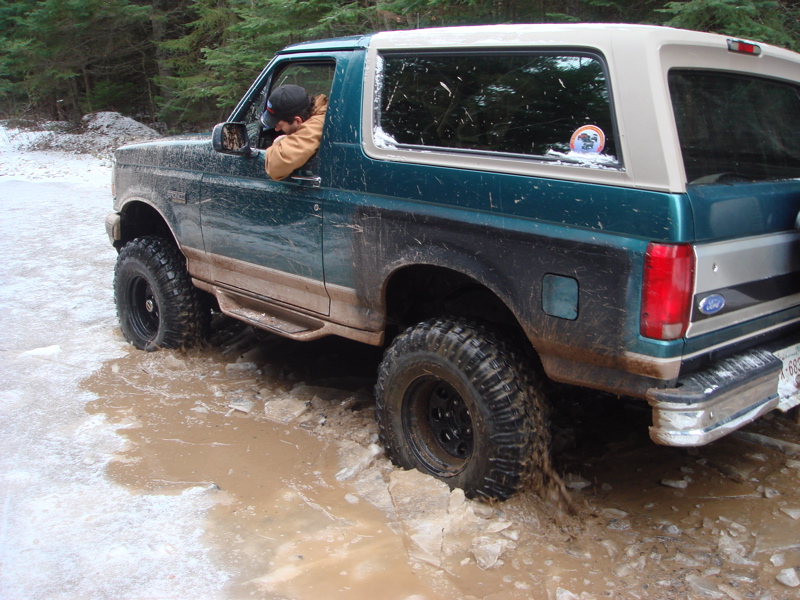
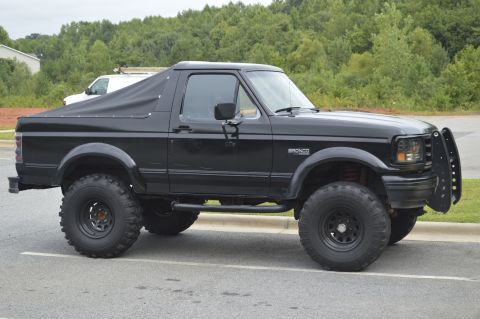
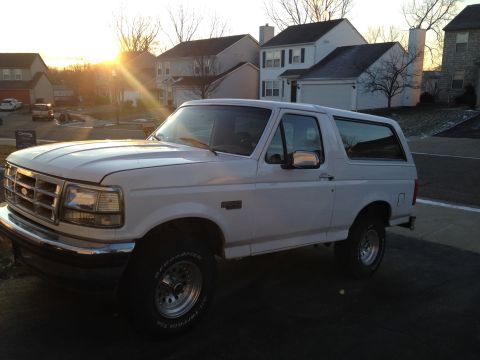
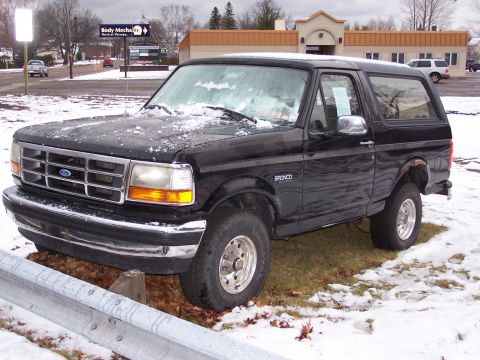
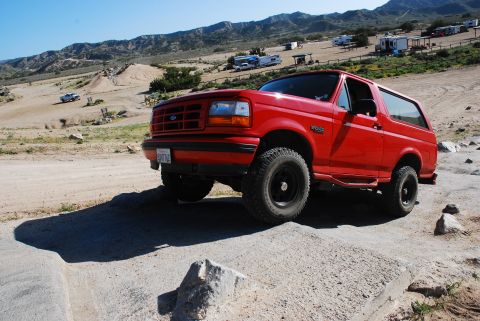
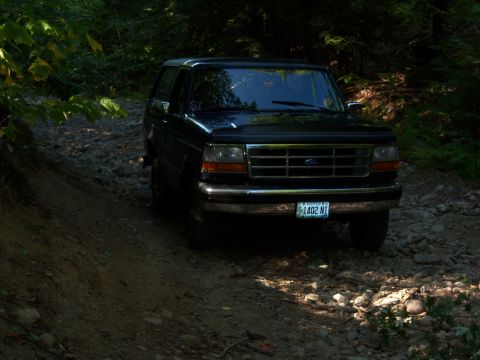
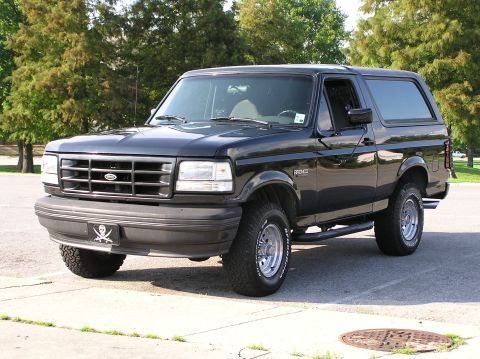
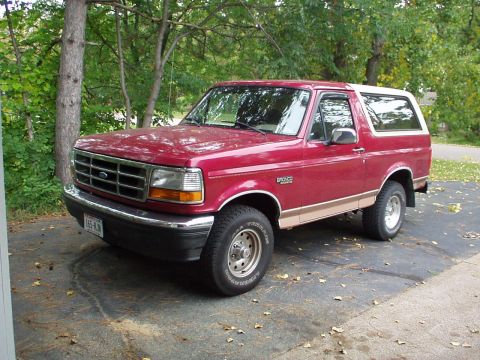
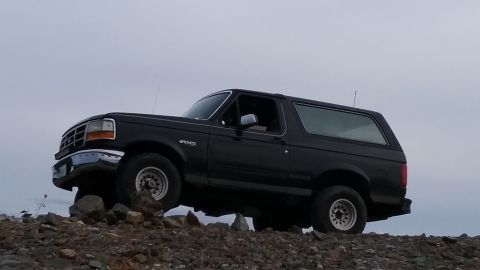
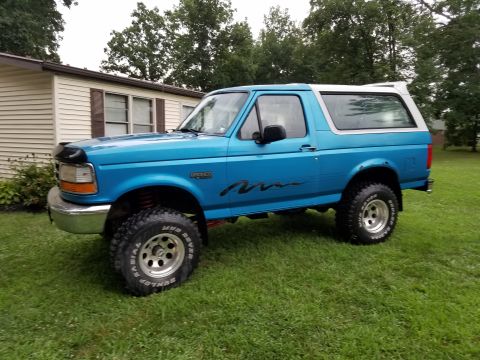
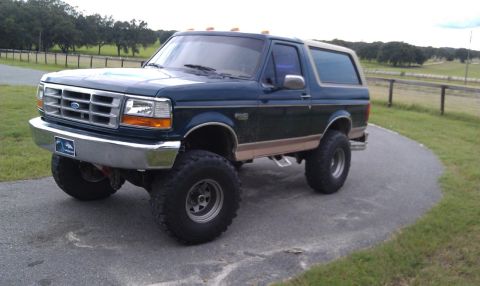
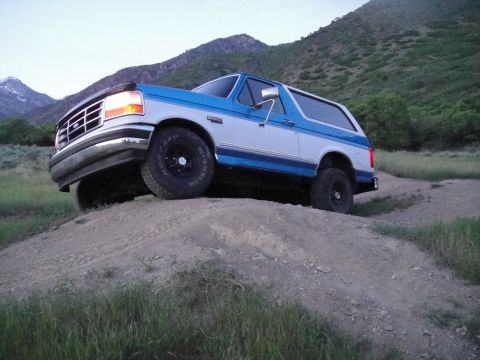
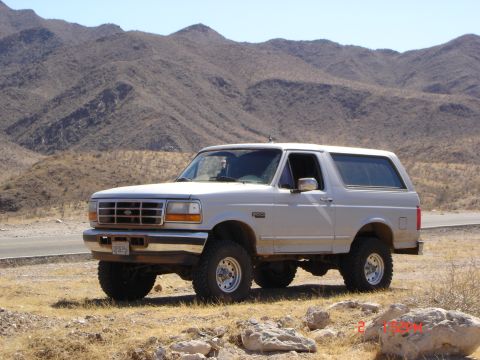
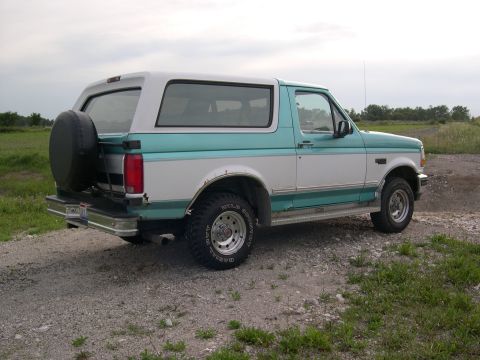
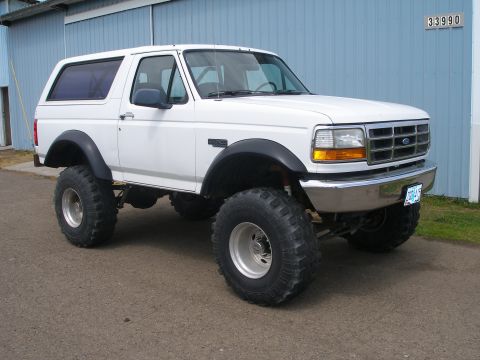
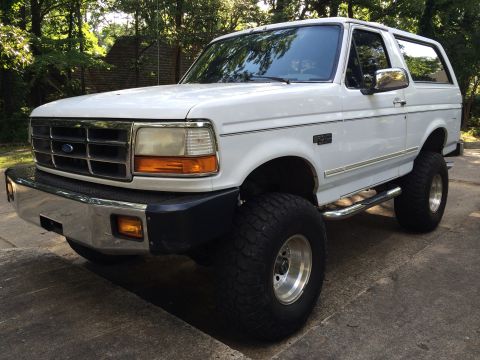
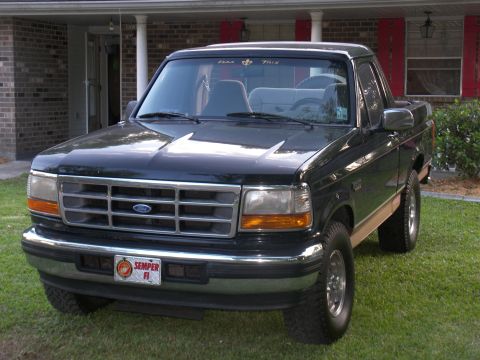
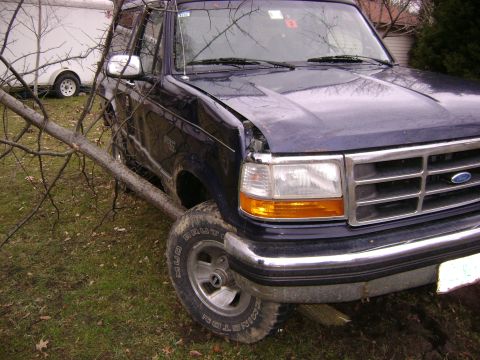
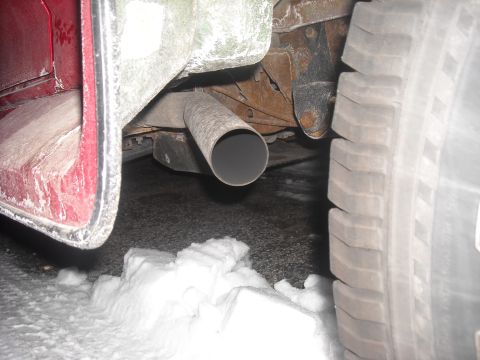
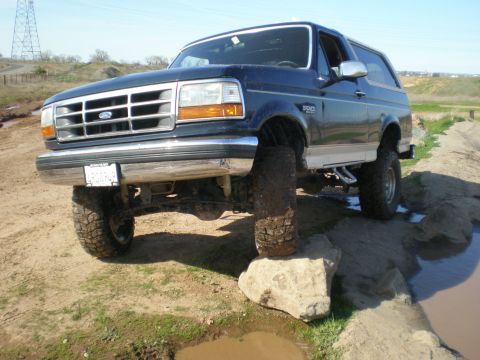
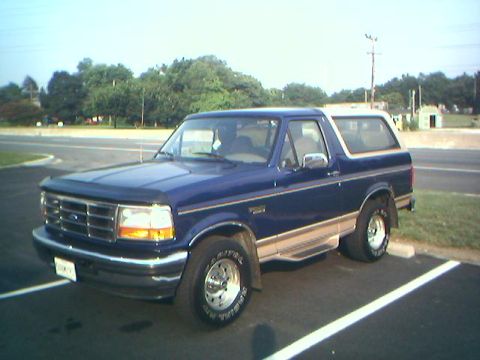
The fifth-generation Ford Bronco ran from 1992 through 1996 and was the last full-size Bronco before the nameplate went dormant until 2021. For 1992 Ford restyled the truck with the rounded sheet metal it shared with the redesigned 1992-1996 F-series, the body enthusiasts later nicknamed OBS for Old Body Style after the 1997 trucks arrived. It kept the removable fiberglass rear roof, a drop-down tailgate with roll-down glass, and a 104.7-inch wheelbase carried over from the prior generation. Power came from the 4.9L (300) inline-six and two small-block V8s, the 5.0L (302) and the 5.8L (351 Windsor), all fuel injected; the six was the base engine through 1993, after which the lineup went V8-only. Trim levels were XL, XLT, and the top Eddie Bauer. A standard center high-mounted stop lamp arrived for 1994, rear-wheel anti-lock brakes carried over from the previous generation and were standard throughout, and a driver-side airbag was added for 1994. Ford ended the Bronco after 1996 and replaced it with the four-door Expedition for 1997.
Other Ford Bronco generations
At a glance
- Years: 1992-1996 (fifth generation, the OBS Bronco)
- Body style: two-door full-size SUV with removable fiberglass rear hardtop and a drop-down tailgate with roll-down glass
- Platform: shares the rounded 1992-1996 F-series body, later nicknamed OBS (Old Body Style)
- Engines: 4.9L (300) inline-six (through 1993), 5.0L (302) V8, and 5.8L (351 Windsor) V8, all fuel injected
- Trims: XL, XLT, Eddie Bauer
- Brakes: front disc, rear drum; standard rear-wheel anti-lock brakes (carried over from the previous generation) throughout
- Safety: standard center high-mounted stop lamp and driver-side airbag added for 1994
- Wheelbase: 104.7 inches
- Replaced by: the four-door Ford Expedition for 1997
Year-by-year changes
| Year | Engines | Drivetrain & brakes | Notable changes |
|---|---|---|---|
| 1992 | 4.9L (300) I6, 5.0L (302) V8, 5.8L (351 Windsor) V8 | manual or automatic, standard four-wheel drive with a two-speed transfer case; front disc, rear drum with standard rear-wheel ABS | Full restyle on the new rounded 1992-1996 F-series body (later called OBS); revised interior and dashboard. |
| 1993 | 4.9L (300) I6, 5.0L (302) V8, 5.8L (351 Windsor) V8 | manual or automatic, standard four-wheel drive with a two-speed transfer case; front disc, rear drum with standard rear-wheel ABS | Carryover year with detail trim and equipment updates. The white 1993 Bronco of the 1994 O.J. Simpson police pursuit is a fifth-generation truck. |
| 1994 | 5.0L (302) V8, 5.8L (351 Windsor) V8 | manual or automatic, standard four-wheel drive with a two-speed transfer case; front disc, rear drum with standard rear-wheel ABS | Driver-side airbag and standard center high-mounted stop lamp added; 4.9L (300) inline-six dropped, making the lineup V8-only; side-impact-related interior and structural updates. |
| 1995 | 5.0L (302) V8, 5.8L (351 Windsor) V8 | manual or automatic, standard four-wheel drive with a two-speed transfer case; front disc, rear drum with rear-wheel ABS | Carryover year with equipment and option-package shuffling. |
| 1996 | 5.0L (302) V8, 5.8L (351 Windsor) V8 | manual or automatic, standard four-wheel drive with a two-speed transfer case; front disc, rear drum with rear-wheel ABS | Powertrains became OBD-II compliant; final model year of the full-size Bronco; replaced by the four-door Expedition for 1997. |
Engines and drivetrain
The 1992-1996 Bronco launched with three engines. The base engine was the 4.9L (300) inline-six, with the 5.0L (302) V8 and the larger 5.8L (351 Windsor) V8 above it, all fuel injected. The 4.9L six was dropped after 1993, so the 1994-1996 trucks were V8-only. The 5.8L gained a modest power increase during these years over the late-1980s versions of the same engine. For 1996, the final model year, the Bronco's powertrains became OBD-II compliant. Buyers could pair the engines with a manual or automatic transmission, and four-wheel drive with a two-speed transfer case was standard across the range; the full-size Bronco was built as a four-wheel-drive truck only, with no regular two-wheel-drive model.
Axles, suspension, and four-wheel drive
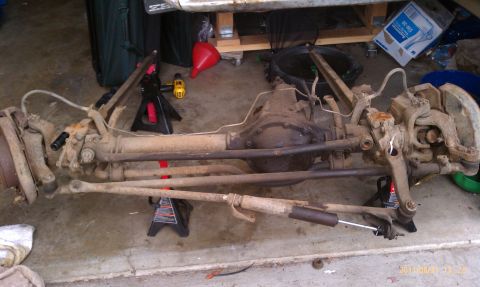
The fifth-generation Bronco kept the body-on-frame, solid-rear-axle layout of the full-size truck. It used a Twin-Traction Beam independent front suspension, the swing-axle beam design Ford ran on its four-wheel-drive light trucks of the era, shared with the four-wheel-drive 1992-1996 F-150. The 104.7-inch wheelbase carried over from the prior generation. Four-wheel-drive Broncos came with a transfer case for high and low range, making the truck a genuine two-speed four-wheel-drive rather than an all-wheel-drive crossover.
Brakes and safety equipment
The 1992-1996 Bronco used front disc and rear drum brakes. Rear-wheel anti-lock braking, which Ford had introduced on the previous fourth-generation truck, carried over and was standard throughout this run rather than being added partway through. The fifth generation then picked up a driver-side airbag for 1994. A standard center high-mounted stop lamp, the third brake light, was added for 1994, when federal rules extended the requirement to light trucks. These changes track the federal safety requirements light trucks were meeting in the mid-1990s.
Body, trims, and the OBS nickname
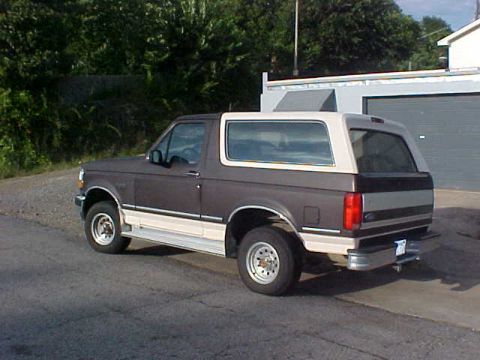
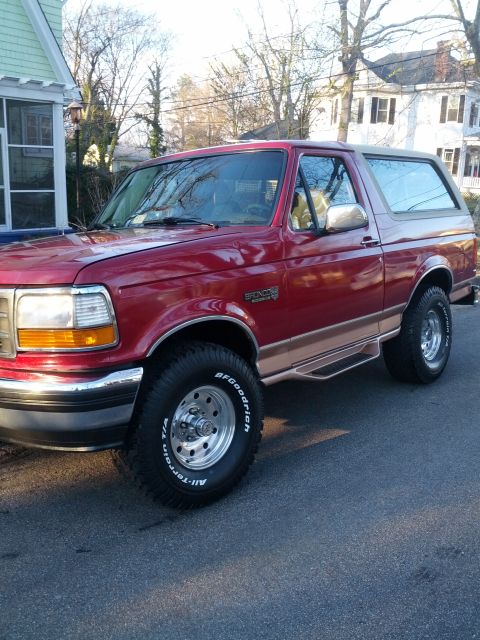
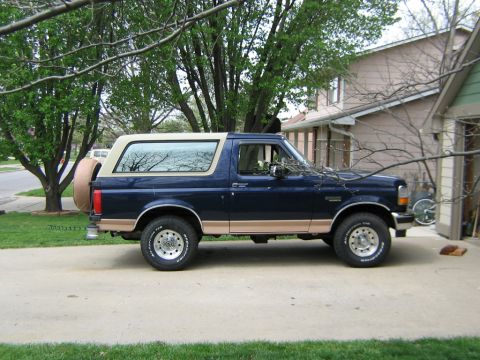
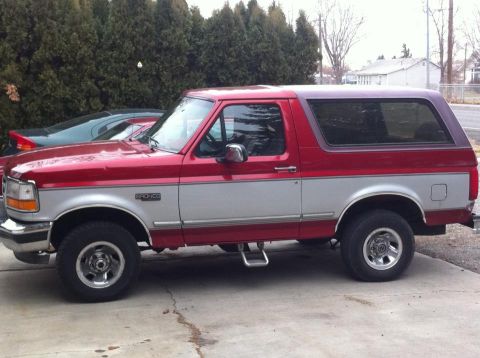
For 1992 Ford restyled the Bronco with the rounded front clip and smoother body sides it shared with the redesigned 1992-1996 F-series. After the 1997 F-150 switched to an all-new aerodynamic shape, enthusiasts began calling this 1992-1996 truck the OBS, for Old Body Style, and the name stuck to both the Bronco and its F-series siblings. The Bronco remained a two-door SUV with a removable fiberglass rear hardtop and a drop-down tailgate whose glass rolled down. Trim levels were the work-oriented XL, the better-equipped XLT, and the top Eddie Bauer, the last adding two-tone paint and upgraded interior appointments.
Why did Ford stop building the Bronco after 1996?
The 1996 model year was the last for the full-size Bronco. The two-door SUV market was shifting toward four-door family haulers, and Ford answered that with the Expedition, a four-door sport utility built on the new 1997 F-150 platform that arrived for the 1997 model year and effectively took the Bronco's place. The Bronco name then sat unused on a U.S. vehicle until the body-on-frame sixth-generation Bronco arrived for 2021.
What to know when buying a 1992-1996 Bronco
Because the fifth-generation Bronco shares its body, frame, and 5.0L and 5.8L V8 drivetrains with the far more common 1992-1996 F-150 and F-250, mechanical and many body parts are easy to source. Common areas to inspect on these trucks are rust in the rear quarters and tailgate, the condition and seal of the removable fiberglass top, and the function of the tailgate glass mechanism. Verify whether a given truck has the driver airbag, since it was added for 1994 rather than at the start of the run; rear-wheel ABS was standard across all years.
Frequently asked questions
What years was the fifth-generation Ford Bronco built?
The fifth-generation Ford Bronco was built from 1992 through 1996. It was the last full-size Bronco; Ford discontinued the model after 1996 and replaced it with the four-door Expedition for 1997. The Bronco name did not return on a production vehicle until the sixth generation arrived for 2021.
What does OBS mean on a 1992-1996 Ford Bronco?
OBS stands for Old Body Style. Enthusiasts use it for the rounded 1992-1996 Ford trucks, including the Bronco and the matching F-series, to distinguish them from the redesigned 1997 and later body. The 1992-1996 Bronco picked up the nickname because it shared that body with the 1992-1996 F-series.
What engines did the 1992-1996 Ford Bronco have?
The 1992-1996 Ford Bronco started with the 4.9L (300) inline-six as the base engine, with the 5.0L (302) V8 and the 5.8L (351 Windsor) V8 optional, all fuel injected. The 4.9L six was dropped after 1993, leaving the 1994-1996 trucks V8-only.
When did the Ford Bronco get a driver airbag and anti-lock brakes?
The fifth-generation Ford Bronco added a driver-side airbag for the 1994 model year. Rear-wheel anti-lock brakes were not new to this generation; they carried over from the previous full-size Bronco and were standard across all 1992-1996 trucks. A standard center high-mounted stop lamp, the third brake light, arrived for 1994.
Is the O.J. Simpson Bronco a fifth-generation Bronco?
Yes. The white 1993 Ford Bronco involved in the June 1994 police pursuit of O.J. Simpson is a fifth-generation OBS Bronco, part of the 1992-1996 run. It was a standard two-door full-size Bronco of that era.
Sources
- Ford factory shop manuals, parts catalogs, and order guides for the 1992-1996 Bronco and F-series
- VIN and door data-plate decoding for engine, trim, and model-year verification
- Established Ford truck and Bronco reference works and owner registries
- Period road tests and manufacturer specification literature from the 1992-1996 model years
Asked all the time
What years was the fifth-generation Ford Bronco built?
The fifth-generation Ford Bronco was built from 1992 through 1996. It was the last full-size Bronco; Ford discontinued the model after 1996 and replaced it with the four-door Expedition for 1997. The Bronco name did not return on a production vehicle until the sixth generation arrived for 2021.
What does OBS mean on a 1992-1996 Ford Bronco?
OBS stands for Old Body Style. Enthusiasts use it for the rounded 1992-1996 Ford trucks, including the Bronco and the matching F-series, to distinguish them from the redesigned 1997 and later body. The 1992-1996 Bronco picked up the nickname because it shared that body with the 1992-1996 F-series.
What engines did the 1992-1996 Ford Bronco have?
The 1992-1996 Ford Bronco started with the 4.9L (300) inline-six as the base engine, with the 5.0L (302) V8 and the 5.8L (351 Windsor) V8 optional, all fuel injected. The 4.9L six was dropped after 1993, leaving the 1994-1996 trucks V8-only.
When did the Ford Bronco get a driver airbag and anti-lock brakes?
The fifth-generation Ford Bronco added a driver-side airbag for the 1994 model year. Rear-wheel anti-lock brakes were not new to this generation; they carried over from the previous full-size Bronco and were standard across all 1992-1996 trucks. A standard center high-mounted stop lamp, the third brake light, arrived for 1994.
Is the O.J. Simpson Bronco a fifth-generation Bronco?
Yes. The white 1993 Ford Bronco involved in the June 1994 police pursuit of O.J. Simpson is a fifth-generation OBS Bronco, part of the 1992-1996 run. It was a standard two-door full-size Bronco of that era.
Technical Reference
Member-uploaded diagrams & documents for this generation. AI-classified; community-verified where badged.
Blueprints (6)
- Brake Booster to Master Cylinder Adapter Plate Blueprint - Ford Bronco SwapThis document is a dimensioned mechanical blueprint (CAD drawing) of a circular adapter plate, uploaded as "Booster2MCplate.jpg", apparently a plate for mating a brake booster to a master cylinder. The plate has an…
- Shop Foundation Slab Plan Blueprint - 60' x 52' Layout with Section Details S-2This document is a structural foundation/slab plan blueprint, apparently for a shop building (upload filename: 'shop foundation drawing clip j.jpg'), not an automotive reference. The plan shows a roughly 60'-3 1/2"…
- Shop Foundation Plan Drawing - Grid C3-C21, S-2 Section Callouts & DimensionsThis scan is a portion of an architectural/structural foundation plan drawing (site-labeled as part of a 'shop foundation drawing' set) that was uploaded to a 1995 Ford Bronco gallery, but it contains no automotive…
- 12" Single Ported Subwoofer Box Cut Sheet & Blueprint (HDS/HDC 12" Subs)This document is a builder's blueprint/cut sheet for a single 12-inch ported subwoofer enclosure. It includes two rendered diagrams: a 3D exterior view of the box showing the round woofer cutout and reference…
- 1994 Ford Bronco Custom Sub Box Top View Blueprint - Dimensions & LayoutThis document is a dimensioned CAD-style line drawing, apparently a top view of a custom subwoofer enclosure (filename "Sub Box Top 2.jpg") for a 1994 Ford Bronco audio installation. The drawing shows the outline of…
- Subwoofer Box Front Baffle Blueprint: 25.25x14 in Panel, 11.25/12.88 in CutoutsThis document is a CAD-style dimensioned blueprint (two views) for the front panel of a custom subwoofer enclosure, uploaded as part of a car-audio build set for a 1994 Ford Bronco. The upper drawing shows a…
Manual Pages (6)
- BMW M3 Owner's Manual Page 3 - Engine Compartment Component LocationsThis is page 3 of a BMW M3 owner's manual, photographed lying on a concrete surface. The page header reads "BMW M3." The main content is an engine compartment illustration (BMW image number 36 95 02 219) with a…
- Supplementary Owner's Manual M3 Contents - Vehicle Immobilization System IndexThis scan shows the contents/index page (page 1) of a supplementary owner's manual booklet, listing three sections: "Vehicle immobilization system" on pages 2-3, "Supplementary Owner's Manual M 3" on pages 3-11, and…
- 1996 Ford Bronco Owner's Manual - Checking & Adding Engine CoolantThis document is a screenshot of a digital (searchable PDF/e-reader) version of a Ford owner's manual page, viewed in an app showing a search for the term 'coolant' (Result 28 of 74). The page is titled 'Engine…
- 1996 Ford F-250/F-350 Diesel Nameplate & Power Stroke Emblem Removal - 01-08-7This is page 01-08-7, "Trim, Exterior," from the 1996 Ford F-150/F-250/F-350/Bronco/F-Super Duty Body and Chassis service manual (dated July 1995), covering removal and installation of exterior trim and emblems. The…
- 1965 NHRA Rule Book Page 15 - Gas & Supercharged Gas Coupes/Sedans ClassesThis is page 15 of what is identified as the 1965 NHRA (National Hot Rod Association) drag racing rule book. The page defines class structures for two competition divisions. Section A covers the Gas Coupes/Sedans…
- Ford Bronco/F-Series Transfer Case Removal, Torque Specs & NP208 Exploded ViewThis is a two-page spread (pages 7C-2 and 7C-3) from a Haynes-style repair manual, Chapter 7 Part C, covering the transfer case on Ford F-series trucks and Broncos. Page 7C-2 lists torque specifications (in ft-lb) for…
Brochures & Literature (6)
- 1994-1995 BMW 3 Series Owner's Manual Booklet Set - Warranty, Radio & AccessoriesThis photograph shows a collection of six original BMW owner's literature booklets, laid out on a stone/concrete surface, apparently from a mid-1990s BMW 3 Series owner's document set. The pieces visible are: a 1994…
- Smittybilt XRC Gen 3 Winch Box - 9.5K/12K Recovery Winch Features & CalloutsThis is a photograph of the retail packaging (box) for a Smittybilt XRC GEN 3 recovery winch, uploaded to a 1996 Ford Bronco gallery as accessory literature. The box features a detailed line drawing of the winch with…
- Full HD 1080P Car DVR Dash Cam with Motion Detection - Product Listing ImageThis is a product advertisement/listing image for a generic aftermarket car dash camera (car DVR), not an OEM automotive reference document. The image shows a compact dash cam labeled 'CAR CAM CORDER' with 'FHD 1080P'…
- Vintage Truck Magazine July/August 2018 Cover: Ford Bronco Ranger XLT FeatureThis document is the front cover of Vintage Truck magazine, July/August 2018 issue (Vol. 26, No. 3). The cover feature is a "Bronco Ranger XLT," shown in two large photographs. The featured truck is a black Ford Bronco…
- Heavy-Duty Headlight Harness 1980-96 Ford Bronco/Truck - Part Numbers & PricesThis document is a scanned catalog/brochure page advertising a Heavy-Duty Headlight Harness upgrade kit. The page includes a photograph of the harness (labeled with part number 36-3580) showing two relays, OE-style…
- Amplified Hide-Away Antenna 38-1145 - AM/FM Hidden Antenna Brochure PageThis document is a catalog/brochure page advertising an Amplified Hide-Away Antenna, part number 38-1145, priced at $24.95. The page shows a product photo of the antenna unit with its long cable, inline amplifier…
Data/Spec Plates (15)
- 1994 Ford Bronco Door Data Spec Plate - VIN, GVWR, Axle & Paint CodesThis document is a photograph of the factory Safety Compliance Certification Label (data/spec plate) affixed to a Ford vehicle, manufactured by Ford Motor Co. in the U.S.A. with a build date of 01/94. It lists a Gross…
- 1994 Ford Bronco Special Paint Code Label - M# 6373, Sales/Paint Code UAThis is a photograph of a factory Ford "Special Paint" decal/sticker affixed to a vehicle, uploaded to document a 1994 Ford Bronco. The label bears the Ford blue oval logo and states "THE PAINT CODE FOR THIS VEHICLE…
- Ford E4OD Solenoid Body Pin ID, Resistance Chart & PCM Pins - ATSG Fig. 16This page (page 13, Figure 16) from an ATSG (Automatic Transmission Service Group) Technical Service Information manual covers solenoid body pin identification and function, uploaded as a reference for a Ford E4OD…
- 1995 Ford Bronco Vehicle Certification Label - VIN, GVWR, Axle & Paint CodesThis is a scan of the factory Vehicle Certification (data/spec) label riveted to a Ford truck, manufactured by Ford Motor Co. in the U.S.A. with a build date of 11/94, consistent with the uploader's claimed 1995 Ford…
- Holden VE / 2009 Pontiac G8 Data Plate - LS3, M10 Trans, FE3, G84 Axle CodesThis photo shows an embossed metal vehicle identification/data spec plate riveted to a body panel (photographed in a dark engine bay or door jamb area). The plate lists the vehicle's build codes: Model VE8EK69-, Body…
- 1996 Ford Bronco VIN Data Plate - GVWR, Axle, Trans & Paint Codes (10/95)This is the factory VIN/certification data plate (Safety Compliance Certification Label) from a Ford sport-utility vehicle manufactured by Ford Motor Co. in the U.S.A. with a build date of 10/95. It lists the Gross…
- Ford OEM Panel F2TZ-15044D70-A Parts Box Label - 1992-96 Bronco/F-Series BezelThis image shows a genuine Ford Parts packaging label affixed to a cardboard shipping box. The label identifies the contents as a single (1X) 'PANEL / PANEL' with Ford part number F2TZ-15044D70-A and secondary…
- Ford Bronco Fuel Pump Shut-Off Switch Warning Label F2UB-9N831-AAThis is a photograph of a factory-applied bilingual (English/French) warning decal found on a Ford vehicle, uploaded to the gallery of a 1995 Ford Bronco. The label, titled 'IF ENGINE FAILS TO START' / 'SI LE MOTEUR…
- 1995 Ford Bronco Calibration Decal 5-64T-R10 - Part F5AE-6E061-MHFThis document is a photograph of a Ford engine calibration decal (data/spec plate), printed in both English and French ("CALIBRATION / ÉTALONNAGE"). The label displays the calibration code "5-64T-R10" in large type…
- 1995 Ford Bronco Door Data Plate - VIN, GVWR, Axle & Paint CodesThis is the factory data/certification label (Safety Compliance Certification Label) for a 1995 Ford Bronco, manufactured by Ford Motor Co. in the U.S.A. with a build date of 06/95. It lists the Gross Vehicle Weight…
- 1996 Ford Bronco Door Data Plate - VIN, GVWR, Axle & Tire Specs (05/96)This is the federal certification / safety compliance data plate (door jamb sticker) from a Ford vehicle manufactured 05/96 by Ford Motor Co. in the U.S.A. It lists the Gross Vehicle Weight Rating of 6300 lb / 2857 kg…
- 1996 Ford Bronco Door Data Plate - VIN, GVWR, Tire, Paint & Axle CodesThis is the factory Safety Compliance Certification Label (data/spec plate) affixed to a 1996 Ford Bronco, manufactured by Ford Motor Co. in the U.S.A. with a build date of 05/96. It lists the Gross Vehicle Weight…
- 1995 Ford Bronco Door Jamb Data Plate - GVWR, Tire Pressure & Axle CodesThis document is a photograph of the manufacturer's certification / safety compliance data plate (door jamb sticker) from a Ford vehicle, uploaded as belonging to a 1995 Ford Bronco. The label states the vehicle was…
- 1995 Ford Bronco Door Data Plate - VIN, GVWR, Axle & Trans Codes (05/95)This is a photograph of the factory Safety Compliance Certification Label (door data plate) affixed to a Ford vehicle, manufactured by Ford Motor Co. in the U.S.A. with a build date of 05/95. The label lists the Gross…
- 1995 Ford Bronco A/C Refrigerant Decal - R-134a Charge & Oil Specs (F5TH-19A688-AA)This document is a photograph of the factory air conditioning caution/specification decal (data spec plate) from a Ford vehicle, uploaded to a 1995 Ford Bronco gallery. The bilingual (English/French) label identifies…
Wiring Diagrams (134)
- 1996 Ford Bronco C202F 76-Pin Connector Pinout - EVTM Page 150-4This is page 150-4 of the 1996 Ford Bronco Electrical & Vacuum Troubleshooting Manual (EVTM), titled "In-Line Connector Faces." It documents connector C202F (part reference 14401), a 76-pin in-line bulkhead connector…
- 1994 Ford Bronco/F-Series C103 & C108 Connector Pinouts - EVTM Page 150-2This is page 150-2 ("In-Line Connector Faces") from the 1994 Ford Bronco/F-Series Electrical and Vacuum Troubleshooting Manual (EVTM). It shows pinout face diagrams for two in-line harness connector pairs: C103 (female…
- 1994 Ford Bronco/F-Series EVTM 150-2: C103 & C108 In-Line Connector PinoutsThis is page 150-2, "In-Line Connector Faces," from the 1994 Ford Bronco/F-Series Electrical & Vacuum Troubleshooting Manual (EVTM). It shows pin-face diagrams for in-line connectors C103 (female C103F and male C103M…
- Ford Bronco VSS to PCM Wiring Diagram - Rear Axle Sensor, PSOM, ABS CircuitThis hand-annotated wiring schematic traces the Vehicle Speed Sensor (VSS) circuit from the Rear Axle VSS (1330 Ω, connector C404) through the Ford Bronco's electrical system to the PCM. Signal wires 519 LG/BK (Rear…
- 1994 Ford Bronco/F-Series Instrument Cluster PSOM Wiring Diagram - EVTM 60-7This is page 60-7 from the 1994 Ford Bronco/F-Series Electrical and Vacuum Troubleshooting Manual (EVTM), showing the wiring diagram for the standard instrument cluster's Programmable Speedometer/Odometer Module…
- 1994 Ford Bronco/F-Series PSOM C252 Connector Pinout - Speedometer WiringThis page (60-8) from the 1994 Ford Bronco/F-Series Electrical & Vacuum Troubleshooting Manual covers the standard instrument cluster, specifically connector C252 for the Programmable Speedometer/Odometer Module…
- 1994 Ford Bronco 4WABS ABS Wiring Diagram - EVTM Page 42-4This is page 42-4 of the 1994 Ford Bronco/F-Series Electrical and Vacuum Troubleshooting Manual (EVTM), showing the Bronco 4-Wheel Anti-lock Brake System (4WABS) wiring diagram. It details the 4WABS hydraulic unit…
- 1994 Ford Bronco Vehicle Speed Sensor Wiring Diagram - EVTM Page 64-2 PSOM VSSThis is page 64-2 of the 1994 Ford Bronco/F-Series Electrical & Vacuum Troubleshooting Manual (EVTM), showing the Vehicle Speed Sensor circuit for the Bronco. The diagram traces the solid-state Acceleration Sensor…
- 1996 Ford Bronco C202M In-Line Connector Pinout - 76-Pin Wiring Diagram EVTMThis is page 150-5 of the 1996 Ford Bronco Electrical & Vacuum Troubleshooting Manual (EVTM), titled "In-Line Connector Faces." It documents connector C202M, part of wiring harness 12A581. The page includes a face-view…
- Ford 5.8L California Fuel Pump Module Wiring Diagram - Engine Controls 25-12This document is a page from a factory-style wiring diagram set, labeled "25-12 Engine Controls, 5.8L (California)". It shows the fuel pump circuit for the California-emissions 5.8L engine. Power comes from connector…
- Ford 5.8L California Engine Controls Wiring Diagram 25-11 - MIL, HO2S, PCMThis document is one page (25-11) of a Ford factory wiring diagram covering Engine Controls for the 5.8L engine with California emissions. It shows circuits feeding the Powertrain Control Module (PCM, pins 17, 10, 23…
- Ford Bronco 5.8L California Engine Controls Wiring Diagram - IAT, HO2S, PCM (25-10)This is page 25-10 of a Ford factory-style wiring diagram covering Engine Controls for the 5.8L (351) engine with California emissions. The diagram shows the circuits for the Intake Air Temperature (IAT) sensor, the…
- Ford 5.8L California Engine Controls Wiring Diagram - PCM, TP, ECT, EGR SensorsThis document is page 25-9 of a Ford wiring diagram set covering Engine Controls for the 5.8L engine with California emissions. It shows the wiring between the Powertrain Control Module (PCM) and several engine control…
- Ford 5.8L California Engine Controls Wiring Diagram - Injectors, IAC, PCM PinsThis document is page 25-8 of a Ford electrical/vacuum troubleshooting-style wiring diagram covering Engine Controls for the 5.8L engine with California emissions. It shows how 12-volt relay-energized power on circuit…
- Ford 5.8L California Engine Controls Wiring Diagram - PCM & Fuel Pump Relay 25-7This document is page 25-7 of a Ford factory-style wiring diagram set, covering Engine Controls for the 5.8L engine with California emissions. It shows the power distribution and control circuits for the Powertrain…
- 1994 Ford Bronco/F-Series EVTM Pg 13-1 Power Distribution Wiring Diagram (Gas)This is a scanned page (13-1, Power Distribution) from the 1994 Ford Bronco/F-Series Electrical and Vacuum Troubleshooting Manual (EVTM), covering gasoline engines. The schematic traces battery power distribution: the…
- Aftermarket Radio Wiring Diagram - Factory Harness vs Adapter Kit InstallThis is a simple, hand-drawn illustrative diagram (not a factory schematic) explaining three ways an aftermarket car radio can be connected to a vehicle's factory wiring harness. The first panel, labeled 'From the…
- 1994 Ford Bronco C198 VIP Data Link Connector Pinout - Fuel Pump Test (926)This document is a scanned page from a Ford Electrical and Vacuum Troubleshooting Manual (EVTM) showing connector C198, the VIP (Vehicle In Process / self-test) Data Link Connector. The illustration is a face view of…
- Headlight Relay Wiring Diagram - Dual Relay Harness Upgrade (Ford Bronco)This document is a color-coded wiring diagram for a headlight relay upgrade/conversion. It shows how two relays (Relay 1 and Relay 2) are wired between the vehicle's battery and the headlight bulbs, with the trigger…
- 1992-95 Ford Bronco/F-Series 5.0L 5.8L & 1991 7.5L Engine Wiring DiagramsThis scan shows two facing pages from a Haynes-style repair manual, Chapter 12 (Chassis electrical system), containing full engine-compartment wiring diagrams for Ford full-size trucks. The left page (12-43) is the…
- 1996 Ford Bronco Vehicle Speed Sensor (VSS) Wiring Diagram - PSOM, 4WABS, PCMThis is page 64-2 of a Ford factory wiring diagram set, covering the Vehicle Speed Sensor (VSS) circuit for the Bronco. The diagram shows the rear axle sensor, which (per the note box) monitors rear axle speed via an…
- Ford F-Series Vehicle Speed Sensor (VSS) Wiring Diagram - PSOM, RABS, PCMThis document is page 64-1 of a Ford wiring diagram set, showing the Vehicle Speed Sensor (VSS) circuit for F-Series trucks. It traces the rear axle sensor, which monitors rear axle speed by sensing exciter-ring teeth…
- Ford Bronco & F-Series 5.8L Fuel Pump Wiring Diagram - Inertia Switch, SenderThis document is page 25-6 of a Ford factory-style wiring diagram set covering Engine Controls for the 5.8L engine. It shows the fuel pump and fuel gauge sender circuits for both F-Series trucks and the Bronco. Both…
- Ford 5.8L Engine Controls Wiring Diagram 25-5 - MIL, CPP Switch, PCM CircuitsThis is page 25-5 of a Ford wiring diagram set covering Engine Controls for the 5.8L engine. It shows the circuit from the fuse panel (fuse 17, 10A, hot in start or run) through circuit 640 R/Y and splice S215 to the…
- Ford 5.8L Engine Controls Wiring Diagram 25-4 - MAP Sensor, HO2S, PCM (Bronco)This document is page 25-4 of a Ford factory-style wiring diagram set covering Engine Controls for the 5.8L engine. It shows the wiring for the Manifold Absolute Pressure (MAP) sensor (connector C1011), the VIP Data…
- Ford Bronco 5.8L Engine Controls Wiring Diagram - PCM, TPS, ECT, IAT, EGR SensorsThis document is page 25-3 of a Ford factory-style wiring diagram set, covering the Engine Controls system for the 5.8L engine. It shows the Powertrain Control Module (PCM, labeled solid state) and its connections to…
- 1996 Ford Bronco 5.8L Engine Controls Wiring Diagram - PCM, Injectors, IACThis document is page 25-2 of a factory-style wiring diagram set covering Engine Controls for the 5.8L engine, filed under a 1996 Ford Bronco. It shows the Powertrain Control Module (PCM, labeled 'solid state') and its…
- Ford 5.8L Engine Controls Wiring Diagram 25-1 - PCM & Fuel Pump Relay CircuitsThis document is page 25-1 of a Ford factory-style wiring diagram covering Engine Controls for the 5.8L engine. It shows the power feed circuits from the Engine Compartment Fuse Box (three 20A fuses at positions U, I…
- Ford Bronco & F-Series 5.0L Fuel Pump Wiring Diagram - Inertia Switch, SenderThis is page 24-8 of a Ford wiring diagram manual titled "Engine Controls, 5.0L," showing the fuel pump and fuel gauge sender wiring for both F-Series trucks and the Bronco. Both circuits begin at connector C202…
- 1996 Ford Bronco 5.0L Engine Controls Wiring Diagram 24-7 - PCM, MIL, CPP SwitchThis document is page 24-7 of a Ford wiring diagram set covering Engine Controls for the 5.0L engine. It shows the power feed circuits into the Powertrain Control Module (PCM). On the left, a Hot-in-Start-or-Run…
- Ford Bronco 5.0L Engine Controls Wiring Diagram - MAP & O2 Sensor to PCM (24-6)This document is one page (24-6) of a Ford wiring diagram set covering Engine Controls for the 5.0L engine. It shows the wiring for the Manifold Absolute Pressure (MAP) sensor and the Heated Oxygen Sensor (HO2S) as…
- Ford 5.0L Engine Controls Wiring Diagram 24-5 - ECT, IAT, TPS, EVP, Knock SensorThis document is page 24-5 of a Ford wiring diagram set, titled "Engine Controls, 5.0L." It shows the sensor input wiring to the Powertrain Control Module (PCM, connector C185) for a 5.0L engine. Sensors covered…
- Ford 5.0L Engine Controls Wiring Diagram 24-4 - Injectors, EGR, IAC, PCM PinsThis document is page 24-4 of a Ford wiring diagram covering Engine Controls for the 5.0L engine without E4OD and without 4R70W transmissions. It shows the 12V relay-energized power distribution from splice S122…
- Ford 5.0L Fuel Injector Wiring Diagram - PCM Pinout, E4OD/4R70W (Page 24-3)This document is page 24-3 of a Ford wiring diagram set covering Engine Controls for the 5.0L engine with either the E4OD or 4R70W automatic transmission. It shows the fuel injector wiring: circuit 361 (Red), which is…
- 1996 Ford Bronco 5.0L Engine Controls Wiring Diagram - EGR, IAC, Purge (24-2)This is page 24-2 of a factory-style wiring diagram covering Engine Controls for the 5.0L engine, uploaded to a 1996 Ford Bronco gallery. It shows five emission/engine-control solenoids and valves fed by circuit 361 R…
- 1996 Ford Bronco 5.0L Engine Controls Wiring Diagram - PCM & Fuel Pump Relay 24-1This document is page 24-1 of a Ford factory-style wiring diagram covering the Engine Controls circuit for the 5.0L engine. It shows power distribution from the engine compartment fuse box, fuse U (20A, hot in start or…
- Ford 4.9L Fuel Pump & Sender Wiring Diagram - F-Series & Bronco (Page 23-7)This document is page 23-7 of a Ford engine controls wiring diagram set covering the 4.9L (300 cubic inch inline six) engine, showing the fuel pump and fuel gauge sender circuits for both F-Series trucks and the…
- Ford 4.9L Engine Controls Wiring Diagram 23-6 - MIL & Clutch Pedal Position SwitchThis document is page 23-6 of a Ford engine controls wiring diagram covering the 4.9L engine. It shows two circuits feeding the Powertrain Control Module (PCM). The first is the Malfunction Indicator Lamp (MIL)…
- Ford 4.9L Engine Controls Wiring Diagram 23-5 - PCM, ECT, IAT & Knock SensorThis document is page 23-5 of a Ford factory wiring diagram covering Engine Controls for the 4.9L engine. It shows the sensor input side of the Powertrain Control Module (PCM), including the Knock Sensor (KS) at…
- Ford 4.9L Engine Controls Wiring Diagram - MAP, EVP, TPS & PCM (Page 23-4)This is page 23-4 of a Ford factory-style wiring diagram covering Engine Controls for the 4.9L engine. It shows the wiring between the Powertrain Control Module (PCM) and three sensors: the Manifold Absolute Pressure…
- Ford 4.9L Engine Controls Wiring Diagram 23-3: Fuel Injectors, HO2S, PurgeThis is page 23-3 of a Ford factory-style wiring diagram covering Engine Controls for the 4.9L engine, uploaded to a 1996 Ford Bronco gallery. The diagram shows the fuel injector and emissions control circuits: power…
- Ford 4.9L Engine Controls Wiring Diagram 23-2 - EGR, AIRB/AIRD, IAC, PCM PinsThis is page 23-2 of a Ford factory-style wiring diagram covering Engine Controls for the 4.9L engine. It shows the power distribution from splice S122 (page 23-1) on circuit 361 (Red), through connector C101 and…
- Ford 4.9L Engine Controls Wiring Diagram 23-1 - PCM & Fuel Pump Relay PowerThis document is page 23-1 of a Ford factory-style wiring diagram covering Engine Controls for the 4.9L engine. It shows the power distribution and grounding for the Powertrain Control Module (PCM). Power comes from…
- Ford Bronco & F-Series 5.8L Fuel Pump Wiring Diagram - Engine Controls 25-6This is page 25-6 of a Ford factory wiring diagram set covering Engine Controls for the 5.8L engine, showing the fuel pump and fuel gauge sender circuits for both F-Series trucks and the Bronco. Power originates from…
- Ford Bronco/F-Series 5.8L Engine Controls Wiring Diagram - MIL & CPP CircuitThis document is page 25-5 of a Ford wiring diagram set covering Engine Controls for the 5.8L engine. It shows the Malfunction Indicator Lamp (MIL) circuit and the clutch pedal position (CPP)/start circuit feeding the…
- Ford Bronco 5.8L Engine Controls Wiring Diagram: MAP & O2 Sensor (Page 25-4)This is page 25-4 of a Ford factory-style wiring diagram set covering Engine Controls for the 5.8L engine, applicable to Bronco, Lightning, and F-Series trucks (with under-8500 lb and over-8500 lb GVW variants…
- Ford 5.8L Engine Controls Wiring Diagram - PCM, ECT, IAT, TPS, EGR Sensors 25-3This document is page 25-3 of a Ford factory-style wiring diagram covering Engine Controls for the 5.8L engine. It shows the sensor input side of the Powertrain Control Module (PCM), including the EGR Control Solenoid…
- Ford Bronco 5.8L Engine Controls Wiring Diagram 25-2 - Injectors, PCM, IACThis document is page 25-2 of a Ford wiring diagram set covering Engine Controls for the 5.8L engine. It shows the 12V relay-energized power feed (circuit 361 R) coming from splice S122 (page 25-1) and distributing…
- Ford Bronco 5.8L Engine Controls Wiring Diagram 25-1 - PCM & Fuel Pump RelayThis document is page 25-1 of a Ford wiring diagram set covering Engine Controls for the 5.8L engine. It shows the power supply path to the Powertrain Control Module (PCM), including the engine compartment fuse box…
- Ford Bronco & F-Series 5.0L Fuel Pump Wiring Diagram - Inertia Switch, SenderThis is page 24-8 of a Ford wiring diagram manual covering Engine Controls for the 5.0L engine, showing the fuel pump and inertia fuel shutoff circuits for both F-Series trucks and the Bronco. Power comes from…
- Ford 5.0L Engine Controls Wiring Diagram 24-7 - PCM, MIL & CPP Switch CircuitsThis is page 24-7, "Engine Controls, 5.0L," a wiring diagram from a Ford factory-style electrical manual covering the engine control (PCM) start/run circuits for the 5.0L engine. It shows the Hot in Start or Run feed…
- Ford Bronco 5.0L Engine Controls Wiring Diagram - PCM, MAP & O2 Sensor (24-6)This is page 24-6 of a factory-style wiring diagram covering the Engine Controls system for a 5.0L Ford engine. The diagram traces circuits between the Powertrain Control Module (PCM, connector C185) and several…
- Ford 5.0L Engine Controls Wiring Diagram 24-5 - ECT, IAT, TPS, EVP, Knock SensorThis document is page 24-5 of a Ford wiring diagram set covering Engine Controls for the 5.0L engine. It shows the sensor wiring circuits connected to the Powertrain Control Module (PCM, connector C185): the Knock…
- Ford 5.0L Engine Controls Wiring Diagram 24-4 (W/O E4OD/4R70W) - PCM & InjectorsThis is page 24-4 of a Ford factory-style wiring diagram covering Engine Controls for the 5.0L engine without E4OD or 4R70W automatic transmissions (i.e., manual transmission applications). The diagram shows the 12V…
- Ford 5.0L E4OD/4R70W Fuel Injector Wiring Diagram - PCM Pins & Wire ColorsThis is page 24-3 of a Ford wiring diagram set covering Engine Controls for the 5.0L engine with either the E4OD or 4R70W automatic transmission. The diagram shows the fuel injector circuit: switched 12V power (circuit…
- 1996 Ford Bronco 5.0L Engine Controls Wiring Diagram - EGR, IAC, Purge, PCMThis document is page 24-2 of a Ford wiring diagram set covering Engine Controls for the 5.0L engine. It shows the power and control circuits for five emission/engine-control solenoids and valves: the EGR Control…
- Ford 5.0L Engine Controls Wiring Diagram 24-1 - PCM & Fuel Pump Relay (Bronco)This document is page 24-1 of a Ford wiring diagram set covering Engine Controls for the 5.0L engine. It shows the power feed circuits from the Engine Compartment Fuse Box, fuse U (20A, hot in start or run) feeding the…
- Ford Bronco & F-Series 4.9L Fuel Pump Wiring Diagram - Inertia Switch, SenderThis is page 23-7 of a Ford engine controls wiring diagram for the 4.9L engine, showing the fuel pump and fuel gauge sender circuits for two vehicle configurations: F-Series and Bronco. Both circuits begin at connector…
- 1996 Ford 4.9L Engine Controls Wiring Diagram 23-6: MIL & CPP Switch CircuitsThis is page 23-6 of a Ford factory-style wiring diagram covering Engine Controls for the 4.9L engine. It shows two main circuits feeding the Powertrain Control Module (PCM). The first circuit runs from a HOT IN START…
- Ford 4.9L Engine Controls Wiring Diagram 23-5 - ECT, IAT, Knock Sensor, PCM PinsThis is page 23-5 of a Ford factory-style wiring diagram titled "Engine Controls, 4.9L," covering sensor circuits connected to the Powertrain Control Module (PCM). It shows the Knock Sensor (KS) at connector C1009 with…
- Ford 4.9L Engine Controls Wiring Diagram - MAP, EVP, TPS & PCM (Page 23-4)This is page 23-4 of a Ford factory-style wiring diagram covering Engine Controls for the 4.9L engine. It shows the wiring between the Powertrain Control Module (PCM, solid state) and three sensors: the Manifold…
- 1996 Ford Bronco 4.9L Engine Controls Wiring Diagram - Fuel Injectors & HO2SThis document is page 23-3 of a Ford wiring diagram set, covering the Engine Controls circuit for the 4.9L inline-six engine. It shows the fuel injector and canister purge solenoid wiring from the engine compartment…
- Ford Bronco 4.9L Engine Controls Wiring Diagram - EGR, AIRB/AIRD, IAC, PCM PinsThis is page 23-2 of a Ford engine controls wiring diagram set for the 4.9L engine, uploaded as part of a 1996 Ford Bronco document album. The diagram shows power circuit 361 (R, red) arriving from splice S122 on page…
- Ford Bronco 4.9L Engine Controls Wiring Diagram - PCM & Fuel Pump Relay (23-1)This document is page 23-1 of an engine controls wiring diagram for a Ford vehicle equipped with the 4.9L inline-six engine. It shows the power distribution and ground circuits for the Powertrain Control Module (PCM)…
- 1996 Ford Bronco Trailer Plug Wiring - C417 7-Pin Connector Pinout (EVTM 150-12)This is page 150-12 ("In-Line Connector Faces") from the 1996 Ford Bronco Electrical & Vacuum Troubleshooting Manual (EVTM). It shows the pin-face views of the two halves of the trailer towing connector: C417F (the…
- 1996 Ford Bronco Trailer/Camper Adapter Wiring Diagram - EVTM Page 95-3This is page 95-3 of the 1996 Ford Bronco Electrical & Vacuum Troubleshooting Manual (EVTM), the third page of the Trailer/Camper Adapter wiring diagram. It shows the power feed and ground circuits for the Trailer…
- 1996 Ford Bronco Trailer/Camper Adapter Wiring Diagram - EVTM Page 95-2This is page 95-2 of the 1996 Ford Bronco Electrical and Vacuum Troubleshooting Manual (EVTM), showing the second sheet of the Trailer/Camper Adapter wiring diagram. It traces the turn signal and hazard flasher…
- 1996 Ford Bronco Trailer/Camper Adapter Wiring Diagram - EVTM Page 95-1This is page 95-1 of the 1996 Ford Bronco Electrical & Vacuum Troubleshooting Manual (EVTM), covering the Trailer/Camper Adapter wiring. The diagram traces three circuits from the engine compartment fuse box: fuse 4…
- 1996 Ford Bronco C107 & C109 In-Line Connector Pinout - Wire Colors & CircuitsThis document is a wiring connector pinout reference page showing two in-line connectors, C107 and C109, each depicted from both mating faces (female and male views). For C107, the female side (C107F) belongs to…
- Ford Bronco/F-Series Backup Lamps Wiring Diagram 93-4 - Trailer Relay & C433/C434This document is page 93-4, "Backup Lamps," a factory-style wiring diagram covering the backup (reverse) lamp circuit. Power arrives on circuit 140 BK/PK, energized at 12V in reverse. A branch labeled BRONCO feeds the…
- 1996 Ford Bronco & F-Series Backup Lamps Wiring Diagram (Page 93-3)This is page 93-3 of a Ford factory wiring diagram covering the Backup Lamps circuit for Bronco and F-Series trucks. It shows circuit 140 (BK/PK, black/pink wire) feeding from connector C103 (referenced on page 93-1)…
- 1996 Ford Bronco Backup Lamps Wiring Diagram 93-2 - MLP Sensor, E4OD/4R70WThis is page 93-2, "Backup Lamps," from a Ford factory wiring diagram manual, uploaded to a 1996 Ford Bronco gallery. It shows the backup lamp circuit as it passes through the Manual Lever Position (MLP) sensor used…
- Ford Bronco Backup Lamps Wiring Diagram 93-1 - Reverse Light CircuitThis is page 93-1 of a Ford factory-style wiring diagram covering the Backup Lamps circuit. It shows how the backup (reverse) lamps receive power from fuse E (15A) in the engine compartment fuse box, which is hot in…
- 1996 Ford Bronco Backup Lamps Wiring Diagram 93-4 - Trailer Relay & GroundsThis document is page 93-4, "Backup Lamps," from a Ford wiring diagram manual, showing the reverse (backup) lamp circuit. Power arrives on circuit 140 BK/PK (black/pink), which carries 12V when the transmission is in…
- Ford Bronco & F-Series Backup Lamp Wiring Diagram 93-3: Trailer Relay, C433/C434This is page 93-3, "Backup Lamps," from a Ford factory wiring diagram set covering both Bronco and F-Series trucks. It shows the backup (reverse) lamp circuit downstream of connector C103 (continued from page 93-1)…
- Ford Bronco Backup Lamps Wiring Diagram 93-2 - MLP Sensor E4OD/4R70W CircuitsThis document is page 93-2, "Backup Lamps," from a Ford wiring diagram manual. It shows the wiring for the Manual Lever Position (MLP) sensor used with the 4R70W or E4OD automatic transmissions, explaining that with…
- 1996 Ford Bronco Backup Lamps Wiring Diagram (93-1) - Reverse Light CircuitThis is page 93-1, "Backup Lamps," of a Ford wiring diagram set, uploaded as part of a 1996 Ford Bronco documentation album. It shows the backup (reverse) lamp circuit power flow. Power originates from a HOT IN RUN 15A…
- 1996 Ford Bronco Backup Lamps Wiring Diagram (93-2): Reverse & Trailer RelayThis is page 93-2 ("Backup Lamps") of a Ford wiring diagram set, uploaded as part of a multi-page collection for a 1996 Ford Bronco. It shows the backup (reverse) lamp circuit. Power enters from connector C103…
- 1996 Ford Bronco Backup Lamp Wiring Diagram - TR Sensor & Reverse Switch 93-1This document is page 93-1, "Backup Lamps," from a Ford factory-style wiring diagram set, uploaded to a 1996 Ford Bronco gallery. It shows the backup (reverse) lamp circuit fed from a 15A fuse in the Engine Compartment…
- Ford Backup Lamps Wiring Diagram 93-3 - Reverse Light & Trailer Relay CircuitThis document is page 93-3 of a Ford factory-style wiring diagram covering the Backup Lamps circuit. It traces circuit 140 (BK/PK wire) from connector C103 (referenced on page 93-1) through connectors C202, C205 and…
- 1996 Ford Bronco Backup Lamps Wiring Diagram 93-2 - TR Sensor E4OD/4R70WThis document is page 93-2, "Backup Lamps," from a Ford electrical/vacuum troubleshooting manual (EVTM) wiring diagram set. It shows the backup lamp circuit routing through the Transmission Range (TR) sensor used with…
- Ford Backup Lamp Wiring Diagram 93-1 - Reverse Light Circuit, C6 & Manual TransThis is page 93-1, "Backup Lamps," from a Ford wiring diagram manual, showing the backup (reverse) lamp circuits for both manual and C6 automatic transmissions. Power comes from fuse E (15A) in the engine compartment…
- 1994 Ford Bronco/F-Series Courtesy Lamps Wiring Diagram - Keyless Entry (89-7)This document is page 89-7 from the 1994 Ford Bronco/F-Series Electrical and Vacuum Troubleshooting Manual (EVTM), covering the Courtesy Lamps circuit for vehicles equipped with Remote Keyless Entry. The wiring diagram…
- 1994 Ford Bronco/F-Series Courtesy Lamps Wiring Diagram - EVTM Page 89-8This is page 89-8 of the 1994 Ford Bronco/F-Series Electrical and Vacuum Troubleshooting Manual (EVTM), showing the Courtesy Lamps wiring diagram for all vehicles equipped with Remote Keyless Entry. The diagram traces…
- 1994 Ford Bronco/F-Series Courtesy Lamps Wiring Diagram - EVTM Page 89-9This is page 89-9 of the 1994 Ford Bronco/F-Series Electrical and Vacuum Troubleshooting Manual (EVTM), showing the Courtesy Lamps wiring diagram for vehicles equipped with Remote Keyless Entry. The schematic traces…
- 1994 Ford Bronco/F-Series In-Line Connector Faces C300 & C318 Pinouts (EVTM)This is page 150-13, "In-Line Connector Faces," from the 1994 Ford Bronco/F-Series Electrical and Vacuum Troubleshooting Manual (EVTM). It shows the connector face (pinout) diagrams for two mating in-line connector…
- Rural Field Landscape Photo (Misfiled) - 1994 Ford Bronco Gallery UploadThis image is not an automotive reference document, wiring diagram, or scanned page of any kind. It is an outdoor landscape photograph taken in daylight, showing a rural scene: a clear blue sky with scattered small…
- 1987-88 Ford F-Series 4.9L (VIN Y) Engine Wiring Diagram - EEC Module PinoutThis document is a scanned engine wiring diagram page for the 1987-88 Ford F-Series Pick-up with the 4.9L (VIN Y) inline-six engine. It centers on the Electronic Engine Control Module (EEC/ECM), showing numbered…
- Ford EEC/EFI Wiring Diagram 1987-1988 - Fuel Pump Relay, Injectors, TFI ModuleThis is a scanned page from a Haynes-style repair manual, Chapter 12 'Chassis electrical system,' page 12-33, showing an engine control/fuel injection wiring diagram for a Ford EFI engine with six fuel injectors…
- Ford Bronco Tailgate Power Window Relay Wiring Diagram - SPDT Relay UpgradeThis document is a hand-modified color wiring diagram (credited to "eighty5eddie") showing an alternate wiring scheme for a Ford Bronco power tailgate window using two SPDT relays. Power originates from fuse panel…
- 1994 Ford Bronco Custom Amp Rack Wiring Diagram - Hifonics Amplifier LayoutThis document is a computer-drawn (CAD-style) wiring layout for a custom car audio amplifier rack, uploaded to a 1994 Ford Bronco gallery as part of a larger stereo-installation drawing set. It contains two panels. The…
- 1994 Ford Bronco 4WABS Control Module C119 Connector Pinout - ABS Wiring DiagramThis is page 42-7 from the 1994 Ford Bronco/F-Series Electrical & Vacuum Troubleshooting Manual (EVTM), covering the Anti-Lock Brakes (ABS) system. The page shows the C119 connector for the 4WABS (four-wheel anti-lock…
- 1994 Ford Bronco 4WABS ABS Control Module C119 Connector Pinout - EVTM 42-7This is page 42-7 of the 1994 Ford Bronco/F-Series Electrical & Vacuum Troubleshooting Manual (EVTM), covering the Anti-Lock Brakes (ABS) system. The page shows the C119 4WABS (four-wheel anti-lock brake system)…
- 1994 Ford Bronco 4WABS ABS Control Module C119 Pinout - EVTM Page 42-7This document is page 42-7 of the 1994 Ford Bronco/F-Series Electrical & Vacuum Troubleshooting Manual (EVTM), covering the Anti-Lock Brakes (ABS) system. It shows the pinout of connector C119, the 40-pin connector for…
- 1994 Ford Bronco 4WABS ABS Module C119 Connector Pinout - EVTM Pg 42-7This is page 42-7 from the 1994 Ford Bronco/F-Series Electrical and Vacuum Troubleshooting Manual (EVTM), covering the Anti-Lock Brakes (ABS) section for the Bronco. It shows the connector face view of C119, the 4WABS…
- Digital Monoblock Amp Speaker Connections Diagram - Subwoofer Wiring 1-8 OhmThis document is a wiring diagram page titled "DIGITAL MONOBLOCK SPEAKER CONNECTIONS." It shows the end panel of a digital monoblock car audio amplifier and how to connect a single speaker (subwoofer) to it. On the…
- Car Audio Amp Rack Wiring Diagram - Sundown SVC-2000D & Hifonics BRX 1616.4This document is a computer-drawn (CAD-style) wiring/layout diagram of a custom car audio amplifier rack, uploaded to the gallery of a 1994 Ford Bronco as 'Sub Cabinet and Amp Rack.jpg'. It shows a rectangular amp rack…
- Dual Battery Parallel Wiring Diagram - XS Power D3400, Mechman 240A AlternatorThis document is a color-coded wiring diagram for a dual-battery, standard-parallel car audio power system, uploaded to a 1994 Ford Bronco gallery. It shows a Mechman 240 Amp alternator whose charge cable passes…
- 1994 Ford Bronco/F-Series Anti-Theft Wiring Diagram - EVTM Page 112-3This is page 112-3 of the 1994 Ford Bronco/F-Series Electrical and Vacuum Troubleshooting Manual (EVTM), covering the Anti-Theft system wiring. The diagram shows the Anti-Theft Controller Module (grid reference 151-14…
- 1994 Ford Bronco/F-Series Anti-Theft Wiring Diagram - EVTM Page 112-2This is page 112-2 of the 1994 Ford Bronco/F-Series Electrical and Vacuum Troubleshooting Manual (EVTM), showing the Anti-Theft system wiring diagram. It centers on the Anti-Theft Controller Module (grid location…
- Ford 5.8L California PCM C185 Connector Pinout - 60-Pin Wiring DiagramThis document is a connector pinout reference for the C185 Powertrain Control Module (PCM) connector on a 5.8L California-emissions Ford vehicle. It shows a diagram of the gray 60-pin PCM connector with circuit numbers…
- Ford 4.9L California PCM C185 Connector Pinout - 60-Pin Wiring DiagramThis document is a pinout reference for connector C185, the 60-pin gray connector of the Powertrain Control Module (PCM) on a Ford with the 4.9L engine in California emissions configuration. It includes a diagram of…
- Ford Bronco Tailgate Window Motor Wiring Diagram 1992-1995 - Switch Test & PinsThis document is a wiring reference for the power tailgate window motor circuit on a Ford Bronco, with the note that fuse, connector, and ground designations shown apply to 1992-95 models (others should consult owner's…
- Ford Bronco Tailgate Power Window Alternate Wiring Diagram with SPDT RelaysThis is a hand-drawn/edited wiring diagram (credited to "eighty5eddie") showing an alternate wiring scheme for a Ford Bronco power tailgate window circuit. Power originates from fuse panel position 14 (20A circuit…
- 1994 Ford Bronco/F-Series Power Distribution Wiring Diagram - Fuel Pump, WABSThis document is page 13-6 ("Power Distribution, Gasoline") from a Ford factory wiring diagram set, labeled "94" and "GASOLINE." It shows power distribution from the engine compartment fuse box for gasoline engines. A…
- Ford Bronco/F-150 Power Distribution Wiring Diagram - PCM Relay, ICM, Fog LampsThis scan is page 94 of a Ford wiring manual, section 13-5 'Power Distribution, Gasoline', showing power distribution for gasoline engines. It traces circuit 16 (R/LG) from splice S206 (page 13-3) through the engine…
- 1994 Ford Bronco/F-Series Power Distribution Wiring Diagram - Gasoline (13-4)This is page 13-4, "Power Distribution, Gasoline," from a 1994 Ford factory wiring diagram set (marked "94" and "GASOLINE"). It shows the power distribution path for circuit 687 (GY/Y) coming from splice S217 (page…
- Ford Bronco/F-Series Power Distribution Wiring Diagram 13-3 - Ignition SwitchThis document is page 13-3, 'Power Distribution, Gasoline,' from a Ford wiring diagram manual (marked '94'). It traces battery power from the engine compartment fuse box (with 50A, 50A, and 20 fusible/link positions P…
- 1996 Ford Bronco/F-Series Power Distribution Wiring Diagram - Gasoline, Page 94This document is page 94 of a factory-style wiring manual, section "13-2 Power Distribution, Gasoline," covering gasoline-engine power distribution from the Engine Compartment Fuse Box. It diagrams three fused feeds: a…
- Ford Bronco/F-Series Power Distribution Wiring Diagram - Gasoline, Page 94This is page 94 of a Ford wiring diagram manual, section 13-1 "Power Distribution, Gasoline," showing the gasoline-engine power distribution circuit. The diagram traces battery power through red (R) wires to the…
- Ford Bronco Power Distribution Wiring Diagram - Fuel Pump Relay, PCM, 4WABSThis document is page 94 of a Ford wiring diagram manual, section "13-6 Power Distribution, Gasoline." It shows the power distribution circuit for gasoline engines, tracing circuit 361 (Red) from the engine compartment…
- 1994 Ford F-Series/Bronco Power Distribution Wiring Diagram - Gasoline (13-5)This is page 13-5 ("Power Distribution, Gasoline") of a Ford factory wiring manual, hand-marked "94" indicating the 1994 model year. The diagram shows power distribution from the engine compartment fuse box (via splice…
- 1994 Ford Bronco/F-Series Power Distribution Wiring Diagram - Fuse E Circuit 298This document is a 1994 Ford power distribution wiring diagram (page 13-4, "Power Distribution, Gasoline") showing how circuit 687 (GY/Y) from splice S217 (page 13-3) feeds fuse E (15A) in the engine compartment fuse…
- 1996 Ford Bronco Power Distribution Wiring Diagram - Ignition Switch & Fuse PanelThis document is page 13-3 ("Power Distribution, Gasoline", diagram section 94) of a Ford factory wiring diagram set, showing power distribution for gasoline engine models. It traces power from the engine compartment…
- Ford Bronco/F-Series Power Distribution Wiring Diagram - Gasoline, Page 94This is page 94 (section 13-2, Power Distribution, Gasoline) from a Ford wiring diagram manual, showing power distribution from the engine compartment fuse box for gasoline-engine trucks. The diagram traces circuits…
- Ford Power Distribution Wiring Diagram - Gasoline, Fuse Links, IAR, Trailer TowThis is page 94, section 13-1 ("Power Distribution, Gasoline") of a Ford factory-style wiring diagram set, showing the gasoline-engine power distribution circuit. The diagram traces battery power through fuse links J…
- 1994 Ford E4OD Transmission Wiring Diagram (Gasoline) - Solenoids, PCM CircuitsThis document is page 30-2 of a Ford wiring diagram manual covering the E4OD automatic transmission with gasoline engines, marked "94" (1994) and "GASOLINE." It shows the complete electrical circuit for the E4OD…
- 1994 Ford E4OD Transmission Wiring Diagram (Gasoline) - BOO Switch, MLP SensorThis is a scanned Ford factory-style wiring diagram, page 30-1, covering the E4OD automatic transmission with gasoline engines, marked "94" (1994). It shows the control circuits between the fuse panel and the…
- Ford E4OD Transmission Wiring Diagram (Gasoline) - Solenoids, PCM & CircuitsThis document is a wiring diagram page (labeled "30-2 E4OD Transmission, Gasoline", marked "94") showing the electrical circuit for the Ford E4OD automatic transmission in gasoline-engine applications. It traces power…
- 1994 Ford E4OD Transmission Wiring Diagram (Gasoline) - BOO, TCS, MLP SensorThis document is page 30-1 of a 1994 Ford wiring diagram manual covering the E4OD automatic transmission control circuit for gasoline engines. It shows power feeds from the fuse panel: fuse 13 (15A, hot in start or…
- Ford 4R70W Transmission Wiring Diagram - MLP, TPS, ECT Sensor to PCM (Page 29-4)This document is page 29-4 of a Ford factory wiring diagram set covering the 4R70W automatic transmission, uploaded as one page of a multi-page series for a 1996 Ford Bronco. The diagram shows the sensor inputs to the…
- Ford 4R70W Transmission Wiring Diagram - PCM Power Relay & Speed Sensor (29-3)This is page 29-3 of a Ford factory wiring diagram (EVTM) covering the 4R70W four-speed electronically controlled automatic transmission. It shows the power feed portion of the transmission circuit: two 20A fuses in…
- Ford 4R70W Transmission Wiring Diagram - Solenoids, EPC & PCM Circuits (Pg 29-2)This is a scanned wiring diagram page (labeled "29-2 4R70W Transmission", section 94) from an automotive electrical/vacuum troubleshooting manual, showing the electronic control wiring for the Ford 4R70W automatic…
- Ford 4R70W Transmission Wiring Diagram - PCM, BOO, TCS, MAF & PSOM CircuitsThis document is page 29-1 of a Ford wiring diagram set covering the 4R70W automatic transmission control circuit (page marked "94"). It shows the powertrain control module (PCM) inputs related to transmission…
- Ford 5.8L C185 PCM Connector Pinout Diagram - Pins, Circuits & Wire ColorsThis two-page document shows the C185 Powertrain Control Module (PCM) 60-pin connector pinout for a Ford vehicle equipped with the 5.8L engine. The first page includes a connector face diagram with all 60 pin positions…
- Ford Bronco Tailgate Power Window Relay Wiring Diagram - Alternate CircuitThis document is a hand-drawn/annotated alternate wiring diagram for a Ford Bronco tailgate power window circuit, credited to "eighty5eddie" and hosted on SuperMotors.net. It shows a modified circuit using two SPDT…
- Ford Bronco Tailgate Window Motor Wiring Diagram 1992-95 - Switch Pinout & TestThis document is a Ford Bronco tailgate (rear) window motor circuit reference, stating that its fuse, connector, and ground designations apply to 1992-95 models (others should consult owner's and shop manuals). It…
- Ford Bronco Tailgate Power Window Relay Wiring Diagram - Alternate SPDT SetupThis document is a hand-modified (alternate) wiring diagram for the power tailgate window circuit of a Ford Bronco, credited to community member 'eighty5eddie' and hosted on SuperMotors.net. It shows an upgraded…
- 1996 Ford Bronco Vehicle Speed Sensor (VSS) Wiring Diagram - PSOM, 4WABS, PCMThis is a scanned wiring diagram, labeled "64-1 Vehicle Speed Sensor" and hand-marked "96 Bronco," showing the vehicle speed sensing circuit for a 1996 Ford Bronco. It traces the rear axle sensor (mounted at the ring…
- 1996 Ford Bronco Starting System Wiring Diagram - Starter Relay & TR SensorThis document is a scanned starting system wiring diagram, page 20-2, labeled "96 Bronco," applicable to the 1996 Ford Bronco. It shows the starter circuit from connector C202 (continued from page 20-1) through circuit…
- 1996 Ford Bronco Starting System Wiring Diagram - CPP Switch & Circuits (20-1)This is page 20-1 of a starting system wiring diagram set, labeled "96 Bronco," covering the start circuit from the ignition switch through the clutch pedal position (CPP) switch or jumper to downstream connectors…
- 1996 Ford Bronco Rear Window Defroster Wiring Diagram (Page 56-1)This document is page 56-1 of a factory-style wiring diagram covering the Rear Window Defroster circuit, labeled for a 1996 Ford Bronco. It shows power feeds from two sources: fuse 7 (15A) in the fuse panel (hot in…
- 1996 Ford Bronco Ignition System Wiring Diagram - ICM, Distributor & CoilThis document is page 21-1, the Ignition System wiring diagram, hand-labeled "96 Bronco." It shows the complete distributor-based ignition circuit: power arrives via a 20 A fuse (position 22) in the Engine Compartment…
- 1996 Ford Bronco Headlamp Wiring Diagram - Headlights, DRL & Hi-Beam IndicatorThis document is a two-part factory-style wiring diagram (pages 85-1 and 85-2, "Headlamps") hand-labeled "96 Bronco." Page 85-1 traces headlamp power from a 30A fuse (position 3) in the engine compartment fuse box (hot…
Service Procedures (12)
- Ford EEC-IV Output State Check & Cylinder Balance Test - Code Reader ProcedureThis two-page spread (pages 39-40, Chapter 4) comes from an aftermarket EEC-IV code reader instruction manual covering "Additional Tests for EEC-IV Systems," applicable to Ford vehicles with EEC-IV engine computers…
- Ford F150/F250/F350 4x4 & Bronco Truck Jacking Instructions Label E7TA-17A083-EAThis is a Ford factory truck jacking instruction decal/label applicable to F150, F250, and F350 4x4 trucks and the Bronco. The label directs the reader to the Owner's Guide for detailed jacking instructions and…
- 1994 Ford Bronco/F-150/Econoline Anti-Theft Alarm Diagnosis Test M (13-11-22)This is page 13-11-22 from the 1994 Ford Econoline / F-150 / F-250 / F-350 / Bronco / F-Super Duty Body/Chassis service manual, covering the Anti-Theft Alarm System (Diagnosis and Testing, continued). The main table…
- 1994 Ford Bronco/F-150 Anti-Theft Alarm Diagnosis - Tests K & L (13-11-21)This page is from the 1994 Ford Econoline/F-150/F-250/F-350/Bronco/F-Super Duty Body/Chassis service manual (dated Aug 1993), Section 13-11 page 21, covering diagnosis and testing of the Anti-Theft Alarm System. It…
- Parasitic Battery Draw Test Procedure - Checking for Unwanted Draw (Wilson)This is a page from a Wilson Electrical Products reference titled "Testing the Alternator," specifically covering the procedure "Checking for Unwanted Draw" (parasitic battery drain). The test applies when a vehicle's…
- Ford Vacuum System Troubleshooting Steps & Tests - Supply, Leak, Component (EVTM)This page is a service procedure covering troubleshooting of an automotive vacuum system, likely from a Ford EVTM (Electrical & Vacuum Troubleshooting Manual). It outlines six orderly troubleshooting steps: verify the…
- 1996 Ford Bronco Vacuum System Troubleshooting - Supply, Leak & Component TestsThis document is a page from a Ford Electrical and Vacuum Troubleshooting Manual (EVTM) covering vacuum system diagnosis. It outlines six general troubleshooting steps: verify the problem, narrow the problem using the…
- 1996 Ford Bronco/F-150 Exterior Trim & Body Side Moulding Removal - Pg 01-08-8This is page 01-08-8 ("Trim, Exterior") from the 1996 Ford F-150, F-250, F-350, Bronco, and F-Super Duty Body/Chassis service manual (dated July 1995). It continues the Removal and Installation procedures for exterior…
- Crankshaft Repair Sleeve Installation Instructions - Rear Main Seal Wear SleeveThis document is a photographed instruction panel printed on product packaging for a crankshaft repair sleeve (rear main seal wear sleeve), uploaded to a 1995 Ford Bronco gallery. It lists eight numbered installation…
- Crankshaft Repair Sleeve Installation Instructions - Rear Main Seal SleeveThis document is a photographed instruction card titled "Installation Instructions - Crankshaft Repair Sleeve," shown alongside the installation tool/sleeve in its packaging. It provides an eight-step procedure for…
- Scat Connecting Rod Installation Instructions - ARP Bolt Torque & Stretch SpecsThis document is an installation instruction sheet from Scat Crankshafts for its connecting rods, titled 'Important Installation Instructions: Please Read Carefully.' It provides a four-step procedure for assembling…
- SCAT Connecting Rod Installation Instructions - Rod Bolt Torque & Stretch SpecsThis document is a SCAT Crankshafts & Connecting Rods installation instruction sheet (an aftermarket parts insert, not a Ford factory document). It provides a four-step procedure for installing SCAT connecting rods…
Vacuum Routing (5)
- 1995 Ford Bronco 5.8L Emissions/VECI Label - Vacuum Hose Routing DiagramThis is a Ford Motor Company Vehicle Emission Control Information (VECI) / Important Vehicle Information underhood label, photographed on the vehicle. It applies to a 1995 model year light-duty truck with the 5.8L…
- 1996 Ford Bronco 5.0L VECI Label - Vacuum Hose Routing Diagram & Spark Plug GapThis document is a scan of the Vehicle Emission Control Information (VECI) label from a Ford truck, photographed under the hood. Issued by Ford Motor Company under the heading 'IMPORTANT VEHICLE INFORMATION,' it states…
- 1995 Ford 5.8L OEM Emissions & Vacuum Hose Routing Diagram Decal (Bronco)This document is a scan of the OEM Ford Motor Company "Important Vehicle Information" emissions/vacuum decal from the engine compartment of a 1995-model-year Ford with the 5.8L gasoline engine. The left portion states…
- 1995 Ford Bronco 5.8L Emissions & Vacuum Hose Routing Decal - VECI LabelThis is a scan of the Ford Motor Company "Important Vehicle Information" emissions/vacuum decal (VECI label) for a 1995 model year Ford medium-duty vehicle with the 5.8L engine. The label states the vehicle has…
- 1996 Ford Bronco A/C-Heater Vacuum Routing Diagram - HVAC Door Vacuum MotorsThis document is a vacuum routing diagram for an automotive A/C-heater (HVAC) system, uploaded as applying to a 1996 Ford Bronco. It traces vacuum supply from the manifold fitting through a vacuum check valve and…
Schematics (7)
- 1993 Ford V8 Serpentine Belt Routing Diagram - Pulley Layout (Q2601-E)This document is a single-page serpentine (accessory drive) belt routing schematic titled "1993 Belt Routing V8." It shows a line drawing of the front of a V8 engine with the serpentine belt path traced around seven…
- Ford 5.0 Serpentine Belt Routing Diagram - Factory & Smog Pump Bypass Belt SizesThis document is a hand-drawn/computer-drawn serpentine belt routing schematic showing two accessory drive belt configurations for a Ford 5.0 engine. The top diagram, labeled "Factory 5.0 with P/S & A/C," shows the…
- 1996 Ford Bronco 5.0L & 5.8L Serpentine Belt Routing Diagram (F6TE-8B656-AA)This is a factory underhood decal (Ford part number F6TE-8B656-AA) showing the serpentine drive belt installation and routing for 5.0L and 5.8L engines. The bilingual (English/French) label is titled "5.0L & 5.8L Drive…
- Caster Angle Diagram - Ford Solid Axle Radius Arm & C-Bushing Steering GeometryThis document is a labeled schematic diagram illustrating the concept of caster angle in a vehicle's front suspension/steering geometry, drawn as a side view of a front wheel with a coil spring, axle, and radius arm…
- Ford 5.0L / 5.8L HO Firing Order Diagram - Spark Plug Wire Routing & TimingThis schematic diagram illustrates the firing order and spark plug wire routing for Ford 5.0L and 5.8L HO (High Output) V8 engines. The firing order is clearly stated as 1-3-7-2-6-5-4-8. The diagram shows a top-down…
- 1994 Ford Bronco Negative Battery Cable Diagram - Ground Cable LengthsThis document is a simple line-drawing schematic of a negative battery cable assembly, showing the full routing and connection points of the cable from one end to the other. Labeled points along the cable, in order…
- 1994 Ford Bronco/F-Series 7.3 Diesel Component Location Diagram - EVTM 151-12This is page 151-12 of the 1994 Ford Bronco/F-Series Electrical and Vacuum Troubleshooting Manual (EVTM), titled 'Component Location Views.' It presents an underhood illustration (view 2 of 2) of the 7.3L DI diesel…
Exploded Parts (3)
- 1996 Ford Bronco/F-150 Distributor Exploded Parts Diagram & Installation 03-07A-6This is page 03-07A-6 from the 1996 Ford F-150, F-250, F-350, Bronco, and F-Super Duty Powertrain/Drivetrain service manual (dated July 1995), covering the ignition distributor section. It shows an exploded-view…
- Ford Bronco Front Coil Spring & Shock Absorber Exploded Diagram (F2858-Q)This document is a black-and-white exploded parts diagram, likely from a Ford factory service manual, showing a front suspension assembly with coil spring and shock absorbers. The illustration depicts an upper…
- Ford Bronco/F-Series Engine Block Ground Cable Diagram - Neg Battery Cable ViewsThis document is an exploded parts diagram showing the routing and attachment of the negative battery cable / engine block ground for a Ford truck. It is divided into multiple labeled views. View B and View D (marked…
Fuse & Relay Charts (2)
- Ford Bronco/F-Series Fuse 18 (10A) - Speedometer, Air Bag, Shift ControlThis document is a cropped scan of a single row from a Ford fuse panel chart, showing the details for fuse position 18. According to the chart, fuse 18 is a 10-amp fuse that protects the following circuits: the…
- 1994 Ford Bronco Fuse 17 (10A) Function - Fuse Panel Legend ChartThis is a narrow cropped scan of one row from a fuse panel legend chart, uploaded as documentation for a 1994 Ford Bronco. The fully visible entry is Fuse 17, rated at 10 amps, which the chart lists as protecting the…
Torque Specs (4)
- Rod Bolt Stretch Monitoring Chart - 8-Rod V8 Connecting Rod Bolt Record SheetThis document is a blank 'Rod Bolt Stretch Monitoring Chart,' a worksheet used during engine assembly to record connecting rod bolt stretch measurements. It provides a grid of eight boxes, one for each connecting rod…
- Rod Bolt Stretch Monitoring Chart & Instructions - Connecting Rod Bolt Gauge LogThis document is a Rod Bolt Stretch Monitoring Chart, apparently part of connecting rod or rod bolt packaging/instructions. The left column contains instructions explaining the importance of monitoring rod bolt…
- SCAT Connecting Rod Bolt Torque Specs - ARP 2000/8740 & SCAT 2001 Cap ScrewsThis document is a SCAT connecting rod installation and torque specification sheet, supplied with SCAT crankshafts and connecting rods. It provides a four-step installation procedure: (1) disassemble the rods and…
- Rod Bolt Stretch Monitoring Chart - V8 Connecting Rod Bolt Measurement SheetThis document is a "Rod Bolt Stretch Monitoring Chart," a blank worksheet included with a set of connecting rods or rod bolts for a V8 engine (it provides entries for eight rods). The left side carries instructions…
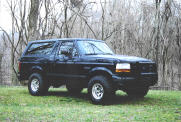
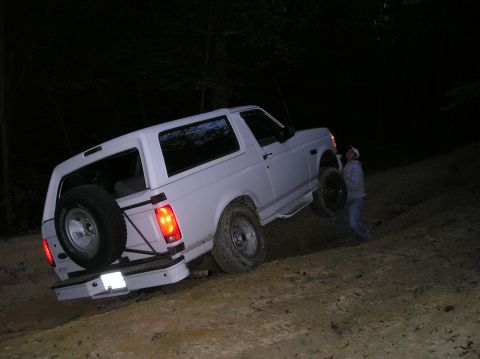
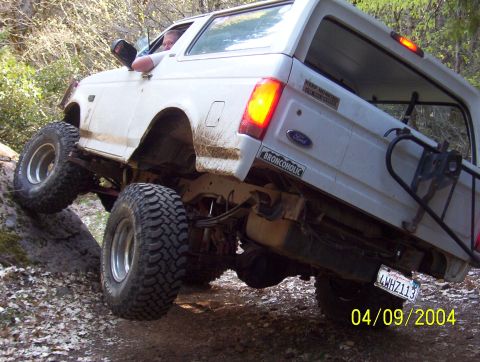
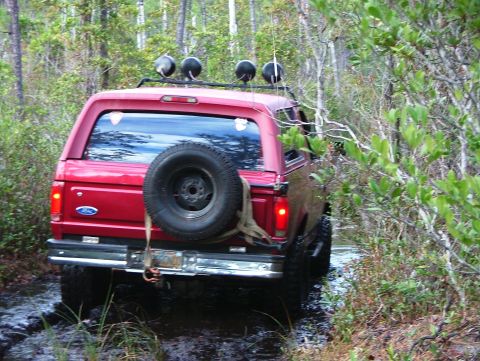
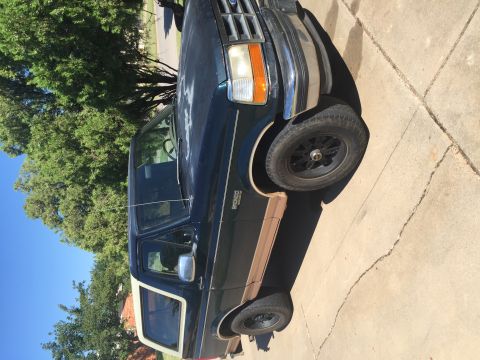
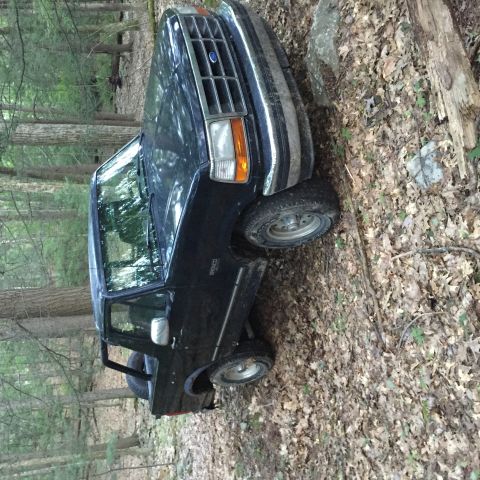
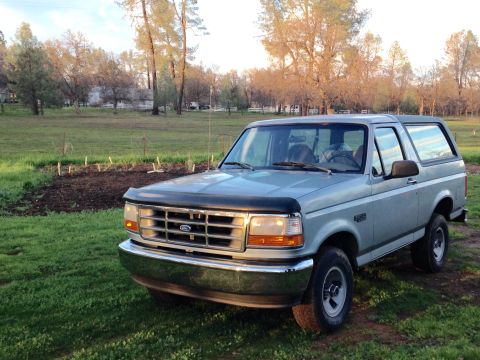
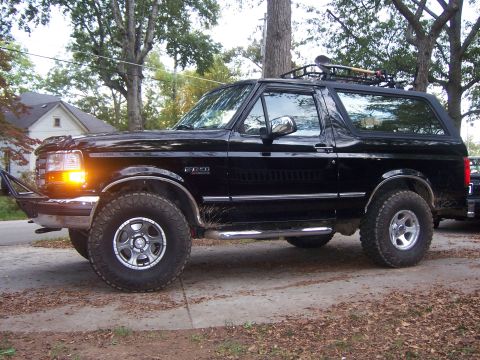
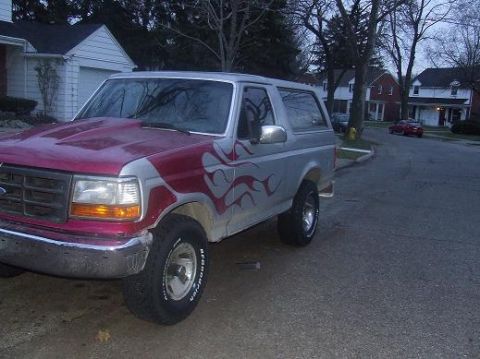
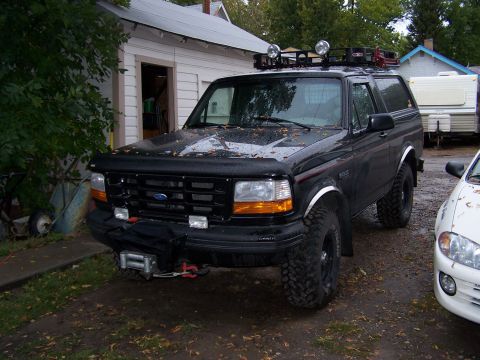
The wall · registered 1992-1996 Broncos
Sorted by depth of documentation. Click any vehicle to open its permanent record.
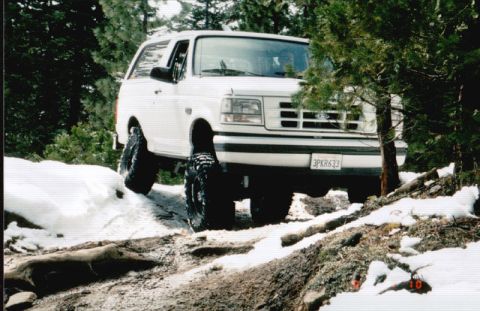
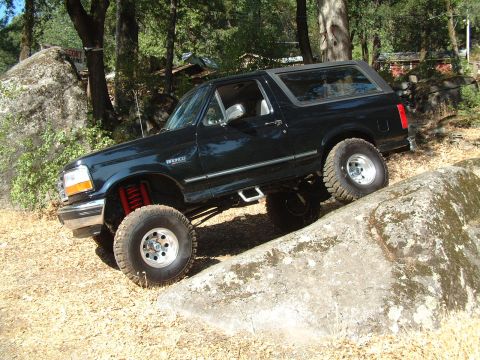
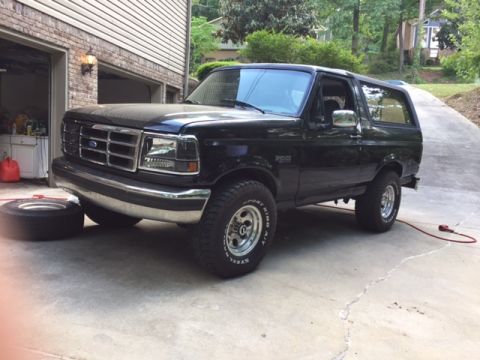
Full year-by-year change log: 1992-1996 Ford Bronco
This log tracks the running and model-year changes to the fifth-generation Ford Bronco (1992-1996), the truck enthusiasts later nicknamed OBS, at the level of body, engine, drivetrain, brakes, and federally driven safety equipment. It is assembled from Ford factory shop manuals, parts catalogs, and order guides for the 1992-1996 Bronco and F-series, VIN and door data-plate decoding for engine and trim verification, established Ford truck reference works and owner registries, and period road tests and manufacturer specification literature.
1992
- Generation introduced. The 1992 Ford Bronco opened the fifth generation with a full restyle on the rounded new 1992-1996 F-series body, the shell enthusiasts later called OBS (Old Body Style) after the 1997 trucks arrived.
- Revised interior and dashboard. The 1992 Bronco received a redesigned interior and dashboard along with the new exterior sheet metal.
- Standard third brake light. The 1992 Bronco came with a standard center high-mounted stop lamp, the third brake light, new with this redesign.
- V8 engines. The 1992 Bronco was a V8-only truck, with the 5.0L (302) V8 as the base engine and the 5.8L (351 Windsor) V8 as the option, both fuel injected; the 4.9L inline-six of some earlier full-size Broncos was not offered.
- Drivetrain and brakes. The 1992 Bronco paired its V8s with a manual or automatic transmission, had standard four-wheel drive with a two-speed transfer case, and used front disc and rear drum brakes with standard rear-wheel anti-lock braking (RABS).
- Carryover dimensions. The 1992 Bronco kept the 104.7-inch wheelbase, the removable fiberglass rear hardtop, and the rear liftgate with roll-down glass from the prior generation.
- Trims. The 1992 Bronco was offered in XL, XLT, and the top Eddie Bauer trims.
1993
- Carryover year. The 1993 Bronco continued the fifth generation with detail trim and equipment updates rather than mechanical change.
- Engines unchanged. The 1993 Bronco kept the 5.0L (302) and 5.8L (351 Windsor) V8s, both fuel injected, with a manual or automatic transmission and standard four-wheel drive with a two-speed transfer case.
- Brakes unchanged. The 1993 Bronco retained front disc and rear drum brakes with standard rear-wheel anti-lock braking carried over from the previous generation.
- O.J. Simpson pursuit. A white 1993 fifth-generation Ford Bronco was the vehicle in the June 1994 police pursuit of O.J. Simpson; it was a standard two-door full-size Bronco of the 1992-1996 run.
1994
- Driver-side airbag added. The 1994 Bronco gained a driver-side airbag, the most significant safety update of the fifth generation.
- Interior and structural updates. The 1994 Bronco received side-impact-related interior and structural updates accompanying the airbag addition.
- Brakes carried over, not new. The 1994 Bronco kept the rear-wheel anti-lock braking that had been standard since the prior generation; the airbag, not ABS, was the new safety item for this year.
- Engines unchanged. The 1994 Bronco continued with the 5.0L (302) and 5.8L (351 Windsor) V8s, a manual or automatic transmission, standard four-wheel drive with a two-speed transfer case, and the OBS body.
1995
- Carryover year. The 1995 Bronco carried over the fifth-generation OBS truck with equipment and option-package shuffling rather than mechanical change.
- Engines unchanged. The 1995 Bronco kept the 5.0L (302) and 5.8L (351 Windsor) V8s with a manual or automatic transmission and standard four-wheel drive with a two-speed transfer case.
- Safety equipment unchanged. The 1995 Bronco retained the driver-side airbag added for 1994, standard rear-wheel anti-lock braking, and the standard third brake light, with front disc and rear drum brakes.
- Carryover specifications. The 1995 Bronco remained a two-door full-size SUV on the 104.7-inch wheelbase in XL, XLT, and Eddie Bauer trims.
1996
- Final model year. The 1996 model year was the last for the full-size Bronco, ending the fifth generation and the nameplate's first run.
- OBD-II compliant. The 1996 Bronco's powertrains became OBD-II compliant for the model year.
- Engines unchanged. The 1996 Bronco kept the 5.0L (302) and 5.8L (351 Windsor) V8s with a manual or automatic transmission and standard four-wheel drive with a two-speed transfer case.
- Safety equipment unchanged. The 1996 Bronco carried the driver-side airbag, standard rear-wheel anti-lock braking, the standard third brake light, and front disc and rear drum brakes.
- Replaced by the Expedition. The 1996 Bronco was succeeded by the four-door Ford Expedition for 1997, built on the new 1997 F-150 platform. The Bronco name then sat unused on a U.S. production vehicle until the sixth-generation Bronco arrived for 2021.